

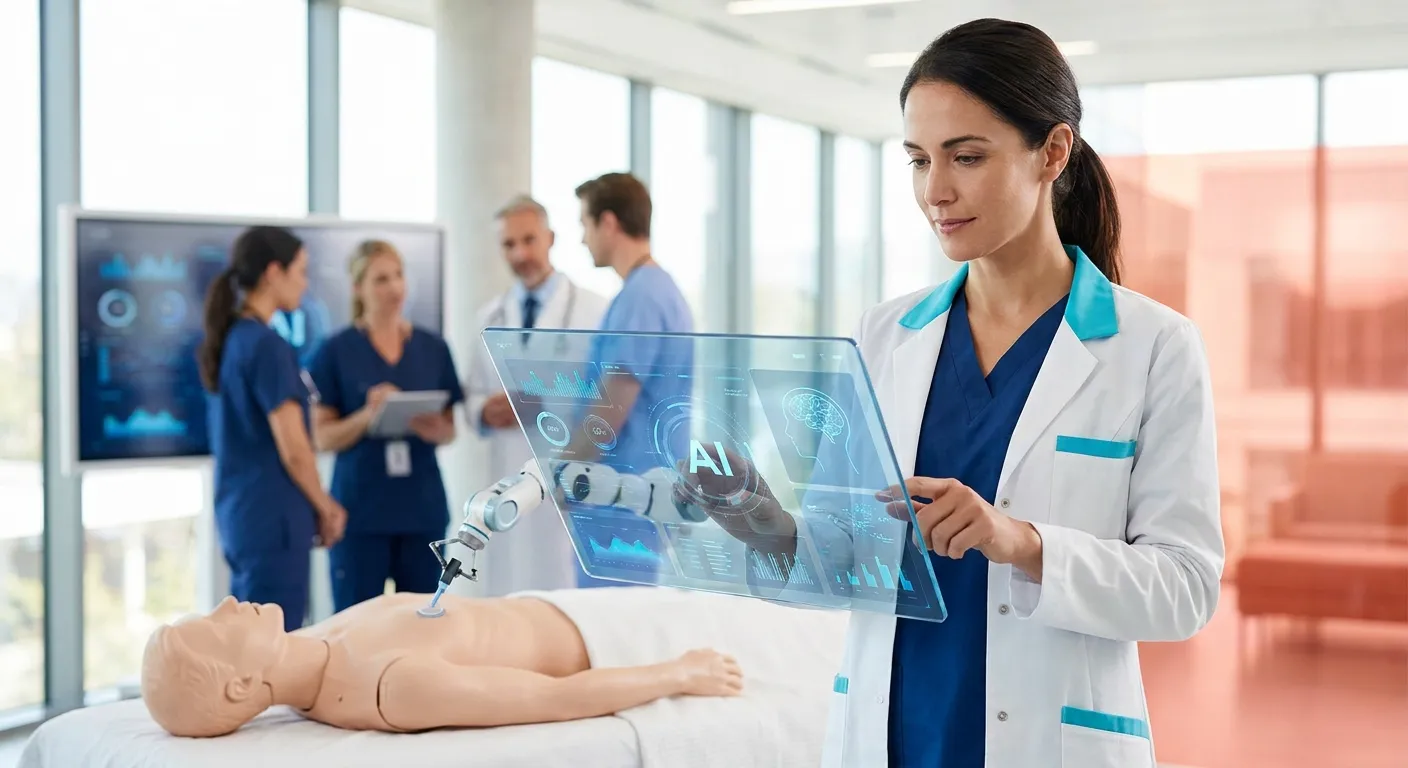
The healthcare sector stands at the precipice of an unprecedented transformation, driven by the rapid advancements and widespread adoption of artificial intelligence. What began as experimental applications is now a full-scale movement, with AI in healthcare transformation fundamentally reshaping patient care, operational efficiency, and medical innovation. TechZone AI explores how this crucial sector is leveraging AI to deliver better outcomes and address complex challenges.
The Accelerating Pace of Healthcare AI Adoption
The integration of AI into healthcare is not a future prospect; it’s a present reality with significant momentum. By the end of 2024, an impressive 85% of healthcare organizations were actively implementing AI. This trend continued into early 2025, where approximately 70% of healthcare payers and providers were already implementing generative AI solutions. These statistics highlight a clear industry consensus: AI is essential for navigating the complexities of modern medicine and administration.
This rapid adoption is driven by AI’s ability to process vast datasets, identify intricate patterns, and provide insights that human analysis alone cannot achieve. For example, from enhanced diagnostics to personalized treatment plans, AI’s role in medicine is expanding. This promises a future where healthcare is more precise, proactive, and accessible.
AI’s Impact on Productivity and Decision-Making
The benefits of intelligent healthcare solutions extend across the entire spectrum of healthcare operations. AI is proving to be a powerful ally in improving productivity and decision-making for healthcare professionals. According to recent data, 80% of respondents report that AI has improved their individual productivity. Furthermore, 50% state it helps them make better decisions. This is particularly critical in a field where timely and accurate decisions can have life-altering consequences.
Consider the application of AI for medical innovation: AI algorithms can analyze medical images with greater speed and accuracy than human eyes. They detect subtle anomalies indicative of disease in its earliest stages. They can even predict patient responses to different therapies. This not only enhances diagnostic capabilities but also frees up clinicians to focus on direct patient interaction and complex case management.
Addressing Workforce Dynamics and Ethical Considerations
While the benefits are clear, the transformation brought by AI also raises important questions about the workforce. The share of workers using AI on the job reached 52% in 2026, with 89% reporting some form of AI usage for work. This necessitates a proactive approach to training and upskilling healthcare professionals. It enables them to effectively collaborate with AI systems.
Concerns about job displacement persist, with 18% of U.S. workers believing their job is likely to be eliminated within five years due to AI or automation. However, broader projections indicate that while AI was projected to displace 75 million jobs by 2022, it also created 133 million new ones. This suggests a net gain in employment. The emphasis shifts towards a hybrid workforce model, where human expertise is augmented by AI capabilities.
Moreover, ethical considerations surrounding data privacy, algorithmic bias, and accountability are paramount. As healthcare organizations increasingly adopt AI, robust frameworks for AI ethics regulation become crucial. These frameworks ensure responsible deployment and build patient trust. Consequently, transparency in AI decision-making processes is vital.
Personalized Medicine and Predictive Analytics
One of the most profound aspects of AI in healthcare transformation is its ability to enable truly personalized medicine. By analyzing a patient’s genetic makeup, lifestyle data, and medical history, AI algorithms can predict disease risk with remarkable accuracy. They can also tailor treatment plans to individual needs. This moves healthcare from a reactive model to a proactive, preventative one.
Predictive analytics, powered by machine learning, helps identify patients at high risk of developing chronic conditions. It also forecasts disease outbreaks. This allows healthcare providers to intervene earlier. It also optimizes resource allocation. For example, hospitals can better manage bed availability during flu seasons. This is based on AI-driven predictions. This illustrates the power of machine learning advancements.
Revolutionizing Drug Discovery and Development
The arduous and expensive process of drug discovery is another area profoundly impacted by AI. Traditional methods can take over a decade and cost billions of dollars for a single drug. AI expedites this by rapidly sifting through vast chemical libraries. It identifies potential drug candidates. It also predicts their efficacy and toxicity. This significantly reduces the time and cost associated with bringing new therapies to market.
AI models can simulate molecular interactions. They also predict how compounds will behave in the human body. This allows researchers to focus on the most promising candidates. As a result, this accelerates the development of treatments for previously incurable diseases. Furthermore, this innovation is vital for future medical breakthroughs.
Enhancing Operational Efficiency and Administrative Tasks
Beyond clinical applications, AI is streamlining numerous operational and administrative tasks within healthcare. This includes automating appointment scheduling, managing electronic health records (EHRs), and processing insurance claims. These tasks, while essential, often consume significant staff time. AI offers efficient solutions.
For instance, AI-powered chatbots can handle routine patient inquiries. They free up administrative staff for more complex interactions. This improves patient satisfaction through quicker responses. It also reduces operational overhead. The efficiency gains contribute directly to better resource utilization. This ultimately enhances overall healthcare delivery.
The Role of Generative AI in Healthcare
Generative AI, a subset of AI that can create new content, is finding innovative applications in healthcare. It can generate synthetic patient data for research and training purposes, protecting patient privacy while providing valuable datasets. Moreover, it assists in designing novel proteins and drug structures.
This advanced AI capability also supports medical education. It creates realistic simulations for surgical training. It also develops personalized learning modules for medical students. The potential of generative AI to foster innovation and improve educational outcomes is substantial. This further cements the role of AI in healthcare transformation.
Challenges and the Path Forward for Healthcare AI
Despite the immense potential, the journey of AI in healthcare transformation is not without its challenges. Data integration across disparate systems remains a significant hurdle. Ensuring data quality and interoperability is crucial for AI models to perform effectively. Consequently, robust data governance strategies are essential.
Regulatory frameworks also need to evolve to keep pace with rapid technological advancements. Establishing clear guidelines for AI deployment, validation, and monitoring is vital for patient safety and trust. Furthermore, addressing the digital divide to ensure equitable access to AI-powered healthcare solutions is an ongoing concern. This ensures that the benefits of healthcare AI reach all populations.
The successful integration of AI requires a collaborative effort involving clinicians, technologists, policymakers, and patients. Continuous research and development, coupled with ethical considerations and robust regulatory oversight, will pave the way for a future where AI truly augments human capabilities in delivering superior healthcare. The synergy between human expertise and artificial intelligence is key to realizing the full promise of this technological shift. This collaborative approach ensures that the benefits of AI in healthcare transformation are maximized.
The Future Landscape of AI-Driven Healthcare
Looking ahead, the future of healthcare will be increasingly intertwined with AI. We can anticipate even more sophisticated AI models that can predict disease trajectories with greater precision. They will also offer real-time clinical decision support. The continued evolution of agentic AI systems may lead to more autonomous diagnostic tools and treatment protocols, operating under human supervision.
Furthermore, the development of specialized vertical AI solutions tailored for specific medical specialties will become more prevalent. These will address unique challenges in areas like oncology, cardiology, and neurology. This targeted approach ensures that AI applications are highly relevant and effective for particular medical needs. The global AI healthcare market size was valued at USD 15.1 Billion in 2023 and is projected to reach USD 187.9 Billion by 2032, growing at a CAGR of 32.5% during the forecast period. This significant growth underscores the expanding influence of AI in healthcare.
The convergence of AI with other emerging technologies, such as swarm robotics for minimally invasive surgery or advanced computer vision applications for diagnostics, will unlock new frontiers in medical science. This integrated approach promises to create a healthcare ecosystem that is more efficient, equitable, and ultimately, more effective in improving human health. The ongoing evolution of AI in healthcare transformation is set to redefine what is possible in patient care and medical innovation.
Conclusion: Embracing the AI Revolution in Healthcare
The journey of AI in healthcare transformation is well underway, promising a future where medical care is more intelligent, personalized, and accessible. From enhancing diagnostic accuracy and accelerating drug discovery to streamlining operations and empowering clinicians, AI’s impact is broad and profound. While challenges related to data integration, ethics, and workforce adaptation remain, the industry’s commitment to innovation is clear. By embracing AI responsibly and strategically, healthcare can move towards a new era of patient-centric care, where technology serves as a powerful ally in promoting well-being and extending healthy lives. The ongoing developments in this field are continuously shaping how healthcare is delivered and experienced globally. This transformative shift is not merely an upgrade but a fundamental redesign of healthcare systems, driven by the intelligent capabilities of artificial intelligence. The long-term benefits for patients and providers alike are immense, making AI in healthcare transformation a critical area of focus for TechZone AI.
FAQ: Frequently Asked Questions About AI in Healthcare
What are the primary benefits of artificial intelligence in medicine?
AI in medicine offers numerous benefits, including enhanced diagnostic accuracy, personalized treatment plans, accelerated drug discovery, improved operational efficiency, and better patient engagement. It helps healthcare professionals make more informed decisions and streamlines administrative tasks, ultimately leading to better patient outcomes.
How is AI impacting patient care specifically?
AI is impacting patient care by enabling earlier disease detection through advanced image analysis, predicting patient responses to therapies, and facilitating remote monitoring. It also supports personalized health recommendations based on individual data, making care more tailored and proactive.
What are the main challenges in adopting AI in medical settings?
Key challenges include ensuring data privacy and security, integrating AI systems with existing healthcare infrastructure, addressing algorithmic bias, and overcoming resistance to change from healthcare professionals. Ethical considerations and the need for robust regulatory frameworks are also significant hurdles.
Will AI replace healthcare professionals?
No, AI is not expected to replace healthcare professionals. Instead, it serves as a powerful tool to augment human capabilities, automate routine tasks, and provide advanced analytical insights. This allows clinicians to focus on complex decision-making, direct patient interaction, and empathetic care, creating a more efficient and effective healthcare system.
How does AI contribute to medical research and drug development?
AI significantly contributes to medical research by rapidly analyzing vast datasets to identify patterns and insights. In drug development, it accelerates the identification of potential drug candidates, predicts their efficacy and toxicity, and optimizes clinical trial design, thereby reducing the time and cost associated with bringing new treatments to market.




Leave feedback about this