

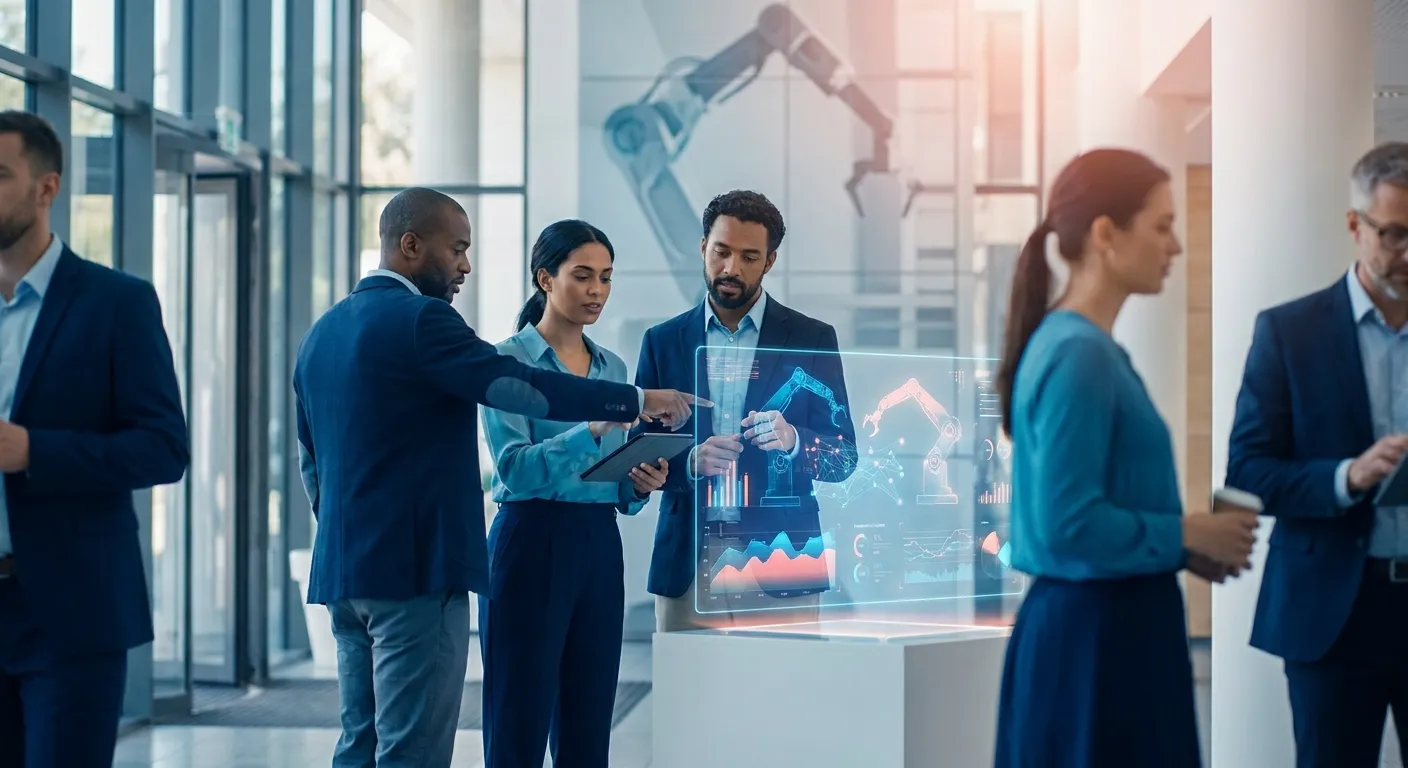
The landscape of technology is undergoing a profound shift, moving beyond mere digital enhancement to a truly intelligent AI transformation. This isn’t just an upgrade; it’s a fundamental re-architecture of how businesses operate, how creative endeavors unfold, and how complex problems are solved across every sector. Between 2025 and 2026, we’ve witnessed AI evolve from an experimental tool to a foundational partner, redefining enterprise architecture and daily work.
Beyond Digital: The Shift to Intelligent Systems
For years, digital transformation focused on digitizing processes and data. While crucial, this often meant automating existing inefficiencies. The current era of intelligent transformation, however, is about enabling systems to autonomously learn, adapt, and make decisions. This shift is profound: AI is no longer just an instrument but a core intelligence, fundamentally reshaping work, creativity, and problem-solving. Businesses are moving beyond basic automation and analytics to embrace systems that not only process information but also generate insights and execute actions with increasing autonomy.
By 2026, the data is clear: 94% of companies globally are utilizing AI in at least one business function, and 83% consider AI a top priority. This isn’t surprising given the projected growth of the global AI market, valued at USD 900 billion in 2026 and expected to reach USD 4,216.29 billion by 2035. This growth is fueled by a concentrated effort by leading companies to redefine how AI integrates into daily life and work. Notably, a significant number of these advancements are detailed in reports from reputable sources like PwC, which consistently tracks AI’s economic impact and adoption trends, providing further context on this rapid expansion.
AI as the Enterprise Backbone
One of the most significant trends is AI becoming the backbone of enterprise architecture. This redefines cloud consumption patterns and reshapes software lifecycle development. Enterprises are actively rebuilding operations so that AI handles everything it can, thereby freeing human talent to concentrate on oversight, creativity, and complex judgment. This strategic pivot ensures that AI systems are not just add-ons but integrated, central components driving operational efficiency and innovation.
This isn’t just about efficiency; it’s about strategic advantage. Companies that embed AI deeply into their core operations are better positioned to respond to market changes, personalize customer experiences, and innovate at an accelerated pace. The focus has shifted from proving AI’s capabilities in 2025 to deploying it at scale in 2026, supported by mature enterprise tooling for security, compliance, auditability, and cost management. Furthermore, the development of vertical AI solutions plays a crucial role in tailoring these broader capabilities to specific industry needs, thereby accelerating adoption.
Reshaping Work and Productivity
The impact on the workforce is equally significant. The share of workers using AI on the job doubled from 26% in 2024 to 41% in 2025, reaching 52% in 2026. A remarkable 89% of workers report using AI for work in some capacity, with 38% integrating it into their daily routines. This widespread adoption is yielding tangible benefits: 80% of respondents report improved individual productivity, and 50% state AI helps them with tasks that would otherwise be impossible. Consequently, this shift frees up human capital for more strategic endeavors, enhancing overall organizational output.
Moreover, the nature of work itself is changing. Repetitive and data-intensive tasks are increasingly delegated to AI, allowing human employees to focus on creativity, critical thinking, and interpersonal skills. This collaboration between human and artificial intelligence is creating new job roles and demanding new skill sets. Therefore, continuous learning and adaptation are becoming paramount for the modern workforce. The decoding of machine learning advancements is vital for understanding these evolving demands.
The Role of Agentic AI Systems in Enterprise
As enterprises embrace this intelligent AI transformation, the rise of agentic AI systems becomes particularly noteworthy. These systems are designed to operate autonomously, making decisions and executing actions in dynamic environments without constant human oversight. Consequently, they represent a significant leap from traditional automation, offering enhanced efficiency and responsiveness. For example, in customer service, agentic AI can handle complex inquiries, personalize interactions, and even anticipate customer needs, significantly improving satisfaction. You can learn more about Agentic AI Systems: Navigating the Autonomous Future of Business on TechZone AI.
Furthermore, agentic AI is transforming supply chain management, optimizing logistics, predicting demand, and even managing inventory autonomously. This leads to reduced operational costs and increased resilience against disruptions. However, the deployment of such powerful systems also necessitates robust frameworks for AI ethics regulation, ensuring responsible and fair operation.
Impact on Creativity and Innovation
The intelligent AI transformation extends far beyond mere efficiency, profoundly influencing creativity and innovation. AI tools are now assisting in generating novel ideas, designing new products, and even composing music or writing scripts. This augmentation of human creativity allows artists, designers, and researchers to explore possibilities previously unattainable due to time or resource constraints. Thus, AI acts as a powerful co-creator, pushing the boundaries of what’s possible.
For instance, in fields like pharmaceutical research, AI accelerates drug discovery by analyzing vast datasets and identifying potential compounds much faster than human researchers could. Similarly, in architecture, AI can generate numerous design iterations based on specified parameters, offering innovative solutions to complex structural challenges. This collaborative approach fosters an environment where innovation thrives, leading to breakthroughs across diverse industries.
Navigating the Challenges of AI Adoption
Despite the immense potential, the intelligent AI transformation is not without its challenges. Data privacy, security, and the ethical implications of autonomous decision-making remain significant concerns. Organizations must invest in robust cybersecurity measures and develop clear ethical guidelines to ensure responsible AI deployment. Additionally, the need for a skilled workforce capable of interacting with and managing AI systems is growing, necessitating significant investment in training and education.
Moreover, integrating AI into legacy systems can be complex and costly. Companies often face the challenge of modernizing their IT infrastructure while simultaneously adopting new AI technologies. This requires careful strategic planning and a phased approach to implementation. Therefore, successful AI adoption hinges on addressing these multifaceted challenges head-on, ensuring a smooth transition into an AI-powered future. The World Economic Forum frequently publishes insights on these challenges, offering valuable perspectives on global AI governance and strategic implementation.
The Future Landscape: 2026 and Beyond
Looking ahead, the intelligent AI transformation will continue to accelerate, embedding AI deeper into every facet of enterprise and daily life. We anticipate further advancements in areas like transformer models, enabling more sophisticated natural language processing and generation. Furthermore, the convergence of AI with other emerging technologies, such as quantum computing and advanced robotics, promises to unlock even greater potential.
By 2026, expect to see more personalized AI experiences, with systems adapting dynamically to individual user preferences and behaviors. The development of more generalizable AI, capable of performing a wider range of tasks, will also be a key trend. This ongoing evolution will necessitate continuous vigilance and adaptation from businesses and individuals alike, ensuring that we harness AI’s power responsibly and effectively.
The Strategic Imperative of AI Integration
For organizations, embracing the intelligent AI transformation is no longer optional; it’s a strategic imperative. Companies that fail to integrate AI effectively risk falling behind competitors who are already reaping its benefits. This means not just adopting AI tools, but fundamentally rethinking business processes, organizational structures, and workforce development. A holistic approach is essential for realizing the full potential of AI.
Furthermore, leadership must champion AI initiatives, fostering a culture of innovation and experimentation. This involves allocating sufficient resources, encouraging cross-functional collaboration, and establishing clear metrics for success. Ultimately, the successful navigation of this transformation will define the leaders of tomorrow’s economy.
Conclusion: A New Era of Intelligence
The intelligent AI transformation is fundamentally reshaping enterprise and work, moving us into an era where artificial intelligence is a core partner in every endeavor. From enhancing productivity and driving innovation to redefining business models, AI’s impact is pervasive and profound. While challenges remain, the clear benefits and rapid advancements signify that this shift is irreversible. Organizations and individuals who proactively engage with this transformation will be best positioned to thrive in the intelligent future of 2026 and beyond. This ongoing evolution requires continuous engagement and strategic foresight to fully capitalize on AI’s vast potential.
FAQ
What does intelligent transformation mean for businesses?
Intelligent transformation for businesses signifies a shift from basic digitalization to systems that autonomously learn, adapt, and make decisions. It means integrating AI as a core intelligence to redefine operations, enhance productivity, and drive innovation across all functions.
How is AI changing the nature of work by 2026?
By 2026, AI is significantly changing work by automating repetitive tasks, thereby freeing human workers to focus on creativity, critical thinking, and complex judgment. It’s leading to improved individual productivity, the creation of new job roles, and a demand for new skill sets that emphasize human-AI collaboration.
What are the primary benefits of this enterprise AI shift?
The primary benefits include enhanced operational efficiency, accelerated innovation, personalized customer experiences, and strategic advantage in competitive markets. Companies are better positioned to respond to market changes and optimize resource allocation.
What challenges accompany the widespread adoption of AI in enterprises?
Challenges include ensuring data privacy and security, navigating ethical considerations of autonomous systems, integrating AI into existing legacy infrastructure, and developing a skilled workforce capable of managing and interacting with advanced AI tools. Careful planning and robust governance are essential.
How will AI continue to evolve beyond 2026?
Beyond 2026, AI is expected to see further advancements in areas like generalizable AI, more sophisticated transformer models, and deeper integration with other emerging technologies such as quantum computing. This will lead to even more personalized and adaptive AI experiences across various sectors.




Leave feedback about this