

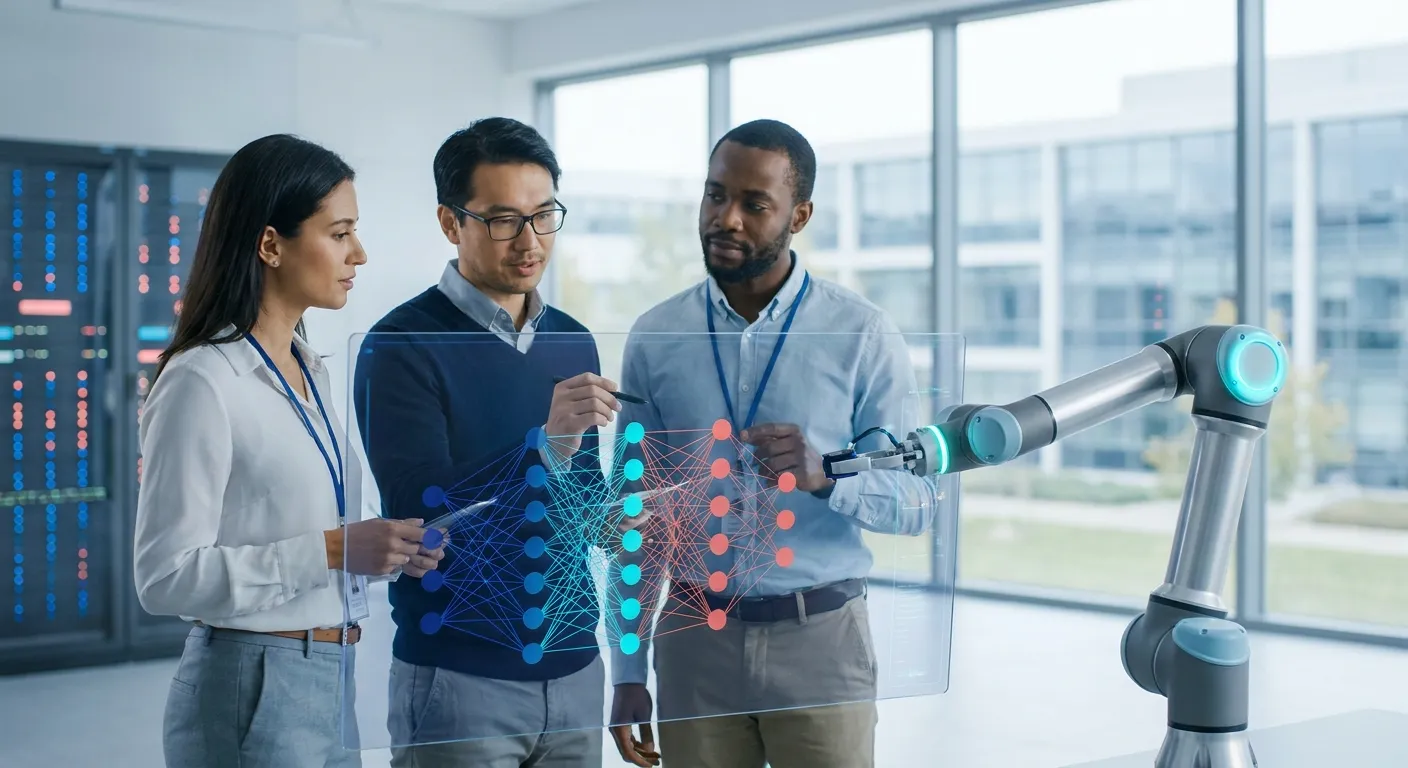
The narrative around artificial intelligence often oscillates between dystopian fears of job replacement and utopian visions of effortless productivity. However, the most realistic and beneficial future lies in the intelligent integration of human capabilities with AI’s strengths: a future defined by Human-AI Collaboration. This paradigm shifts the focus from AI simply automating tasks to AI augmenting human intellect, creativity, and problem-solving skills, creating symbiotic relationships that unlock unprecedented potential across industries.
Human-AI Collaboration: A Symbiotic Relationship
Instead of viewing AI as a competitor, consider it a powerful partner. AI excels at processing vast amounts of data, identifying patterns, performing repetitive tasks with precision, and generating insights at speeds impossible for humans. Humans, conversely, bring intuition, emotional intelligence, critical thinking, creativity, and ethical reasoning—qualities AI struggles to replicate. When these strengths combine, the result is often superior to either working in isolation. For instance, in design, AI can generate countless iterations, while a human designer provides the creative direction and refines the aesthetic. In healthcare, AI can flag anomalies in scans, while a doctor applies their diagnostic expertise and empathy.
Designing for Effective Human-AI Collaboration
Successfully fostering Human-AI Collaboration requires intentional design. This means building AI systems that are transparent, explainable, and user-friendly, allowing humans to understand AI’s suggestions and intervene when necessary. It also involves training human workers not just on how to use AI tools, but how to think critically about AI outputs and integrate them into their workflow. Organizations must cultivate a culture that embraces experimentation and continuous learning, recognizing that the optimal blend of human and AI effort will evolve. The goal is to elevate human potential, allowing individuals to focus on higher-order tasks that require uniquely human attributes, while AI handles the computational heavy lifting. This collaboration isn’t just about efficiency; it’s about redefining work itself for a more innovative and fulfilling future.
The Evolution of Human-AI Interaction
Historically, AI’s role was largely confined to automating routine processes. Early AI applications focused on tasks like data entry, simple calculations, and repetitive manufacturing steps. However, as machine learning and deep learning advanced, so did the sophistication of AI systems. Consequently, AI began to move beyond mere automation. Today, we are witnessing a profound shift towards augmentation. This signifies a partnership where AI enhances human capabilities, rather than merely replacing them. For example, in legal research, AI can quickly sift through millions of documents. A lawyer then applies their judgment to interpret relevance and construct arguments. This represents a significant leap forward in how humans and AI interact.
Moreover, the development of more intuitive interfaces has facilitated this evolution. Natural language processing (NLP) and computer vision now allow for more seamless communication between humans and AI. Consequently, human operators can interact with complex AI systems using natural language commands or visual cues. This reduces the learning curve and broadens the accessibility of advanced AI tools. Furthermore, continuous feedback loops are crucial for refining these interactions. As humans provide input, AI models learn and adapt, improving their collaborative effectiveness over time. This iterative process ensures that the partnership becomes increasingly robust and productive.
Applications Across Industries
The impact of human-AI partnership extends across numerous sectors, transforming operations and creating new opportunities. In creative fields, for instance, AI tools assist artists, musicians, and writers by generating initial concepts or refining existing works. An architect might use AI to generate thousands of design variations, then select and perfect the most promising options. Similarly, in journalism, AI can analyze vast datasets to identify emerging trends or verify facts. Human journalists then weave these insights into compelling narratives, adding the irreplaceable element of human perspective and storytelling.
In finance, intelligent systems help analysts identify market anomalies and predict trends. These tools process real-time data at an incredible pace, providing insights that would be impossible for human teams alone. However, human financial experts remain essential for strategic decision-making, risk assessment, and client relations. They interpret the AI’s complex outputs and apply their understanding of economic nuances and client needs. Furthermore, in education, AI-powered platforms can personalize learning experiences. They adapt to individual student paces and preferences, offering tailored content and feedback. Educators, meanwhile, focus on mentorship, critical thinking development, and fostering a supportive learning environment. This synergistic approach ensures comprehensive growth.
Challenges and Ethical Considerations
While the promise of Human-AI Collaboration is immense, several challenges must be addressed. One primary concern is the potential for algorithmic bias. If AI systems are trained on biased data, they can perpetuate and even amplify existing societal inequalities. Therefore, rigorous testing and ethical oversight are paramount. Developers must actively work to identify and mitigate biases, ensuring fairness and equity in AI applications. Another challenge involves data privacy and security. As AI systems process vast amounts of sensitive information, robust safeguards are essential to protect user data from breaches and misuse.
Furthermore, the issue of accountability in collaborative systems is complex. When an error occurs, determining whether the human, the AI, or both are responsible can be difficult. Clear guidelines and regulatory frameworks are needed to define roles and responsibilities. Moreover, ensuring transparency in AI’s decision-making processes is critical. Humans must understand how AI arrives at its conclusions to build trust and effectively collaborate. Lack of transparency can lead to mistrust and hinder the adoption of AI tools. Addressing these ethical considerations is vital for the successful and responsible deployment of AI-human partnerships.
Building a Collaborative Workforce
To fully realize the benefits of Human-AI Collaboration, organizations must invest in reskilling and upskilling their workforce. This involves training employees not only on how to operate AI tools but also on how to interpret AI-generated insights and integrate them into their decision-making processes. A key aspect of this training is developing ‘AI literacy’—an understanding of AI’s capabilities, limitations, and ethical implications. Workers need to learn how to ask the right questions of AI and how to critically evaluate its outputs.
Moreover, fostering a culture of continuous learning is essential. The landscape of AI is constantly evolving, requiring ongoing adaptation from both humans and machines. Companies should establish internal programs and partnerships with educational institutions to provide relevant training. Encouraging experimentation and a growth mindset among employees will help them embrace new technologies rather than resist them. Ultimately, building a collaborative workforce means empowering individuals to work alongside intelligent systems, enhancing their own value and contributing more effectively to organizational goals. This proactive approach ensures that the workforce remains agile and competitive in an AI-augmented future.
The Future Landscape: Beyond Augmentation
Looking ahead, the trajectory of Human-AI Collaboration extends beyond mere augmentation. We anticipate a future where AI systems become even more deeply integrated into human cognitive processes, acting as intelligent extensions of our minds. This could manifest as AI assistants that anticipate needs, proactively offer relevant information, and even help structure thoughts in complex problem-solving scenarios. Imagine AI not just providing data, but actively participating in brainstorming sessions, offering novel perspectives derived from its vast knowledge base. This level of integration promises to redefine productivity and innovation.
Furthermore, advancements in brain-computer interfaces (BCIs) could blur the lines between human and AI intellect. While still in early stages, BCIs could enable direct, seamless communication between human minds and AI systems. This could lead to instantaneous access to information and processing power, fundamentally altering how we learn, create, and interact with the world. Such a future necessitates careful ethical consideration and robust societal discussions. However, the potential for vastly expanded human potential through advanced human-AI teaming is undeniable. It represents a paradigm shift from tool-use to genuine cognitive partnership.
In conclusion, Human-AI Collaboration is not just a buzzword; it is a fundamental shift in how we approach work, innovation, and problem-solving. By strategically combining the unique strengths of humans—creativity, intuition, and ethical reasoning—with AI’s unparalleled computational power and data processing capabilities, we can achieve outcomes far exceeding what either could accomplish alone. The journey requires thoughtful design, ethical considerations, and continuous investment in human skills. As we move forward, fostering this symbiotic relationship will be paramount for progress across all sectors. Indeed, the intelligent partnership between humans and AI promises a future of unprecedented innovation and enhanced human potential. For more insights on AI’s impact, visit IBM’s AI resources. Additionally, explore ethical AI frameworks at DeepMind’s Ethics & Society.
FAQ
What is the primary difference between AI automation and AI augmentation?
AI automation focuses on systems performing tasks independently, often replacing human labor for repetitive or data-heavy operations. AI augmentation, conversely, involves AI enhancing human capabilities, acting as a tool or partner to improve human performance in tasks requiring creativity, judgment, or complex problem-solving.
How does intelligent human-machine partnership benefit businesses?
Businesses benefit from enhanced productivity, improved decision-making through data-driven insights, increased innovation by freeing human workers for higher-value tasks, and better resource allocation. It allows companies to achieve more complex goals with greater efficiency.
What skills are important for working effectively with artificial intelligence?
Key skills include critical thinking, problem-solving, data literacy, adaptability, and an understanding of AI’s capabilities and limitations. Emotional intelligence and creativity also remain crucial, as these are uniquely human attributes that complement AI’s strengths.
Can AI collaboration lead to job displacement?
While some routine jobs may be automated, the focus of AI-human synergy is on creating new roles and enhancing existing ones. It shifts the demand towards skills that involve managing AI, interpreting its outputs, and performing tasks that require uniquely human attributes like empathy and strategic thinking.
How can organizations encourage effective human-AI teaming?
Organizations can encourage this by investing in training programs, fostering a culture of experimentation, designing transparent and user-friendly AI systems, and establishing clear ethical guidelines. Promoting open communication and feedback loops between human users and AI developers is also vital.
Explore more: More from TechZone AI

Leave feedback about this