

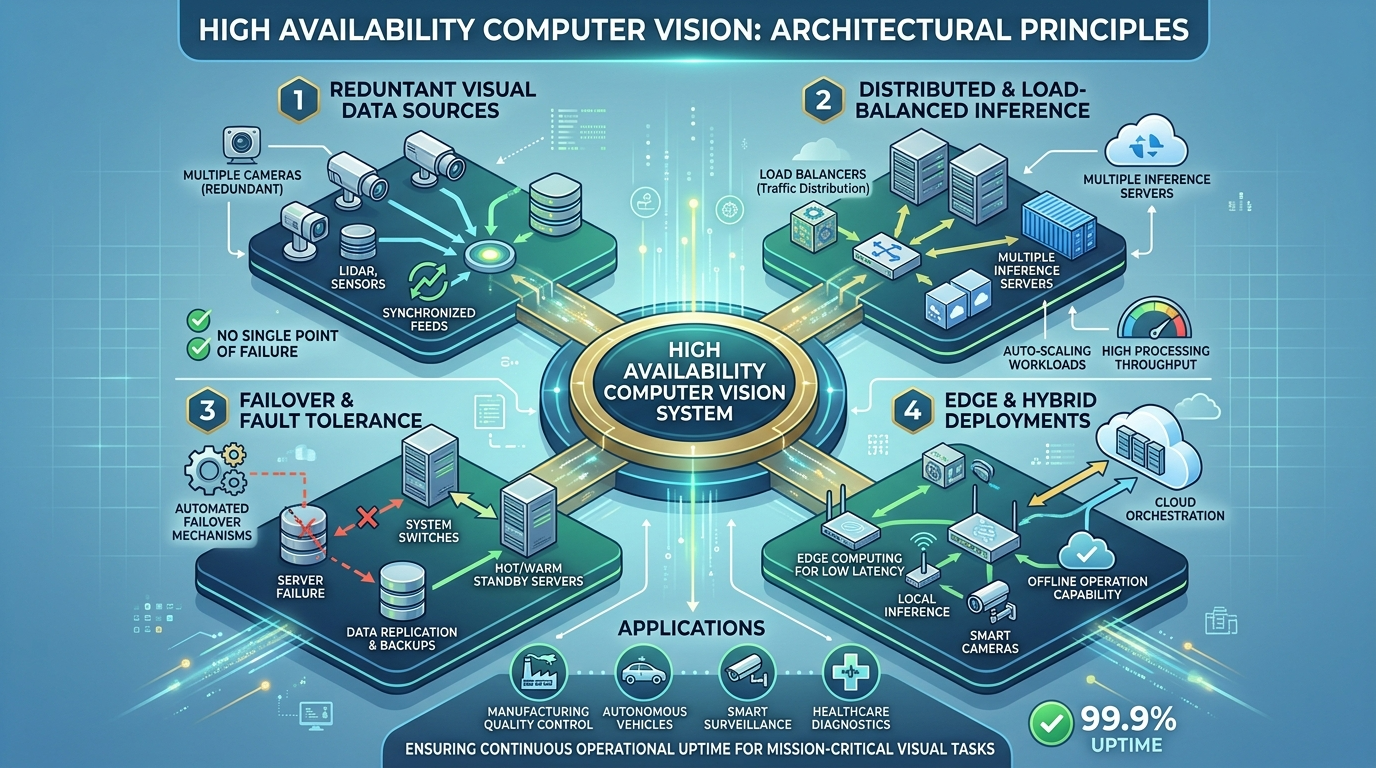
Artificial intelligence and computer vision technologies are transforming modern operations. Industries now use vision systems for inspection, monitoring, automation, and analytics. However, many organizations still rely on older infrastructure that was never designed for modern AI workloads. As a result, maintaining high availability computer vision systems becomes critical for companies integrating advanced technologies into legacy environments.
High availability ensures that computer vision platforms remain operational even during hardware failures, network disruptions, or system maintenance. This reliability is essential for real-time applications such as manufacturing inspection, security monitoring, and automated logistics.
Without strong infrastructure planning, downtime can disrupt operations and reduce productivity.
Therefore, organizations must design architectures that support high availability computer vision even when operating within older systems.
Through redundancy, distributed processing, and monitoring tools, businesses can maintain reliable computer vision performance while preserving legacy infrastructure investments.
Why Availability Matters in Computer Vision Systems
Computer vision systems often support mission-critical tasks. For example, manufacturing plants rely on vision systems to detect product defects. Security systems use image analysis to monitor facilities and identify potential threats.
When these systems fail, operations may stop or safety risks may increase.
For this reason, high availability computer vision is essential in environments that depend on continuous image processing.
Legacy platforms present additional challenges.
Older servers, networks, and storage systems may lack the reliability required for modern AI workloads.
However, organizations can overcome these limitations through careful system design.
Redundant components, failover mechanisms, and distributed processing help maintain consistent performance.
By prioritizing high availability computer vision, organizations protect operations from costly disruptions.
Reliable systems also improve confidence in AI-driven decision-making.
Common Challenges in Legacy Computer Vision Environments
Legacy infrastructure introduces several challenges when deploying modern AI technologies. These challenges often affect system availability and performance.
First, outdated hardware may struggle to handle large volumes of visual data.
Image processing requires significant computational resources.
Without adequate capacity, systems may slow down or crash.
Second, network limitations can interrupt data transfer between cameras and processing servers.
Unstable connectivity increases the risk of downtime.
Third, older software systems may lack compatibility with modern machine learning frameworks.
These integration issues complicate high availability computer vision strategies.
Finally, maintenance procedures for legacy platforms may require system shutdowns.
Without redundancy, these maintenance windows interrupt critical operations.
Organizations must address these challenges carefully when designing reliable computer vision infrastructures.
Architecture Strategies for High Availability
To achieve high availability computer vision, organizations must design resilient system architectures.
These architectures ensure that vision systems continue operating even during component failures.
Redundant Hardware Systems
Redundancy involves deploying backup hardware components.
For example, organizations may install multiple processing servers that handle image analysis tasks.
If one server fails, another immediately takes over.
Redundant systems reduce downtime and improve reliability.
This strategy supports effective high availability computer vision deployments.
Distributed Processing Architecture
Distributed systems spread workloads across multiple devices.
Edge computing devices can analyze images locally before sending results to central systems.
This architecture reduces dependence on a single processing unit.
Distributed environments strengthen overall system reliability.
Failover Mechanisms
Failover systems automatically switch operations to backup infrastructure when primary components fail.
These mechanisms detect failures quickly and activate alternative resources.
Failover technology ensures continuous operation in high availability computer vision environments.
Load Balancing
Load balancing distributes processing tasks across multiple servers.
Balanced workloads prevent system overload and maintain stable performance.
This technique helps organizations maintain consistent availability.
Infrastructure Components Supporting Reliability
Several infrastructure components help organizations maintain high availability computer vision in legacy environments.
These technologies strengthen system resilience and operational continuity.
Edge Computing Devices
Edge devices process images directly near cameras.
Local processing reduces network dependency and improves response times.
Edge computing also supports continuous operation during network disruptions.
Cloud Backup Systems
Cloud infrastructure can store visual data and processing results.
Organizations can recover quickly from local system failures.
Monitoring and Alert Systems
Monitoring platforms track system health and performance.
Alerts notify administrators when systems experience unusual behavior.
Early detection prevents failures and supports high availability computer vision strategies.
Containerized Applications
Container technologies allow organizations to deploy vision applications across multiple environments.
Containers simplify scaling and recovery processes.
These capabilities improve system reliability in legacy infrastructures.
Best Practices for Maintaining System Availability
Organizations must follow several best practices to achieve effective high availability computer vision performance.
First, companies should conduct regular infrastructure assessments.
System audits identify weaknesses in hardware, software, and networking environments.
Second, organizations should implement automated monitoring tools.
Real-time monitoring helps detect performance issues early.
Third, businesses should test disaster recovery procedures.
Testing ensures that failover mechanisms function correctly during emergencies.
Fourth, organizations should maintain updated software environments.
Outdated software increases vulnerability to system failures.
Finally, companies should design scalable architectures.
Scalable systems allow organizations to expand capacity without disrupting operations.
These best practices strengthen high availability computer vision strategies across legacy platforms.
Industry Use Cases Requiring High Availability
Several industries rely heavily on high availability computer vision systems for daily operations.
Manufacturing facilities use vision systems to detect defects and monitor production lines.
Downtime in these systems can halt manufacturing processes.
Transportation companies use visual analytics to monitor traffic conditions and improve safety.
Reliable systems ensure that monitoring operations remain continuous.
Retail organizations use computer vision for inventory tracking and store analytics.
System failures could interrupt business insights and operational visibility.
Healthcare providers also rely on vision technologies for medical imaging analysis.
High availability ensures that diagnostic systems remain accessible when needed.
These examples demonstrate why reliable infrastructure remains essential for computer vision deployments.
Future Technologies Improving Vision System Reliability
Advances in computing technology continue improving high availability computer vision architectures.
One emerging development involves artificial intelligence operations platforms.
These systems monitor AI performance automatically and detect anomalies.
Another innovation involves advanced edge computing devices.
New hardware platforms can process complex AI models directly on local devices.
Improved networking technologies also support reliable computer vision systems.
High-speed connectivity allows distributed systems to communicate efficiently.
Additionally, container orchestration platforms enable automated deployment and scaling.
These platforms simplify infrastructure management across multiple environments.
As these technologies mature, organizations will find it easier to maintain high availability computer vision systems even in legacy environments.
Conclusion
Computer vision technologies play an increasingly important role in modern industries. However, organizations must ensure that these systems remain reliable and operational at all times.
Maintaining high availability computer vision is especially important in legacy environments where infrastructure limitations may increase system vulnerability.
Through careful architectural planning, redundancy, and distributed processing, organizations can achieve consistent system performance.
Monitoring tools, failover mechanisms, and edge computing solutions further strengthen reliability.
Although legacy platforms present unique challenges, companies can still implement robust computer vision systems with the right strategies.
As AI technologies continue evolving, high availability will remain a critical requirement for successful computer vision deployments.
Organizations that prioritize system resilience will gain long-term operational stability and improved technological performance.
FAQ
1. Why is availability important for computer vision systems?
Continuous operation ensures that vision systems can monitor environments and analyze images without interruptions.
2. What causes downtime in AI vision platforms?
Hardware failures, network disruptions, and software compatibility issues can interrupt system performance.
3. Can legacy infrastructure support reliable vision systems?
Yes. With redundancy, distributed processing, and monitoring tools, organizations can maintain reliable operations.
4. What technologies improve system reliability?
Edge computing, cloud backups, containerization, and automated monitoring tools help maintain stable performance.
5. How can companies prevent vision system failures?
Organizations should implement monitoring systems, failover strategies, and regular infrastructure assessments.


Leave feedback about this