

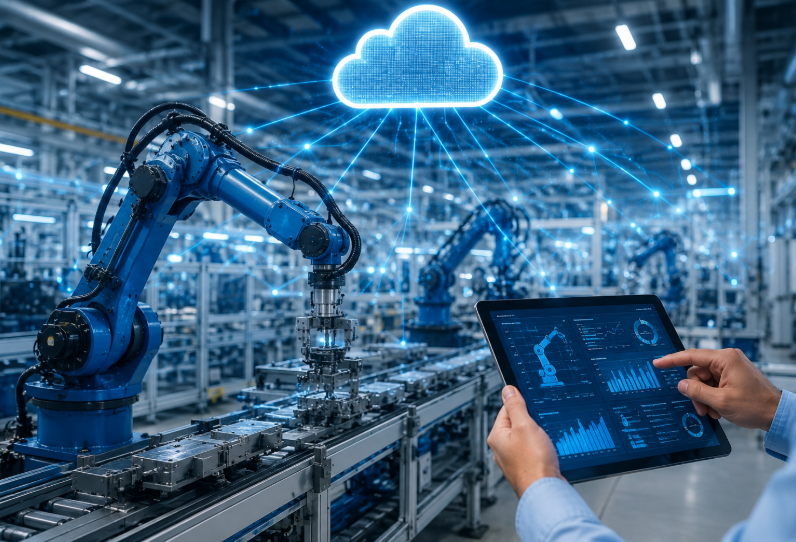
Manufacturing has changed dramatically over the last decade as automation, artificial intelligence, and cloud computing reshape industrial operations. Factories no longer rely solely on isolated machines performing repetitive tasks independently. Instead, modern facilities increasingly use connected systems that communicate, analyze data, and optimize production in real time. This shift has made cloud robotics integration one of the most important developments in advanced manufacturing.
Traditional robotics systems often operated within closed environments. While those machines improved productivity, they usually lacked flexibility and real-time connectivity. Today, manufacturers need smarter systems capable of adapting quickly to changing production demands. Cloud-connected robotics platforms now allow companies to monitor operations remotely, share data instantly, and coordinate machines across multiple facilities.
This transformation supports faster decision-making and greater efficiency throughout the production process. Robots connected through cloud infrastructure can receive updates, access machine learning models, and collaborate with broader manufacturing systems more effectively. As a result, businesses gain more visibility, scalability, and operational control.
Manufacturers also face increasing pressure to improve speed while reducing downtime and labor shortages. Cloud-based robotics systems help address these challenges by combining automation with centralized data management and predictive analytics. Consequently, many companies now view connected robotics as a long-term strategic investment rather than simply an operational upgrade.
Why Manufacturing Is Moving Toward Connected Robotics
Modern manufacturing environments demand flexibility. Consumer expectations change rapidly, supply chains remain unpredictable, and production schedules often shift without warning. Traditional automation systems struggle to adapt quickly because they depend heavily on local programming and isolated machine control.
Cloud robotics integration helps manufacturers create more responsive operations by connecting robots to centralized computing systems and shared data environments. Instead of functioning independently, machines communicate continuously with cloud platforms that manage workflows, monitor performance, and support real-time adjustments.
This connectivity improves visibility throughout the factory floor. Managers can track production metrics, machine health, and operational efficiency from virtually any location. Additionally, engineers gain faster access to performance data that supports maintenance planning and process optimization.
Scalability represents another major advantage. Manufacturers often expand operations across multiple facilities, yet maintaining consistent robotic systems can become difficult. Cloud-based infrastructure allows organizations to deploy updates, software improvements, and operational changes across multiple sites simultaneously.
Remote management has become increasingly valuable as well. Technical teams no longer need to remain physically present for every system update or troubleshooting process. Instead, cloud-connected platforms enable faster support and reduced operational delays.
The rise of smart manufacturing strategies has accelerated adoption further. Industry 4.0 initiatives depend heavily on connected systems capable of sharing data across production lines, enterprise software, and analytics platforms.
How Cloud Computing Supports Robotics Systems
Cloud computing provides the foundation that enables modern robotics systems to operate more intelligently and collaboratively. Instead of relying entirely on local hardware, robots can now access remote computing resources for storage, processing, and machine learning applications.
Cloud robotics integration allows robots to offload complex computational tasks to cloud servers. This approach reduces the need for expensive onboard processing hardware while improving flexibility and scalability.
Machine learning capabilities become more accessible through cloud infrastructure as well. Robots can use centralized AI models to improve object recognition, movement optimization, and predictive decision-making. These improvements help manufacturing systems operate with greater precision and adaptability.
Centralized data storage also improves operational consistency. Production data from multiple robots and facilities can be collected, analyzed, and compared within unified cloud platforms. This visibility supports better planning and long-term optimization strategies.
Software updates become easier through cloud connectivity too. Manufacturers can deploy new features, security patches, and performance improvements across entire robotic fleets without extensive downtime.
Another important benefit involves collaboration between systems. Cloud-connected robots can communicate with warehouse software, inventory platforms, quality control systems, and enterprise resource planning tools. This integration creates smoother workflows throughout the manufacturing environment.
Real-time monitoring further improves operational awareness. Engineers can identify inefficiencies, detect performance issues early, and respond more quickly to unexpected disruptions.
Improving Production Efficiency Through Connectivity
Efficiency remains one of the biggest priorities in manufacturing. Even small delays or quality issues can create significant financial losses over time. Connected robotics systems help manufacturers reduce inefficiencies while improving operational consistency.
Cloud robotics integration supports predictive maintenance strategies that reduce unexpected downtime. Sensors continuously collect machine performance data, which cloud-based analytics platforms use to identify warning signs before failures occur.
Production scheduling also becomes more efficient through centralized coordination. Cloud-connected systems can adjust workflows dynamically based on inventory levels, equipment status, and demand forecasts.
Quality control improves significantly as well. Connected robotics systems can analyze production data continuously to detect inconsistencies or defects during manufacturing rather than after completion.
Manufacturers additionally gain faster access to operational insights. Instead of relying on delayed reporting processes, managers can monitor production performance in real time and make immediate adjustments when necessary.
Inventory management benefits from integration too. Robots connected to cloud-based supply chain systems help maintain accurate inventory tracking and improve warehouse coordination.
Energy efficiency often improves as a result of better monitoring and automation. Connected systems optimize machine usage patterns, reduce idle time, and support smarter resource allocation.
Workforce productivity also changes positively. Employees spend less time handling repetitive monitoring tasks and more time focusing on analysis, optimization, and strategic decision-making.
The Role of AI and Machine Learning
Artificial intelligence plays a growing role in connected manufacturing environments. As robotics systems generate more operational data, machine learning algorithms help manufacturers extract meaningful insights and improve automation capabilities.
Cloud robotics integration allows AI models to process large datasets efficiently across multiple systems and facilities. This centralized learning approach improves accuracy while accelerating operational improvements.
Vision systems represent one major area of advancement. AI-powered robots can identify defects, classify objects, and adapt to changing production conditions more effectively than traditional rule-based systems.
Predictive analytics also supports better maintenance planning. Machine learning models analyze sensor data to identify performance trends and forecast potential equipment issues before they cause failures.
Autonomous decision-making capabilities continue improving as well. Some robotic systems can now adjust movement patterns, optimize workflows, and respond to environmental changes with minimal human intervention.
Natural language interfaces are becoming more common too. Technicians increasingly interact with manufacturing systems through conversational AI tools that simplify troubleshooting and operational management.
Data sharing across robotic fleets strengthens learning efficiency further. Cloud-based machine learning platforms allow improvements discovered in one facility to benefit operations elsewhere almost immediately.
AI additionally enhances safety monitoring. Intelligent systems can identify unusual machine behavior, detect hazards, and alert workers before incidents occur.
Challenges Manufacturers Must Address
Despite the advantages of connected robotics systems, implementation still presents several challenges for manufacturers. Technical complexity, cybersecurity concerns, and infrastructure costs often influence adoption decisions.
Cloud robotics integration requires reliable network connectivity because production systems depend heavily on real-time communication and data exchange. Facilities with weak network infrastructure may experience performance limitations or operational delays.
Cybersecurity remains one of the largest concerns. Connected systems create additional entry points for potential attacks, making strong security protocols essential. Manufacturers must protect operational data, intellectual property, and production systems carefully.
Integration with legacy equipment can also become difficult. Many factories still operate older machinery not originally designed for cloud connectivity. Upgrading or integrating those systems may require additional investment and customization.
Workforce adaptation creates another challenge. Employees need training to manage cloud-connected systems, analyze data effectively, and work alongside advanced automation technologies.
Cost considerations influence adoption as well. While cloud-connected robotics often reduce long-term operational expenses, initial deployment costs may still be significant for some organizations.
Latency concerns affect certain manufacturing applications too. Some robotic operations require extremely fast response times that depend on edge computing support alongside cloud infrastructure.
Regulatory compliance adds complexity in some industries. Manufacturers handling sensitive data or operating within heavily regulated sectors must ensure that connected systems meet all security and operational requirements.
How Edge Computing Complements Cloud Robotics
Although cloud computing powers many modern robotics systems, edge computing has become increasingly important for manufacturing environments requiring low latency and real-time responsiveness.
Cloud robotics integration often combines centralized cloud platforms with localized edge computing infrastructure. This hybrid approach allows systems to process time-sensitive tasks locally while still benefiting from cloud-based analytics and storage.
Edge devices handle immediate operational decisions close to the production floor. Consequently, robots can respond faster to changing conditions without depending entirely on remote cloud servers.
This structure improves reliability as well. Even if internet connectivity experiences temporary disruption, local edge systems can continue supporting critical manufacturing processes.
Bandwidth efficiency improves too because only essential data moves to centralized cloud platforms. Local systems filter and process large amounts of operational information before transferring relevant insights.
Manufacturers increasingly use edge computing for quality inspection, motion control, and safety monitoring because these functions require rapid response times.
Meanwhile, cloud platforms continue supporting long-term analytics, machine learning model training, and enterprise-wide coordination. Together, cloud and edge technologies create a more balanced and efficient operational environment.
This combination allows manufacturers to scale connected robotics systems without sacrificing performance or operational reliability.
Global Adoption Trends Across Industries
Connected robotics adoption continues expanding globally as industries pursue greater automation and digital transformation. Automotive manufacturing remains one of the largest adopters due to its long history of robotic automation and high production complexity.
Electronics manufacturers increasingly use cloud-connected robotics systems to support precision assembly, inventory management, and rapid production adjustments.
Pharmaceutical companies also invest heavily in advanced automation because connected systems improve quality control, traceability, and regulatory compliance.
Food and beverage manufacturers use connected robotics for packaging, sorting, and supply chain coordination. Cloud platforms help maintain operational consistency while improving efficiency.
Logistics and warehousing operations have expanded adoption rapidly as e-commerce growth increases demand for automated fulfillment systems.
Cloud robotics integration has additionally gained traction among small and mid-sized manufacturers. Cloud-based platforms reduce infrastructure barriers and allow smaller companies to access advanced automation capabilities more affordably.
Governments worldwide continue supporting smart manufacturing initiatives as part of broader economic modernization strategies. Investment incentives and digital transformation programs encourage businesses to adopt connected technologies more aggressively.
Technology providers also continue expanding robotics-as-a-service models, making advanced automation more accessible to organizations with limited capital budgets.
The Future of Connected Manufacturing Systems
The future of manufacturing will likely depend heavily on intelligent, connected automation systems capable of adapting continuously to changing conditions. Robotics technology continues evolving rapidly alongside advancements in cloud computing, AI, and industrial networking.
Cloud robotics integration will likely become more sophisticated as machine learning systems improve autonomous decision-making and predictive capabilities. Robots may eventually coordinate complex production activities with minimal human intervention.
Digital twins are expected to play a larger role as well. Manufacturers increasingly create virtual simulations of production systems that mirror real-world operations in real time. These models help optimize workflows, predict maintenance needs, and improve efficiency before physical changes occur.
Collaborative robots, often called cobots, will also expand adoption. These systems work alongside human employees more safely and flexibly than traditional industrial robots.
5G connectivity may accelerate innovation further by improving network speed and reducing latency across connected manufacturing environments.
Sustainability goals will likely influence future development too. Connected robotics systems help manufacturers optimize energy usage, reduce waste, and improve operational efficiency.
Workforce roles will continue evolving as automation expands. Employees may focus more heavily on analytics, oversight, optimization, and strategic management rather than repetitive physical tasks.
Ultimately, connected manufacturing systems will likely become more intelligent, integrated, and adaptive as technology continues advancing globally.
Conclusion
Cloud robotics integration is reshaping modern manufacturing by connecting automation systems, cloud platforms, and intelligent analytics into unified operational environments. Manufacturers now use connected robotics to improve efficiency, scalability, flexibility, and real-time decision-making across production facilities.
These systems support predictive maintenance, AI-driven optimization, centralized monitoring, and smoother collaboration between machines and enterprise software platforms. At the same time, cloud-connected robotics help organizations respond more effectively to changing production demands and competitive pressures.
Although implementation challenges remain, advances in cloud computing, edge processing, artificial intelligence, and industrial networking continue accelerating adoption worldwide. Industries ranging from automotive and electronics to logistics and healthcare increasingly rely on connected robotics to strengthen operational performance.
The future of manufacturing will likely depend on intelligent automation systems capable of learning, adapting, and communicating continuously across digital ecosystems. Companies that invest in connected robotics infrastructure today may gain significant long-term advantages in productivity, innovation, and operational resilience.
FAQ
1. What Is Cloud-Connected Robotics in Manufacturing?
It refers to robotic systems linked to cloud platforms for data sharing, monitoring, automation, and centralized operational management.
2. How Does Connectivity Improve Factory Efficiency?
Connected systems support real-time monitoring, predictive maintenance, automated updates, and faster production adjustments.
3. Why Is Edge Computing Important for Robotics?
Edge computing reduces latency by processing time-sensitive tasks locally while still supporting cloud-based analytics and storage.
4. Which Industries Use Connected Robotics Most Often?
Automotive, electronics, logistics, pharmaceuticals, and food manufacturing are among the largest adopters of connected robotics systems.
5. Can Small Manufacturers Use Cloud Robotics Platforms?
Yes. Many cloud-based solutions now offer scalable and cost-effective automation tools suitable for smaller manufacturing operations.





Leave feedback about this