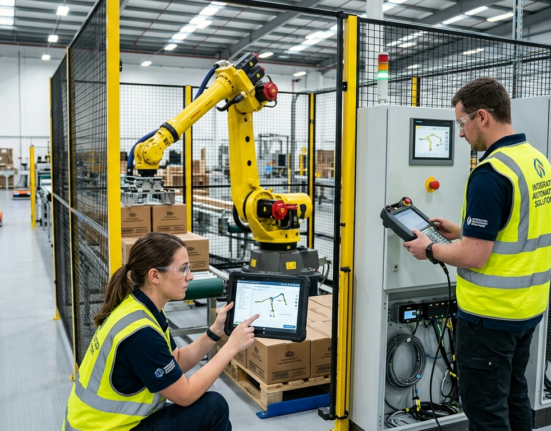

Manufacturers increasingly adopt automation to improve productivity, quality, and operational efficiency. Industrial robots now perform tasks such as assembly, welding, packaging, and inspection. However, implementing robotics requires significant financial investment. Equipment costs, integration services, and training programs can add up quickly. For this reason, evaluating robotics integration ROI is essential before launching automation initiatives.
Return on investment analysis helps organizations determine whether robotic deployment delivers long-term financial value. Companies must compare implementation costs with operational benefits such as improved productivity, reduced errors, and lower labor expenses.
Moreover, ROI analysis provides insights into how quickly automation investments will pay for themselves.
When organizations understand robotics integration ROI, they make more informed decisions about adopting robotic technologies.
Careful evaluation ensures that automation strategies align with business goals and deliver measurable financial returns.
Why ROI Matters in Robotics Integration
Automation technologies promise substantial operational improvements. However, businesses must ensure that automation investments generate measurable financial returns.
Therefore, calculating robotics integration ROI helps organizations evaluate the financial viability of robotic projects.
ROI analysis provides a clear framework for comparing automation costs with performance improvements.
Manufacturers can determine how robotic systems influence productivity, efficiency, and operational reliability.
Additionally, ROI calculations help organizations prioritize automation projects.
Some processes benefit significantly from robotics, while others may not produce sufficient financial returns.
By measuring robotics integration ROI, companies can focus on projects that deliver the greatest value.
This approach supports strategic investment decisions and reduces financial risk.
Key Costs in Robotics Integration Projects
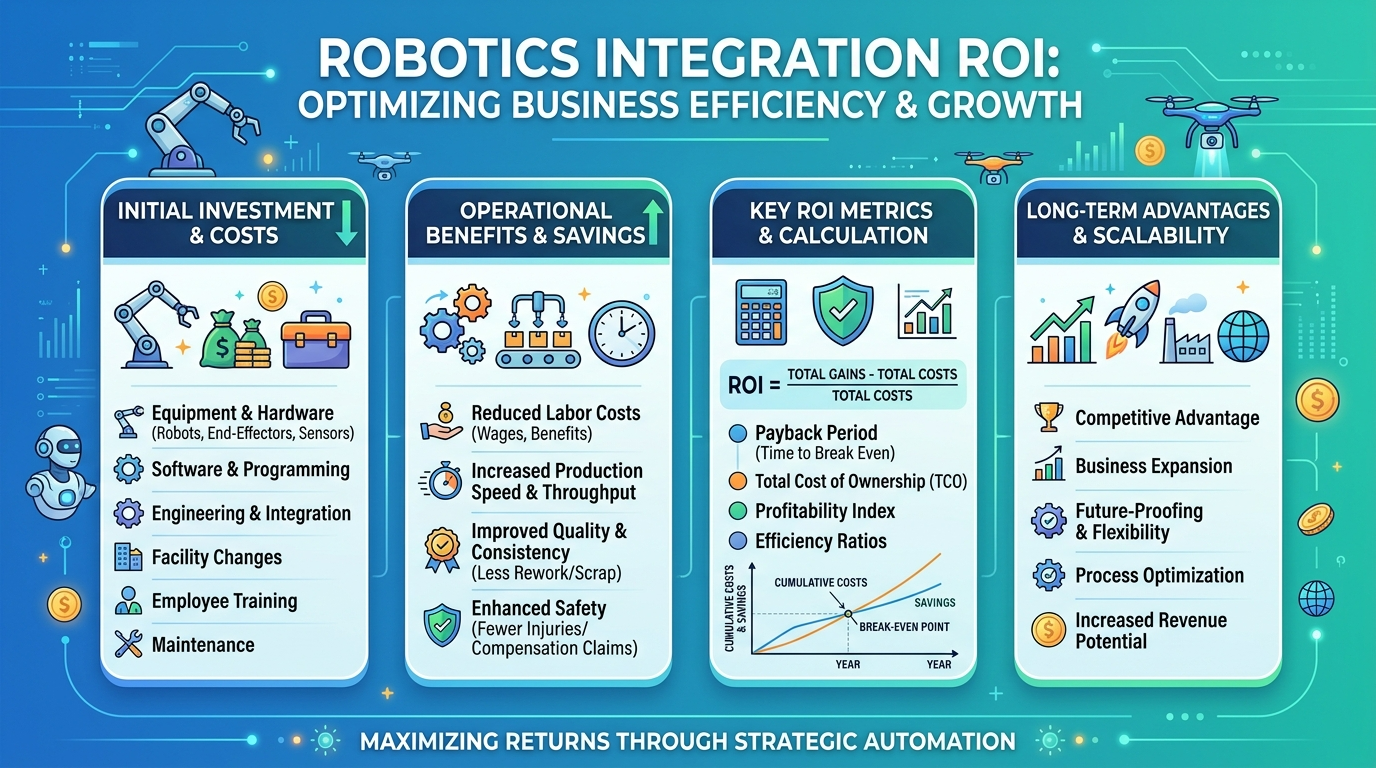
Understanding robotics integration ROI begins with identifying all costs associated with automation deployment.
Manufacturers must evaluate several financial factors before implementing robotic systems.
Equipment and Hardware Costs
Industrial robots represent the largest investment in automation projects.
Companies must purchase robotic arms, sensors, controllers, and safety systems.
These components form the foundation of robotic production systems.
Integration and Engineering Services
Integration specialists configure robots and connect them with manufacturing systems.
Engineering services may include programming, system design, and testing.
These services contribute significantly to total project costs.
Infrastructure Modifications
Some facilities require modifications to support robotic systems.
Manufacturers may need to upgrade electrical systems, install safety barriers, or redesign production lines.
Infrastructure changes influence robotics integration ROI calculations.
Training and Workforce Development
Employees must learn how to operate and maintain robotic systems.
Training programs ensure that workers understand automation technologies.
Workforce development costs also affect overall automation investment.
Measuring Financial Benefits of Robotics Integration
To evaluate robotics integration ROI, organizations must quantify the financial benefits of automation.
These benefits often extend beyond simple labor cost reductions.
Productivity Improvements
Robots perform repetitive tasks consistently and efficiently.
Automation often increases production output significantly.
Higher productivity directly improves financial performance.
Quality and Error Reduction
Robotic systems maintain consistent precision during manufacturing processes.
This consistency reduces defects and rework costs.
Improved product quality contributes positively to robotics integration ROI.
Labor Cost Optimization
Automation allows employees to focus on higher-value tasks.
Robots handle repetitive or hazardous activities.
Although automation may not eliminate jobs entirely, it can reduce labor costs over time.
Operational Efficiency
Robots operate continuously without fatigue.
Manufacturers can extend production hours and increase throughput.
Operational efficiency gains play an important role in evaluating automation ROI.
Calculating ROI for Robotics Projects
Organizations typically use financial formulas to calculate robotics integration ROI.
The basic ROI formula compares net financial gains with the initial investment.
The calculation usually follows this structure:
ROI = (Total Financial Benefits – Total Investment Costs) / Total Investment Costs
This formula helps organizations estimate the profitability of automation projects.
Companies often evaluate ROI over several years because robotic systems provide long-term value.
Additionally, organizations consider payback periods.
The payback period measures how long it takes for automation benefits to cover initial costs.
Accurate financial modeling strengthens robotics integration ROI analysis and improves strategic decision-making.
Real-World Example of Robotics ROI
A manufacturing company implemented robotic automation in its packaging line. Before automation, workers manually packaged products, which limited production speed.
The organization invested in robotic equipment, integration services, and training programs.
Initial costs totaled $1 million.
After deployment, the company increased production output by 40 percent.
Labor costs decreased because fewer workers were required for packaging tasks.
Defect rates also dropped significantly.
Over five years, the company saved $2 million in operational costs.
When calculating robotics integration ROI, the organization determined that the automation investment delivered substantial financial returns.
This example demonstrates how robotic systems can produce measurable long-term benefits.
Challenges in Measuring Robotics ROI
Although evaluating robotics integration ROI provides valuable insights, organizations may face challenges during analysis.
One challenge involves quantifying indirect benefits.
For example, automation may improve workplace safety or employee satisfaction.
These advantages are difficult to measure financially.
Another challenge involves long-term uncertainty.
Technology upgrades, maintenance requirements, and market changes may affect ROI calculations.
Additionally, companies must consider hidden costs.
Unexpected integration challenges or infrastructure modifications may increase expenses.
Despite these complexities, organizations can still estimate robotics integration ROI through careful financial analysis and strategic planning.
Strategies to Improve Robotics ROI
Manufacturers can maximize robotics integration ROI by following several best practices.
First, organizations should identify processes with high automation potential.
Repetitive tasks often deliver the greatest productivity improvements.
Second, companies should conduct pilot projects before full deployment.
Small-scale implementations allow organizations to evaluate performance and refine automation strategies.
Third, manufacturers should partner with experienced robotics integrators.
Expert guidance ensures that robotic systems operate efficiently.
Fourth, organizations should invest in employee training.
Skilled workers help maintain robotic systems and improve operational performance.
Finally, companies should monitor automation performance continuously.
Regular evaluation helps organizations optimize workflows and improve robotics integration ROI over time.
Future Trends in Robotics ROI Evaluation
Automation technologies continue evolving rapidly. As a result, methods for measuring robotics integration ROI are also improving.
One emerging trend involves data-driven analytics.
Advanced monitoring tools track robotic performance and operational metrics.
These insights help organizations evaluate financial benefits more accurately.
Another trend includes artificial intelligence integration.
AI-powered robots can adapt to changing production environments and optimize workflows automatically.
This adaptability improves long-term ROI potential.
Additionally, manufacturers increasingly adopt flexible automation systems.
Collaborative robots allow organizations to automate tasks without extensive infrastructure changes.
These innovations make it easier for companies to achieve strong robotics integration ROI.
Conclusion
Automation technologies are transforming manufacturing industries around the world. Industrial robots improve productivity, enhance product quality, and optimize operational efficiency.
However, implementing robotic systems requires careful financial evaluation.
By calculating robotics integration ROI, organizations can determine whether automation investments deliver long-term value.
ROI analysis compares implementation costs with financial benefits such as productivity improvements, error reduction, and labor optimization.
Although measuring ROI may involve challenges, organizations that conduct thorough financial assessments make better investment decisions.
Furthermore, strategic planning and continuous monitoring help manufacturers maximize automation benefits.
As robotics technology continues advancing, companies that evaluate automation investments carefully will gain significant competitive advantages.
FAQ
1. What does ROI mean in robotics automation projects?
Return on investment measures how much financial value automation generates compared with the initial deployment cost.
2. How long does it take to recover automation investments?
Many robotics projects achieve payback within two to five years, depending on system complexity and productivity gains.
3. What factors influence automation investment returns?
Equipment costs, integration services, productivity improvements, and labor savings all influence financial outcomes.
4. Can small manufacturers benefit from robotic automation?
Yes. Smaller companies often implement collaborative robots to automate specific tasks efficiently.
5. Why should manufacturers analyze automation investments carefully?
Financial evaluation ensures that automation projects align with operational goals and deliver measurable business benefits.