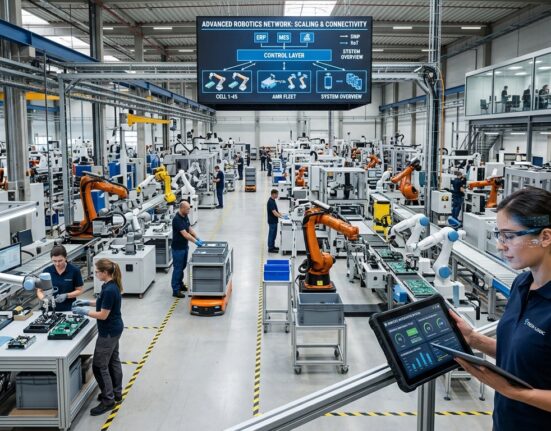


Robots are no longer science fiction—they’re our coworkers, assistants, and productivity partners. Across the globe, automation is transforming industries, creating an urgent need for new skills. The rise of robotics is not replacing the human workforce; it’s redefining it. Global workforce upskilling in robotics has become the key to unlocking innovation, efficiency, and sustainable career growth.
From factory floors to hospital wards, the integration of robotics has sparked a new industrial revolution—one powered by data, precision, and human creativity. But for organizations and workers alike, the question remains: how do we adapt to this fast-evolving landscape? The answer lies in a global movement toward robotics education, reskilling, and lifelong learning.
The Global Shift Toward a Robotic Future
Technology has always shaped the way we work. The printing press, electricity, and computers each transformed industries and created entirely new professions. Robotics is simply the next chapter—only faster and more interconnected than ever.
According to the International Federation of Robotics, the number of industrial robots worldwide has exceeded 3.9 million units. But what’s even more striking is the rapid adoption across sectors beyond manufacturing. From agriculture to logistics, from education to defense, robots are becoming essential to modern operations.
This acceleration has created a global demand for workers who can design, maintain, and collaborate with robotic systems. Upskilling the workforce is no longer a luxury—it’s a necessity. Without it, economies risk falling behind in competitiveness and innovation.
Why Upskilling in Robotics Is Now Essential
Upskilling refers to learning new skills to stay relevant in a changing work environment. In robotics, it means understanding how to operate, program, or work alongside machines that automate repetitive or complex tasks.
As industries adopt robotics, roles evolve rather than disappear. A factory assembler might become a robot technician. A logistics worker could shift into systems monitoring. A nurse could oversee robotic assistants in patient care.
By investing in robotics upskilling, workers future-proof their careers. For companies, it means greater productivity, fewer operational errors, and a workforce capable of managing automation rather than being displaced by it.
The message is clear: those who learn to work with robots will lead the future of work.
Top Global Workforce Upskilling Trends in Robotics
Let’s explore the major trends shaping how nations, companies, and individuals are adapting to the robotics revolution.
1. National Robotics Education Initiatives
Governments worldwide are realizing that robotics literacy is a national priority. Countries like Japan, Germany, and South Korea have made robotics education part of their long-term economic strategies.
For example, Japan’s “Society 5.0” initiative integrates robotics and AI across industries while emphasizing human-centered innovation. In Germany, vocational programs now include robotics and mechatronics training as part of apprenticeships. Even developing nations such as India and Brazil are launching robotics-focused skill development missions to bridge the digital divide.
This shift isn’t just about technology—it’s about preparing citizens for a smarter, more automated future.
2. Corporate Reskilling Programs
Forward-thinking organizations are investing in their people through robotics upskilling programs. Tech giants like Amazon, Siemens, and ABB have introduced internal academies that teach employees how to work with collaborative robots (cobots), AI systems, and digital twins.
For example, Amazon’s $700 million “Upskilling 2025” initiative provides robotics and automation training to employees, helping them transition into higher-value technical roles. These programs prove that automation doesn’t eliminate jobs—it upgrades them.
3. Integration of AI and Robotics Training
Artificial intelligence and robotics go hand in hand. As robots become smarter, understanding how AI influences decision-making, pattern recognition, and autonomy has become critical.
Educational institutions are responding with hybrid programs in robotics, machine learning, and data science. Universities such as MIT, ETH Zurich, and Nanyang Technological University now offer advanced robotics courses that combine engineering with AI-driven problem-solving.
Professionals with cross-disciplinary expertise—those who can merge human insight with algorithmic precision—are among the most in-demand talents today.
4. Rise of Online Robotics Learning Platforms
The digital education boom has democratized access to robotics training. Online platforms like Coursera, Udacity, and edX offer certification programs from top universities and industry leaders. Learners can now gain practical skills in robotics programming, industrial automation, or drone technology from anywhere in the world.
This accessibility has empowered professionals in remote regions to join the global robotics workforce. As lifelong learning becomes a cultural norm, online platforms are bridging the gap between education and employability.
5. Human-Robot Collaboration Training
Robots aren’t replacing people—they’re becoming coworkers. This shift demands not only technical skills but also emotional intelligence, adaptability, and safety awareness.
Human-robot collaboration (HRC) training teaches workers how to safely share workspaces with cobots, interpret robotic behavior, and optimize workflows for joint efficiency. Companies that adopt HRC training report improved productivity, reduced injury rates, and higher employee satisfaction.
6. Cross-Industry Upskilling Programs
Robotics is no longer limited to manufacturing. Industries from agriculture to retail are integrating automation in unique ways.
- Healthcare: Surgical and assistive robots are redefining medical practice.
- Agriculture: Autonomous tractors and drones improve crop management.
- Logistics: Robotics in warehouses optimize order fulfillment and delivery.
- Hospitality: Service robots handle cleaning, concierge, and room service roles.
Upskilling in robotics now applies to anyone—from doctors to farmers—who interacts with automated systems in their daily work.
The Economic and Social Impact of Robotics Upskilling
The benefits of global workforce upskilling in robotics extend beyond personal career growth—they influence entire economies. Nations investing in robotics education enjoy higher productivity, innovation rates, and global competitiveness.
For developing economies, robotics upskilling represents a gateway to leapfrog industrial stages. Rather than following traditional development paths, countries can build smart factories and advanced service industries right from the start.
Socially, upskilling helps reduce inequality by creating new job pathways for workers displaced by automation. It allows employees to transition into roles that require creativity, critical thinking, and technical collaboration—skills that robots can’t replicate.
Barriers to Global Robotics Upskilling
Despite the progress, challenges remain. The global skills gap continues to widen between those with access to robotics education and those without.
Limited Access to Training
In many regions, robotics training is still expensive or geographically inaccessible. Rural communities and low-income populations risk being left behind unless governments and organizations invest in inclusive education programs.
Rapid Technological Change
Technology evolves faster than curricula. By the time a course is designed, the tools may already be outdated. Continuous curriculum updates and agile learning systems are vital to keep education relevant.
Workforce Resistance and Fear
Many workers still view robots as competitors rather than collaborators. Overcoming this fear requires awareness campaigns and success stories showing how robotics can enhance, not replace, human potential.
The Role of Employers in Upskilling
Employers play a critical role in bridging the robotics skills gap. Organizations that invest in employee training gain a future-ready workforce capable of driving digital transformation.
Key employer strategies include:
- Partnering with universities or online platforms for tailored robotics programs.
- Offering incentives for employees to pursue robotics certifications.
- Establishing mentorship systems that pair experienced engineers with trainees.
- Hosting internal hackathons or innovation challenges focused on robotics solutions.
By making learning part of company culture, employers turn upskilling into a continuous, empowering process rather than a one-time event.
The Future of Global Workforce Upskilling in Robotics
Looking ahead, the momentum around robotics upskilling will only intensify. The global robotics market is projected to exceed $275 billion by 2030, driven by advancements in AI, 5G, and cloud computing.
The next frontier will focus on human-robot symbiosis—a world where people and intelligent machines collaborate seamlessly. This means workers won’t just operate robots; they’ll guide, teach, and enhance them.
Education systems will evolve toward modular, interdisciplinary learning, blending coding, engineering, psychology, and design thinking. Employers will prioritize adaptability and continuous learning over static degrees. And nations will compete not only in robotics innovation but in building the most skilled and versatile workforce.
In short, the future of robotics isn’t about replacing humans—it’s about augmenting human potential.
Conclusion
The global workforce upskilling in robotics marks one of the most significant transformations of our time. As automation becomes a universal language, learning to work with robots is the new literacy of the 21st century.
Those who embrace this change will thrive, finding purpose and opportunity in a world where humans and machines work side by side. For workers, it’s a chance to future-proof their careers. For companies, it’s a pathway to innovation. And for society, it’s a step toward a smarter, more inclusive world.
In the end, robotics upskilling isn’t about technology—it’s about evolution. It’s about preparing people everywhere to shape, rather than fear, the future.
FAQ
1. What does robotics upskilling mean?
Robotics upskilling means learning new technical and collaborative skills to work with robotic systems across various industries.
2. Why is global robotics upskilling important?
It ensures workers remain employable in an automated world while helping companies and economies stay competitive and innovative.
3. Which industries benefit most from robotics upskilling?
Manufacturing, healthcare, logistics, agriculture, and retail are leading industries integrating robotics and upskilling programs.
4. How can individuals start learning robotics?
You can begin with online courses, certifications, or hands-on workshops that teach robotics programming, AI integration, or automation basics.
5. What is the future of workforce upskilling in robotics?
The future emphasizes human-robot collaboration, AI integration, and lifelong learning to adapt to rapid technological change.