

MLOps team training has become one of the most decisive factors in machine learning success. Models do not fail on their own. Pipelines break. Monitoring is ignored. Ownership becomes unclear. Most failures trace back to skills gaps rather than algorithms.
Machine learning is no longer a research project. It is production software that must perform under pressure. That shift changes everything. Teams must move beyond experimentation and learn how to build systems that are reliable, secure, and repeatable.
This article explores why MLOps team training matters, what skills modern teams need, and how organizations can train people for long-term machine learning success instead of short-lived wins.
Why MLOps Team Training Matters More Than Technology
Technology evolves fast. Skills lag behind even faster.
Organizations often invest heavily in tools while underinvesting in people. The result is predictable. Pipelines stall. Models drift. Incidents multiply. Confidence erodes.
MLOps team training matters because it:
- Reduces production failures
- Improves deployment reliability
- Shortens incident response time
- Aligns ML systems with business goals
Well-trained teams turn complexity into control. Untrained teams turn innovation into risk.
The Shift From Data Science to Production ML
Early machine learning focused on accuracy. Production ML focuses on stability.
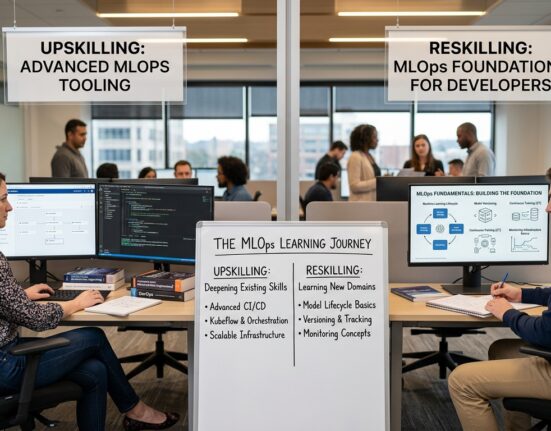
This shift requires new capabilities. Data scientists must understand deployment. Engineers must understand model behavior. Operations teams must understand data pipelines.
MLOps team training bridges these gaps by building shared understanding. Instead of silos, teams develop a common language around systems, risks, and responsibilities.
When everyone understands the full lifecycle, handoffs become smoother and failures decrease.
Core Skills Required for Effective MLOps Teams
Modern ML teams need more than coding ability. They need systems thinking.
MLOps team training should cover skills such as:
- Data pipeline design and reliability
- Model versioning and reproducibility
- CI/CD for machine learning
- Monitoring, drift detection, and alerting
- Infrastructure and cloud fundamentals
- Security and access control
These skills allow teams to manage ML as a living system rather than a static artifact.
Training for End-to-End Ownership
Ownership gaps cause failures.
When no one owns the full ML lifecycle, issues fall between teams. Training must reinforce responsibility from data ingestion to model retirement.
MLOps team training encourages:
- Clear ownership models
- Shared accountability
- Defined escalation paths
- Lifecycle awareness
End-to-end ownership reduces confusion and accelerates resolution when problems arise.
Balancing Theory and Practical Skills
Theory matters. Practice matters more.
Many teams understand machine learning concepts but struggle with real-world constraints. Training must reflect production realities rather than ideal conditions.
Effective MLOps team training emphasizes:
- Hands-on pipeline building
- Real incident simulations
- Debugging failing deployments
- Monitoring live systems
Practical experience builds confidence and competence faster than abstract instruction.
Training for Collaboration Across Roles
MLOps sits at the intersection of multiple disciplines. Collaboration is not optional.
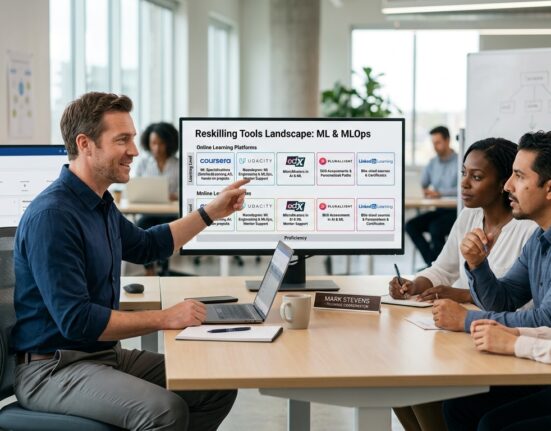
Training programs should bring roles together rather than isolating them. Data scientists, engineers, and operations teams must learn side by side.
Collaborative training improves:
- Communication across roles
- Shared understanding of constraints
- Faster decision-making
- Reduced handoff errors
MLOps team training works best when learning is collective.
The Role of Automation Literacy
Automation underpins MLOps. Teams must understand it, not fear it.
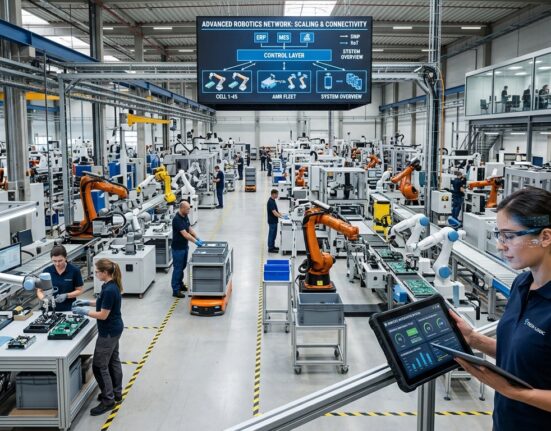
Training should explain how automation supports reliability rather than replacing judgment. Pipelines, testing, and deployment automation reduce manual error.
Automation literacy includes:
- Understanding CI/CD workflows
- Knowing when automation should stop
- Interpreting automated alerts
- Maintaining automated systems
This knowledge prevents blind trust and blind resistance.
Monitoring and Observability Training
Most ML failures happen quietly.
Models drift. Data changes. Performance degrades slowly. Without observability, teams react too late.
MLOps team training must emphasize monitoring skills, including:
- Defining meaningful metrics
- Detecting data and concept drift
- Interpreting performance signals
- Responding to alerts effectively
Monitoring turns surprises into manageable events.
Security and Compliance as Training Priorities
Security cannot be bolted on later.
Machine learning systems handle sensitive data and automated decisions. Teams must understand security risks and compliance obligations.
Training should cover:
- Secure data handling practices
- Access control models
- Audit and logging requirements
- Regulatory considerations
Security-aware teams reduce both technical and reputational risk.
Adapting Training to Organizational Maturity
Not all teams start in the same place.
Early-stage teams need fundamentals. Mature teams need refinement. Training must evolve alongside systems.
MLOps team training programs should adapt by:
- Assessing current capability
- Prioritizing high-risk gaps
- Updating content regularly
- Scaling depth over time
Static training programs fail in dynamic environments.
Measuring the Impact of MLOps Team Training
Training should deliver measurable outcomes.
Organizations often struggle to justify training investments. Metrics help.
Indicators of effective MLOps team training include:
- Fewer production incidents
- Faster deployment cycles
- Improved model stability
- Higher team confidence
When training improves outcomes, value becomes visible.
Avoiding Common Training Pitfalls
Training fails when it is treated as a checkbox.
Common mistakes include:
- One-time workshops without follow-up
- Tool-focused training without context
- Ignoring real production constraints
- Separating learning from daily work
MLOps team training must be continuous, relevant, and embedded in practice.
Building a Culture of Continuous Learning
Machine learning does not stand still. Neither should teams.
The most successful organizations treat learning as infrastructure. Time is allocated. Curiosity is rewarded. Knowledge sharing is encouraged.
Continuous learning cultures support:
- Faster adaptation to change
- Reduced burnout
- Higher engagement
- Stronger long-term performance
Training becomes part of how work gets done.
Leadership’s Role in MLOps Team Training
Training succeeds or fails at the leadership level.
Leaders set priorities. They allocate time. They model behavior.
Effective leaders support MLOps team training by:
- Protecting learning time
- Encouraging experimentation
- Supporting knowledge sharing
- Treating mistakes as learning signals
Leadership commitment turns training into momentum.
Future-Proofing Machine Learning Teams
Tools will change. Skills must evolve.
MLOps team training prepares organizations not just for current systems, but for future complexity. Teams learn how to learn, not just how to use tools.
Future-ready teams are:
- Adaptable
- Resilient
- Confident under change
- Capable of scaling responsibly
Training becomes a strategic advantage.
Conclusion
MLOps team training is the foundation of sustainable machine learning success. Tools alone cannot deliver reliability, trust, or scale. People make systems work.
By investing in practical skills, cross-functional collaboration, and continuous learning, organizations transform machine learning from fragile experimentation into dependable infrastructure. When teams are trained well, machine learning delivers on its promise consistently and responsibly.
FAQ
1. What is MLOps team training?
It is the structured development of skills needed to deploy, monitor, and maintain machine learning systems in production.
2. Why is MLOps training critical for ML success?
Because most ML failures stem from operational and collaboration gaps rather than model accuracy.
3. Who should participate in MLOps team training?
Data scientists, engineers, operations staff, and stakeholders involved in ML systems.
4. How often should MLOps training occur?
Continuously, with regular updates as tools, systems, and risks evolve.
5. What is the biggest risk of skipping MLOps training?
Unreliable systems, frequent incidents, and loss of trust in machine learning initiatives.