
Machine learning has moved far beyond research labs. Today, organizations rely on scalable systems that deliver models into production. As a result, MLOps certification programs have become essential for professionals who want to bridge the gap between data science and operations.
These certifications teach practical skills for deploying, monitoring, and maintaining machine learning systems. Moreover, they help professionals understand automation pipelines, infrastructure management, and collaboration across teams.
Because the demand for machine learning solutions continues to grow, companies increasingly look for engineers who understand operational workflows. Therefore, gaining formal credentials can significantly improve both credibility and career opportunities.
In this guide, you will discover the most respected programs available today. Additionally, you will learn how to choose the right certification based on your experience level and career goals.
Why MLOps Skills Are Becoming Essential
Machine learning models are valuable only when they operate reliably in production. However, deploying them successfully requires more than building algorithms.
Engineers must manage data pipelines, version control, monitoring systems, and automation frameworks. Consequently, organizations now prioritize professionals who understand both machine learning and software operations.
This shift explains why MLOps certification programs are growing in popularity. They teach the workflows needed to move models from experimentation to real-world applications.
Furthermore, companies benefit from certified professionals because they can implement reliable ML pipelines faster. As a result, teams reduce deployment errors and improve scalability.
Another advantage is collaboration. Certified specialists often understand how data scientists, engineers, and DevOps teams work together. Therefore, they can coordinate development processes more effectively.
Ultimately, organizations need operational stability. Skilled MLOps professionals help ensure machine learning systems remain efficient, reliable, and secure.
Core Skills Covered in MLOps Certifications
Although different training providers offer unique courses, most MLOps certification programs focus on similar technical areas.
These skills form the foundation of modern machine learning operations.
Machine Learning Deployment
First, professionals learn how to move models from development environments into production systems.
This includes packaging models, managing APIs, and ensuring compatibility with cloud infrastructure. Additionally, deployment strategies often involve containerization tools such as Docker.
Because reliable deployment is critical, certification courses emphasize repeatable processes and automation pipelines.
Pipeline Automation
Automation is another essential component of modern ML operations.
Training programs teach how to design continuous integration and continuous deployment pipelines. As a result, teams can update models automatically when new data becomes available.
Moreover, automated pipelines reduce manual work and minimize deployment errors.
Monitoring and Model Performance
Machine learning models can degrade over time as real-world data changes.
Therefore, monitoring systems are necessary to detect issues such as data drift or declining performance. Most MLOps certification programs include training on observability tools and monitoring dashboards.
Professionals also learn how to trigger alerts when model performance drops below acceptable levels.
Infrastructure and Scalability
Another important skill involves managing the infrastructure that supports machine learning systems.
Courses often cover cloud platforms such as AWS, Azure, and Google Cloud. In addition, professionals learn how to scale services efficiently using container orchestration tools.
This knowledge ensures models can handle large workloads without performance issues.
Top MLOps Certification Programs to Consider
Professionals who want to advance their careers can choose from several respected training programs. Each option offers different strengths depending on your goals.
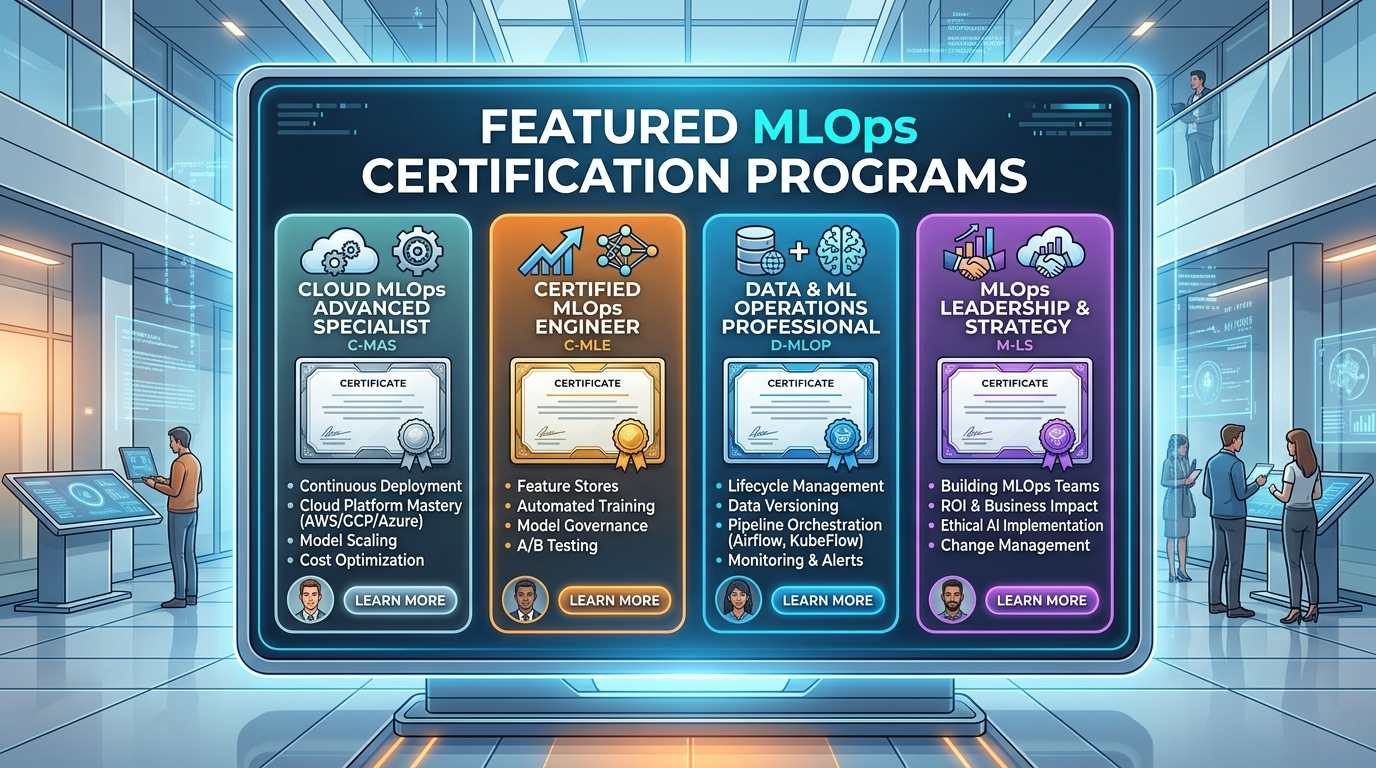
Below are some of the most valuable MLOps certification programs available today.
Google Professional Machine Learning Engineer
Google’s certification focuses heavily on production machine learning environments.
Participants learn how to design ML pipelines, deploy models, and manage infrastructure using Google Cloud tools. Additionally, the certification tests knowledge of real-world ML operations.
Because Google Cloud is widely used, this credential holds strong industry recognition.
AWS Certified Machine Learning Specialty
Amazon’s certification emphasizes scalable ML deployment using AWS services.
Candidates learn about data engineering, feature pipelines, model training, and monitoring. Moreover, the exam evaluates practical knowledge of machine learning systems in production.
Many professionals choose this certification because AWS remains one of the largest cloud platforms worldwide.
Microsoft Azure AI Engineer Associate
Microsoft’s AI engineering certification includes many operational components related to ML deployment.
Students learn how to manage machine learning solutions using Azure tools. Furthermore, the program covers model monitoring, automation pipelines, and infrastructure management.
For organizations that rely on Microsoft ecosystems, this certification offers clear value.
Coursera Machine Learning Engineering for Production
This program, often called the MLOps specialization, focuses entirely on production machine learning workflows.
Students explore dataset management, pipeline automation, monitoring, and governance practices. Unlike many cloud-focused programs, this course emphasizes foundational operational principles.
Because it combines theory and hands-on training, many engineers use it to strengthen practical skills.
DataCamp Machine Learning Engineer Certification
DataCamp offers a certification pathway focused on deploying models and managing ML workflows.
The curriculum includes model versioning, pipeline orchestration, and infrastructure scaling. Additionally, participants gain hands-on experience using common ML tools.
This option is often suitable for professionals transitioning from data science roles into operational positions.
How to Choose the Right Certification
With many options available, selecting the best training program requires careful consideration.
Different MLOps certification programs focus on different technical environments and career paths.
Consider Your Current Role
First, evaluate your professional background.
Data scientists may benefit from certifications focused on deployment and infrastructure. Meanwhile, DevOps engineers might prefer courses emphasizing machine learning pipelines.
Understanding your current skill set helps identify the most valuable program.
Evaluate Cloud Platform Alignment
Many organizations rely heavily on specific cloud platforms.
Therefore, selecting a certification aligned with your company’s infrastructure can provide immediate benefits. For example, AWS-based teams may prefer Amazon’s ML specialty certification.
Matching training with real-world environments improves practical impact.
Assess Hands-On Learning Opportunities
Practical experience matters more than theory.
High-quality MLOps certification programs include hands-on labs and real deployment exercises. These experiences help professionals develop confidence working with production systems.
Consequently, programs that emphasize projects often deliver stronger career outcomes.
Review Industry Recognition
Not all certifications carry the same industry weight.
Cloud provider credentials typically offer broader recognition. However, specialized training programs can also be valuable if they focus on production workflows.
Researching employer demand can help guide your decision.
Benefits of Earning an MLOps Certification
Completing professional training can transform your career path.
The advantages of MLOps certification programs extend far beyond technical knowledge.
Career Advancement
Certification signals expertise to employers.
Recruiters often prioritize candidates who demonstrate practical knowledge of machine learning deployment. Consequently, certified professionals may qualify for higher-level roles.
Higher Salary Potential
Specialized ML operations roles often command higher salaries.
Because fewer professionals possess both machine learning and DevOps skills, certified specialists frequently earn competitive compensation.
In addition, certifications help justify salary negotiations during hiring or promotion discussions.
Improved Project Success
Organizations benefit from better deployment workflows when trained professionals lead ML operations.
Certified engineers understand automation, monitoring, and scalability. As a result, machine learning projects become more reliable and easier to maintain.
Stronger Professional Credibility
Industry credentials increase trust among colleagues and stakeholders.
When professionals complete MLOps certification programs, they demonstrate commitment to mastering complex technical workflows.
This credibility often leads to leadership opportunities within engineering teams.
Future Trends in MLOps Certifications
The field of machine learning operations continues to evolve rapidly.
Therefore, certification programs must adapt to emerging technologies and industry needs.
One growing trend involves automation platforms designed specifically for machine learning pipelines. Future MLOps certification programs will likely emphasize tools that simplify deployment and monitoring.
Another development is the integration of governance and responsible AI practices. As regulations expand, professionals must understand compliance requirements when deploying models.
Additionally, edge computing is gaining attention. Organizations increasingly deploy models on mobile devices and IoT systems. Certifications may soon include training on distributed machine learning environments.
Finally, collaborative workflows will become even more important. Modern teams rely on shared tools that connect data science, engineering, and operations teams.
Professionals who understand these integrated workflows will remain highly valuable.
Conclusion
Machine learning systems must operate reliably in production environments. Therefore, professionals who understand operational workflows are increasingly in demand.
Completing MLOps certification programs can help engineers build the skills needed to deploy, monitor, and scale machine learning solutions effectively.
These programs teach critical capabilities such as pipeline automation, infrastructure management, and model monitoring. Furthermore, certifications demonstrate expertise to employers and clients.
Whether you work in data science, DevOps, or machine learning engineering, gaining operational knowledge can significantly enhance your career.
By choosing the right certification program and applying these skills in real-world environments, professionals can help organizations build more reliable and scalable machine learning systems.
Ultimately, mastering ML operations ensures that innovative models deliver real business value.
FAQ
1. What skills should professionals learn for machine learning operations?
Key skills include model deployment, automation pipelines, monitoring systems, and infrastructure management. Understanding cloud platforms and collaboration workflows is also essential.
2. Are cloud provider certifications useful for ML engineers?
Yes. Credentials from major cloud providers often include production deployment training. They also demonstrate practical knowledge of scalable machine learning environments.
3. How long does it take to complete an MLOps certification course?
Most certification programs require several weeks to a few months. However, the timeline depends on the course structure and the learner’s prior experience.
4. Do data scientists benefit from operations-focused training?
Absolutely. Learning operational workflows helps data scientists deploy models more effectively. It also improves collaboration with engineering teams.
5. Can beginners start with machine learning operations training?
Beginners can start if they have basic programming and machine learning knowledge. However, foundational ML skills are usually recommended before studying operational workflows.