
Artificial intelligence has rapidly become a core driver of innovation across industries. Organizations now rely on machine learning to automate processes, improve predictions, and deliver better customer experiences. However, many companies lack the internal expertise required to manage these systems effectively. As a result, ML MLOps reskilling strategies have become essential for businesses seeking to remain competitive.
Rather than hiring entirely new teams, many organizations choose to train their existing workforce. This approach allows companies to retain institutional knowledge while building advanced technical capabilities.
Furthermore, reskilling initiatives support long-term innovation by creating teams that understand both business processes and machine learning technologies.
Although building AI capabilities may seem complex, structured reskilling programs can help organizations transition smoothly.
In this guide, you will learn how ML MLOps reskilling strategies help companies develop skilled teams, integrate machine learning workflows, and sustain AI-driven transformation.
Why Companies Must Invest in AI Workforce Development
Artificial intelligence is no longer limited to technology companies. Today, businesses across healthcare, finance, retail, and manufacturing rely on data-driven systems.
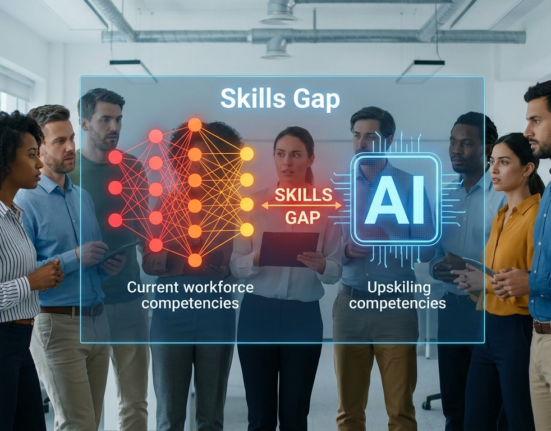
Because of this shift, organizations must develop technical capabilities internally. Consequently, ML MLOps reskilling strategies help companies bridge the growing skills gap.
Hiring specialized AI engineers can be expensive and time-consuming. However, existing employees often understand company operations better than new hires.
Training these employees enables organizations to combine domain expertise with machine learning knowledge.
Additionally, reskilling improves employee retention. Workers feel more engaged when companies invest in their professional growth.
Another benefit involves faster technology adoption. Skilled teams can implement machine learning projects more efficiently.
Therefore, workforce development has become a strategic priority for organizations implementing artificial intelligence.
Understanding the Skills Needed for ML and MLOps
Before launching training initiatives, companies must understand the skills required for modern AI operations.
Effective ML MLOps reskilling strategies focus on both technical and operational competencies.
Machine learning engineers design and train predictive models. These professionals work with data scientists to build algorithms that analyze large datasets.
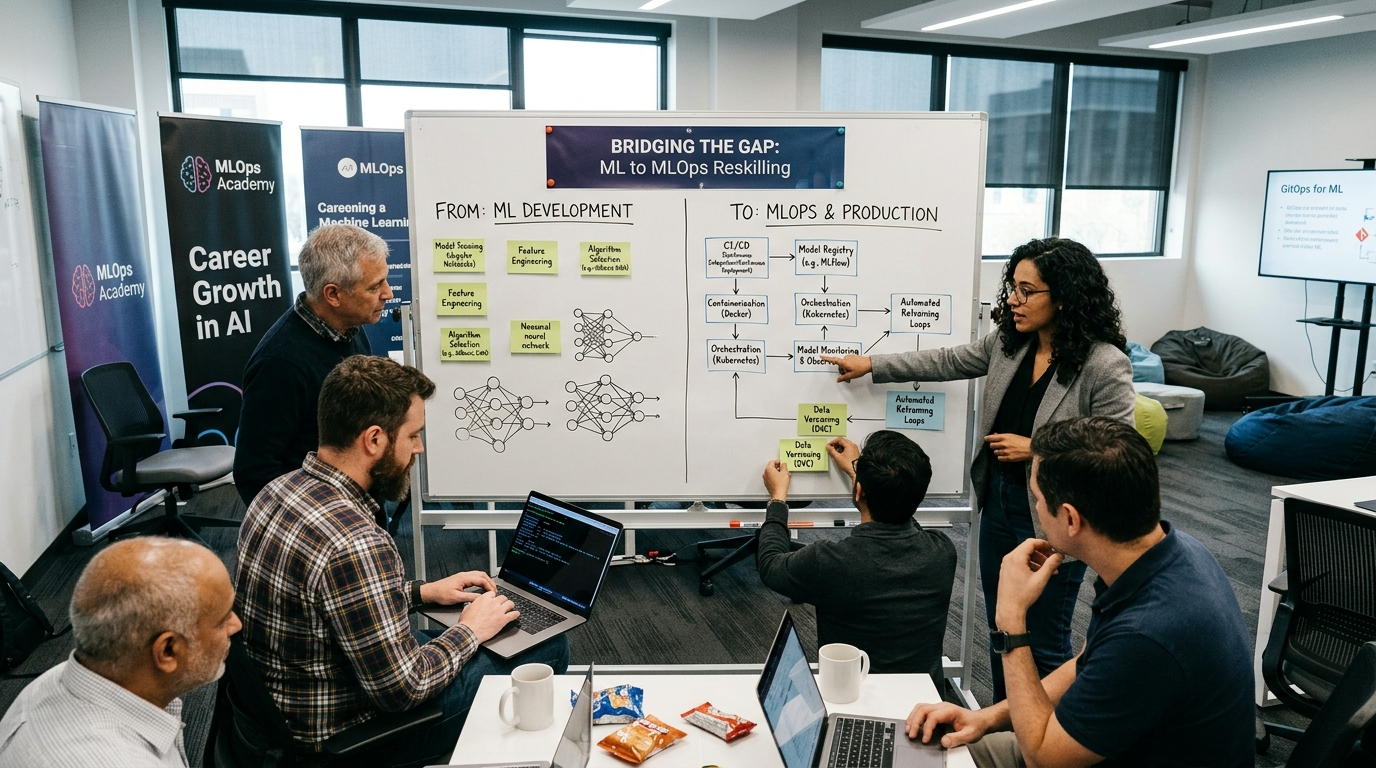
Meanwhile, MLOps specialists manage the deployment, monitoring, and maintenance of machine learning systems.
Because these roles require collaboration, organizations must train employees in multiple disciplines.
Programming skills represent the foundation of most machine learning careers. Languages such as Python play a central role in data analysis and model development.
Additionally, data engineering knowledge helps teams manage datasets efficiently.
Finally, cloud computing and automation tools support scalable machine learning operations.
Understanding these skill requirements allows organizations to design targeted training programs.
Building Effective Corporate Reskilling Programs
Successful workforce transformation requires structured learning initiatives. Companies must design programs that support long-term professional development.
Several approaches strengthen ML MLOps reskilling strategies within organizations.
Establish Clear Learning Pathways
Employees need clear learning objectives when transitioning into new technical roles.
Organizations should define structured training paths that guide workers through foundational and advanced topics.
For example, beginners may start with statistics, programming, and data analysis.
Later stages may introduce machine learning algorithms, model deployment, and monitoring techniques.
Clear learning pathways help employees progress confidently through complex subjects.
Offer Hands-On Learning Opportunities
Practical experience plays a critical role in technical training.
Effective ML MLOps reskilling strategies include projects that simulate real-world machine learning workflows.
Employees may analyze company datasets, build predictive models, or automate data pipelines.
These hands-on activities help workers apply theoretical knowledge to practical business challenges.
Moreover, project-based learning strengthens problem-solving skills.
Create Internal Mentorship Programs
Mentorship accelerates learning and supports collaboration across teams.
Experienced engineers or data scientists can guide employees through technical challenges.
Mentorship also encourages knowledge sharing across departments.
When organizations combine mentorship with structured training, reskilling initiatives become more effective.
Integrate Training with Business Projects
Training programs should align with real organizational goals.
Employees learn more effectively when working on projects that impact their company.
For example, teams may develop machine learning models that improve forecasting or customer analytics.
By connecting learning with business outcomes, organizations maximize the value of ML MLOps reskilling strategies.
Technology Platforms Supporting Workforce Reskilling
Modern learning platforms make technical training more accessible for corporate teams.
These tools support scalable ML MLOps reskilling strategies across large organizations.
Online Learning Platforms
Online education platforms provide structured courses in machine learning and data science.
Employees can access training materials anytime, allowing flexible learning schedules.
Additionally, these platforms offer certifications that validate technical knowledge.
Such programs support consistent training across distributed teams.
Internal Knowledge Portals
Many organizations create internal training hubs where employees access learning resources.
These portals include tutorials, documentation, and project guidelines.
Centralized knowledge systems help employees develop technical skills independently.
Consequently, internal resources strengthen ongoing ML MLOps reskilling strategies.
Collaborative Development Environments
Machine learning development often requires collaborative tools.
Shared development environments allow teams to experiment with data, models, and pipelines.
These environments encourage teamwork and accelerate learning.
Moreover, collaborative platforms support continuous experimentation with new technologies.
Cloud-Based Training Labs
Cloud environments allow employees to practice machine learning workflows without complex infrastructure setup.
Workers can test algorithms, deploy models, and analyze data safely.
These environments provide valuable hands-on experience.
As a result, cloud training labs enhance corporate reskilling programs.
Overcoming Challenges in Workforce Reskilling
Although reskilling programs offer significant benefits, organizations may encounter obstacles.
Addressing these challenges strengthens ML MLOps reskilling strategies.
Limited Technical Background
Many employees begin training without programming experience.
Companies should provide introductory courses that explain basic data science concepts.
Gradual learning helps workers build confidence in technical subjects.
Time Constraints
Employees often struggle to balance training with daily responsibilities.
Organizations should allocate dedicated learning time within work schedules.
Flexible learning environments also help employees progress at their own pace.
Cultural Resistance
Some teams may hesitate to adopt new technologies.
Clear communication about the benefits of AI helps address these concerns.
Leadership support also encourages employees to participate in training programs.
Measuring Program Success
Companies must evaluate whether training initiatives deliver real value.
Performance metrics such as project completion, skill certifications, and deployment outcomes help measure progress.
Continuous evaluation improves long-term ML MLOps reskilling strategies.
Future Trends in AI Workforce Development
The demand for AI expertise will continue to grow rapidly. Consequently, organizations must adapt their training programs to keep pace with technological change.
Future ML MLOps reskilling strategies will likely incorporate several emerging trends.
First, AI-powered learning platforms will personalize training experiences. These systems analyze employee progress and recommend targeted courses.
Second, microlearning modules will allow employees to learn specific skills quickly.
Third, simulation-based training environments will replicate real machine learning pipelines.
Additionally, cross-functional training programs will become more common.
Employees from business, engineering, and analytics teams will collaborate on AI initiatives.
Finally, organizations will increasingly partner with universities and research institutions.
These collaborations provide access to advanced expertise and emerging technologies.
Together, these trends will transform how companies develop AI-ready workforces.
Conclusion
Artificial intelligence is reshaping how organizations operate and compete. However, successful AI adoption requires skilled teams capable of building and maintaining machine learning systems.
Through well-designed ML MLOps reskilling strategies, companies can transform their existing workforce into AI-enabled professionals.
Structured learning programs, hands-on projects, and mentorship initiatives help employees develop technical expertise.
Moreover, technology platforms and collaborative tools support scalable training efforts across organizations.
Although reskilling requires time and investment, the long-term benefits are significant.
Companies that empower their employees with machine learning and MLOps knowledge will gain a strong competitive advantage.
As AI continues to evolve, workforce development will remain one of the most important drivers of sustainable innovation.
FAQ
1. Why should companies train employees in machine learning operations?
Training employees helps organizations build internal expertise while retaining valuable institutional knowledge.
2. What skills are important for machine learning operations roles?
Key skills include programming, data engineering, model deployment, monitoring systems, and cloud infrastructure management.
3. How long does it take to train teams in machine learning technologies?
Training timelines vary, but many programs require several months of structured learning and practical project experience.
4. Are online platforms useful for corporate technical training?
Yes. Many organizations use online learning platforms to provide structured courses and certifications for employees.
5. What industries benefit most from AI workforce reskilling?
Industries such as finance, healthcare, manufacturing, retail, and logistics increasingly rely on machine learning technologies.