
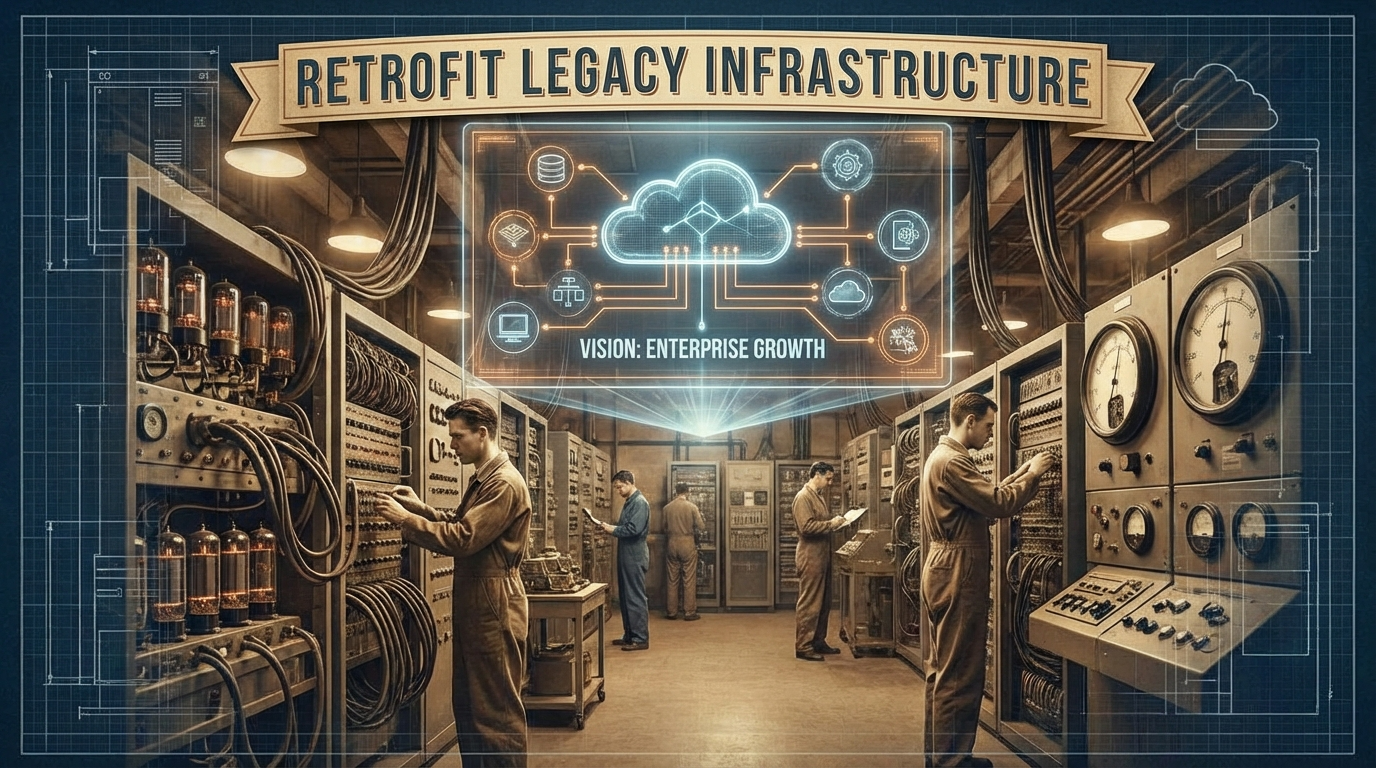
Modern enterprises face a familiar tension. On one hand, innovation demands speed, intelligence, and automation. On the other hand, much of the world still runs on legacy infrastructure. Old cameras. Aging machines. Decades-old control systems. The good news? You don’t have to tear everything out to move forward.
That’s where retrofit legacy infrastructure vision strategies come in.
Computer vision allows enterprises to add a new layer of intelligence on top of existing assets. Instead of replacing hardware, organizations teach systems to see, interpret, and act. This shift changes everything. Costs drop. Risk decreases. Insights multiply.
So how does it work in practice? And more importantly, how can large organizations do it without disrupting operations?
Let’s break it down.
Why Enterprises Are Retrofitting Instead of Replacing
Ripping out legacy systems sounds bold. In reality, it’s risky and expensive. Downtime alone can cost millions. Moreover, many older systems still perform their core functions well. What they lack is perception.
That gap creates opportunity.
By applying retrofit legacy infrastructure vision, enterprises enhance what already exists. Cameras become sensors. Video feeds become data streams. Physical processes become measurable.
Several factors drive this approach.
First, budget constraints matter. Even large enterprises operate within financial limits. Retrofitting spreads investment over time instead of forcing massive capital expenditure.
Second, operational continuity is critical. Manufacturing plants, utilities, and transportation networks cannot simply shut down for months.
Third, compliance and safety concerns often prevent full replacement. Certified systems may be difficult to swap without regulatory hurdles.
As a result, retrofitting becomes the most practical path forward.
What Computer Vision Adds to Legacy Infrastructure
At its core, computer vision gives machines the ability to interpret visual data. That ability unlocks insights that were previously invisible.
When applied to legacy infrastructure, the impact is immediate.
Existing cameras can detect defects, monitor safety, and track movement. Industrial equipment can be observed without physical sensors. Human behavior can be analyzed in real time.
All of this happens without touching the core system logic.
Retrofit legacy infrastructure vision acts like a digital overlay. It watches. It learns.
Because of this, enterprises gain:
- Real-time visibility into operations
- Automated quality control
- Predictive maintenance signals
- Improved safety compliance
- Actionable analytics for decision-making
Importantly, these benefits arrive without destabilizing mission-critical systems.
Assessing Readiness Before Retrofitting
Before deploying any computer vision solution, enterprises must understand what they already have.
Not all legacy infrastructure is equal. Some environments are camera-rich. Others rely on analog systems. Some produce clean data. Others don’t.
A readiness assessment typically focuses on several areas.
First, existing visual assets must be reviewed. Cameras, inspection systems, and video archives all matter. Even low-resolution feeds can often be used with modern models.
Second, compute availability is evaluated. Some environments support edge devices. Others require centralized processing.
Third, data access and governance are considered. Security, privacy, and compliance shape deployment decisions.
Finally, business objectives are clarified. Retrofitting without a clear outcome leads to wasted effort.
When these elements align, retrofit legacy infrastructure vision becomes much easier to implement.
Edge vs Cloud in Retrofitting Scenarios
One of the most important architectural choices involves processing location.
Edge computing places vision models close to the data source. Cloud computing centralizes analysis.
Both options play a role.
In environments where latency matters, edge devices are preferred. Manufacturing lines, traffic systems, and safety monitoring often require instant responses.
Conversely, cloud-based systems excel at aggregation and learning. They allow enterprises to analyze trends across locations and time.
Many retrofit legacy infrastructure vision deployments use a hybrid approach. Initial inference happens at the edge. Deeper analysis happens in the cloud.
This balance reduces bandwidth costs while preserving intelligence.
Integrating Computer Vision Without System Disruption
Integration is where many projects fail. Legacy systems are fragile. Changes can have unintended consequences.
Successful retrofitting follows a non-invasive philosophy.
Computer vision systems typically operate in parallel. They observe outputs rather than control inputs. Alerts are generated externally. Decisions are suggested, not enforced.
Over time, trust builds.
Once accuracy is proven, enterprises may allow limited automation. Even then, fallback mechanisms remain in place.
This gradual integration approach protects uptime while delivering value early.
Use Cases Driving Enterprise Adoption
The range of retrofit legacy infrastructure vision use cases continues to grow. However, several stand out due to proven ROI.
Manufacturing Quality Assurance
Factories often rely on manual inspection or basic sensors. Vision systems detect defects faster and more consistently.
Instead of replacing machinery, cameras watch the output. Models identify anomalies. Operators receive alerts.
As a result, scrap rates fall. Productivity rises.
Predictive Maintenance
Legacy equipment rarely reports its own condition. However, visual cues often precede failure.
Computer vision detects leaks, vibrations, wear patterns, and misalignment. Maintenance becomes proactive rather than reactive.
This approach extends asset life without invasive instrumentation.
Workplace Safety Monitoring
Safety compliance is a universal concern. Vision systems monitor PPE usage, unsafe behavior, and restricted areas.
By retrofitting existing cameras, enterprises improve safety without installing new hardware.
Importantly, privacy-preserving techniques can be applied to protect workers.
Transportation and Logistics
Ports, warehouses, and rail yards are full of legacy infrastructure. Vision systems track containers, vehicles, and congestion.
Operational visibility improves. Bottlenecks are identified. Planning becomes data-driven.
Again, no replacement is required.
Data Challenges in Legacy Environments
Legacy systems were not designed for AI. As a result, data quality issues arise.
Lighting may be inconsistent. Camera angles may be suboptimal. Resolution may be low.
Fortunately, modern computer vision models are resilient. Techniques such as data augmentation and transfer learning compensate for imperfect inputs.
Additionally, enterprises can improve conditions incrementally. Small changes yield large gains.
The key is not perfection, but progress.
Training Models on Real-World Legacy Data
One mistake enterprises make is relying solely on generic models.
While pre-trained models provide a starting point, fine-tuning is essential. Legacy environments have unique characteristics.
Training data should reflect real conditions. Shadows. Noise. Variability.
Annotation tools simplify this process. Human-in-the-loop workflows improve accuracy over time.
With each iteration, retrofit legacy infrastructure vision becomes more reliable and valuable.
Security and Compliance Considerations
Security cannot be an afterthought.
Legacy systems often lack modern protections. Adding AI layers introduces new attack surfaces.
Enterprises must isolate vision systems from control networks. Access should be restricted. Data should be encrypted.
Compliance also matters. Industries such as healthcare and transportation face strict regulations.
Fortunately, computer vision can be deployed in compliant ways. On-device processing minimizes data exposure. Anonymization protects identities.
When designed properly, retrofitting enhances security rather than weakening it.
Change Management and Workforce Adoption
Technology alone does not drive success. People do.
Employees may fear automation. Others may distrust AI recommendations.
Clear communication helps. Vision systems should be positioned as tools, not replacements.
Training programs build confidence. Early wins demonstrate value.
When workers see how retrofit legacy infrastructure vision reduces manual burden, resistance fades.
Measuring ROI from Retrofitted Vision Systems
Executives demand numbers. Fortunately, ROI is measurable.
Common metrics include defect reduction, downtime avoidance, safety incidents prevented, and labor savings.
Soft benefits also matter. Better decision-making. Improved morale. Enhanced compliance.
By tracking these outcomes, enterprises justify further investment.
Scaling Across the Organization
Once a pilot succeeds, scaling becomes the next challenge.
Standardization helps. Reusable models. Modular architecture. Shared governance.
Cloud platforms simplify deployment across sites. Edge devices can be replicated.
Over time, retrofit legacy infrastructure vision becomes part of the enterprise fabric.
The Future of Retrofitting with Computer Vision
The pace of innovation continues to accelerate.
Vision models grow more efficient. Hardware becomes cheaper. Integration tools mature.
As a result, retrofitting will only get easier.
Enterprises that act now build a foundation for future AI initiatives. Those that wait fall behind.
The question is no longer whether to retrofit. It’s how fast you can do it.
Conclusion
Legacy infrastructure is not a liability. It’s an opportunity.
With the right approach, enterprises can transform existing systems into intelligent assets. Computer vision provides the eyes. AI provides the insight. Strategy provides the direction.
By embracing retrofit legacy infrastructure vision, organizations modernize without disruption. They reduce risk while unlocking value. They move forward without leaving the past behind.
That balance is the true mark of enterprise innovation.
FAQ
1. What does retrofit legacy infrastructure vision mean?
It refers to adding computer vision capabilities to existing systems without replacing core infrastructure.
2. Can old cameras really support computer vision?
Yes. Many modern vision models perform well even with low-resolution or analog feeds.
3. Is retrofitting safer than full system replacement?
In most cases, yes. Retrofitting minimizes downtime, cost, and operational risk.
4. How long does it take to see ROI from retrofitted vision systems?
Many enterprises see measurable benefits within months, especially in quality and safety use cases.
5. Do retrofitted vision systems require AI expertise in-house?
Not necessarily. Vendors and platforms can manage complexity while teams focus on outcomes.