
Organizations often rely on systems built decades ago. These legacy platforms still manage essential operations such as finance, logistics, and customer records. However, businesses now want to use artificial intelligence to gain deeper insights from their data. As a result, legacy AI interoperability has become a critical priority for digital transformation.
Instead of replacing old infrastructure immediately, companies can connect existing platforms with modern AI models. This strategy preserves valuable data while enabling advanced analytics and automation.
Moreover, integrating traditional systems with artificial intelligence allows organizations to modernize gradually. Businesses can improve efficiency, enhance decision-making, and unlock new innovation opportunities.
However, achieving seamless integration requires thoughtful planning, technical expertise, and the right tools.
This guide explains how legacy AI interoperability works, why it matters, and which strategies help organizations connect older systems with modern AI technologies.
Why Legacy Systems Still Matter
Many organizations still rely on legacy platforms for daily operations. Although these systems may appear outdated, they often support critical business functions.
Because replacing entire infrastructures is expensive and risky, companies prefer to modernize gradually. Consequently, legacy AI interoperability enables organizations to extend the life of existing systems.
Legacy platforms also store valuable historical data. This information can improve predictive models, customer insights, and operational forecasting.
However, traditional systems were not designed for modern analytics or artificial intelligence. Therefore, integration strategies must bridge the gap between older architectures and modern computing environments.
Additionally, companies often run multiple legacy systems that operate independently. Connecting these systems to AI platforms allows businesses to unify their data ecosystems.
Ultimately, organizations gain the ability to innovate without disrupting essential operations.
Key Challenges in Integrating Legacy Platforms with AI
While integration offers many benefits, it also introduces technical challenges. Companies must address these issues to achieve successful legacy AI interoperability.
Outdated System Architectures
Many legacy platforms rely on older programming languages and proprietary software environments.
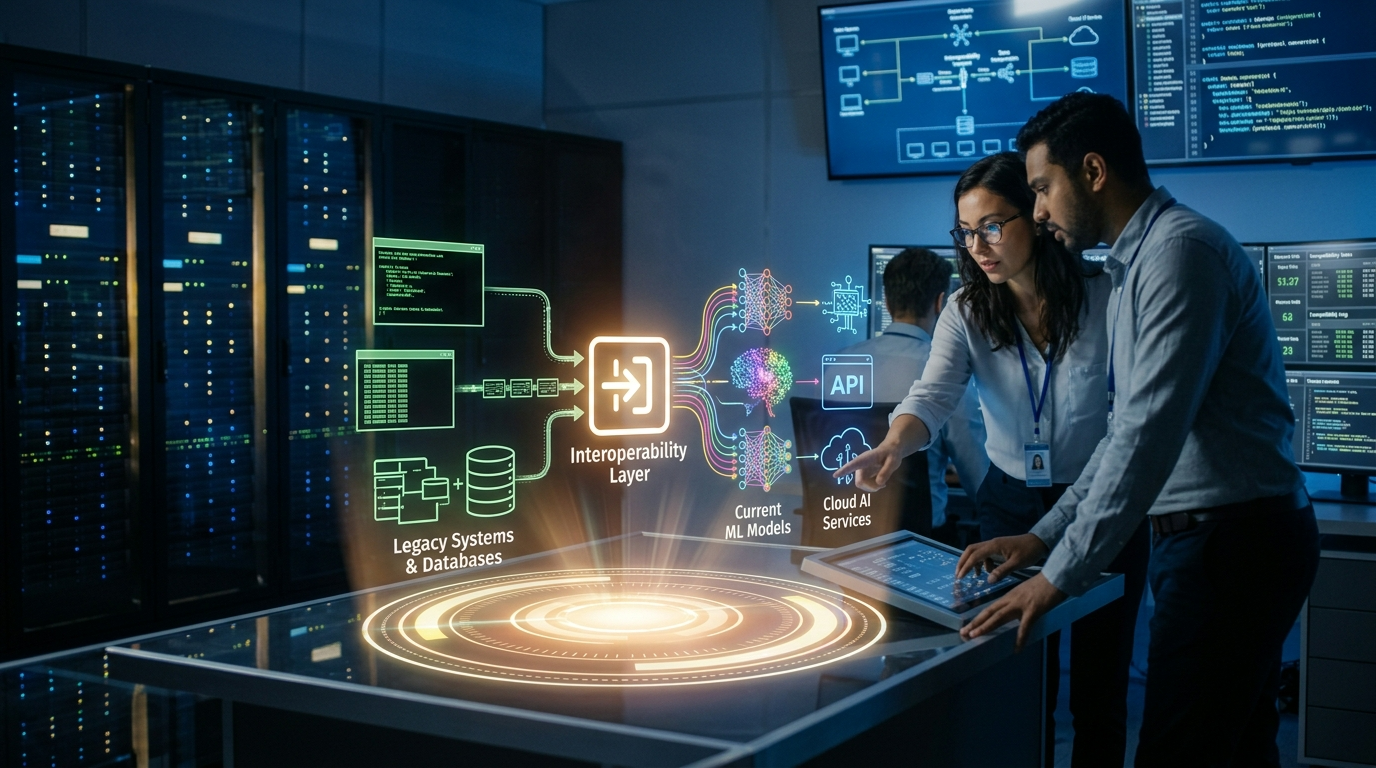
Because these systems lack modern APIs, connecting them with AI platforms can be complicated. Engineers often need custom integration layers or middleware to enable communication.
Despite these difficulties, integration remains possible with the right architectural approach.
Data Compatibility Issues
Artificial intelligence systems require structured and accessible data.
However, legacy platforms often store information in outdated formats or isolated databases. Therefore, organizations must convert and standardize data before feeding it into AI models.
Effective data transformation pipelines support reliable legacy AI interoperability.
Security and Compliance Concerns
Integrating older systems with modern AI infrastructure can introduce security risks.
Legacy platforms may lack advanced security features required for modern data protection standards.
As a result, companies must implement security gateways, encryption methods, and compliance controls.
These safeguards protect sensitive information during integration processes.
Performance Limitations
Older systems were not designed for large-scale analytics workloads.
AI applications often require high processing power and fast data access. Therefore, integration strategies must ensure legacy platforms can support increased data demands.
Careful system architecture helps maintain performance while enabling advanced analytics.
Strategies for Achieving Seamless Integration
Organizations can overcome integration challenges by adopting proven strategies. These approaches help companies implement successful legacy AI interoperability initiatives.
Use Middleware Integration Layers
Middleware acts as a bridge between older systems and modern applications.
This software layer enables communication between different platforms without altering legacy infrastructure.
For example, middleware can translate data formats, manage system requests, and handle application interactions.
By introducing integration layers, organizations simplify legacy AI interoperability while protecting existing systems.
Implement API Gateways
Application programming interfaces allow software systems to communicate effectively.
Although many legacy platforms lack native APIs, organizations can build custom API gateways.
These gateways expose legacy data to AI applications while maintaining system security.
Consequently, businesses enable AI-driven analytics without modifying core legacy software.
Adopt Data Transformation Pipelines
Data transformation plays a crucial role in integration projects.
Organizations must clean, standardize, and structure data before AI systems can use it effectively.
Modern data pipelines automate these tasks using extraction, transformation, and loading processes.
These pipelines ensure reliable data flow for legacy AI interoperability.
Leverage Cloud-Based Integration Platforms
Cloud platforms offer powerful tools for connecting legacy systems with modern AI technologies.
These environments provide scalable computing resources, integration frameworks, and data processing tools.
By migrating integration layers to the cloud, organizations improve flexibility and scalability.
Cloud-based infrastructure also simplifies legacy AI interoperability by centralizing integration processes.
Technologies Supporting Legacy AI Integration
Several technologies enable organizations to connect legacy systems with modern AI tools effectively.
These technologies support scalable and efficient legacy AI interoperability strategies.
Enterprise Service Buses
Enterprise service buses allow multiple systems to communicate through a centralized integration platform.
They manage message routing, protocol translation, and system communication.
Because enterprise service buses standardize interactions between applications, they simplify integration workflows.
Data Virtualization Platforms
Data virtualization tools allow AI models to access legacy data without moving it physically.
Instead of copying data into new systems, virtualization platforms create a unified data layer.
This approach improves efficiency and supports real-time analytics.
Artificial Intelligence APIs
AI service providers offer APIs that allow businesses to access machine learning capabilities.
Companies can integrate these APIs with legacy platforms through middleware or custom connectors.
As a result, organizations enhance legacy AI interoperability without building AI systems from scratch.
Containerization and Microservices
Modern software architectures use containers and microservices to isolate applications.
These technologies allow developers to build flexible integration services around legacy systems.
Because microservices operate independently, they improve scalability and system reliability.
Benefits of Integrating Legacy Systems with AI
Organizations that implement legacy AI interoperability unlock significant strategic advantages.
These benefits support digital transformation while protecting existing infrastructure investments.
Enhanced Data Utilization
Legacy systems contain vast amounts of historical information.
By connecting these systems with AI models, businesses can extract valuable insights.
Predictive analytics, customer behavior analysis, and operational forecasting all become possible.
Improved Operational Efficiency
AI-powered automation helps organizations streamline repetitive processes.
For example, machine learning models can analyze operational data and recommend workflow improvements.
Consequently, companies reduce inefficiencies and improve productivity.
Accelerated Innovation
Integration enables businesses to experiment with AI-driven solutions without replacing legacy systems.
Teams can test new technologies while maintaining stable operations.
This flexibility encourages innovation across departments.
Reduced Modernization Costs
Replacing entire infrastructures requires substantial investment.
Instead, legacy AI interoperability allows organizations to modernize gradually.
Companies maintain existing systems while integrating advanced technologies.
This approach reduces financial risk during digital transformation.
Future Trends in Legacy System Integration
Technology continues to evolve rapidly, and integration strategies are becoming more advanced.
In the coming years, legacy AI interoperability will likely benefit from several emerging trends.
One important trend involves low-code and no-code integration tools.
These platforms allow developers and business teams to connect systems without extensive programming knowledge.
Another development includes AI-driven integration platforms.
These tools automatically detect data structures and suggest integration workflows.
As a result, organizations can accelerate integration projects significantly.
Edge computing is also gaining attention.
Instead of sending all data to centralized servers, companies process data closer to its source.
This approach reduces latency and improves performance for AI applications.
Additionally, hybrid cloud environments are becoming increasingly common.
Businesses combine on-premise systems with cloud-based AI services to achieve flexible architectures.
These innovations will make integration easier and more accessible for organizations of all sizes.
Conclusion
Modern organizations must balance innovation with operational stability. While artificial intelligence offers powerful capabilities, many companies still rely on legacy infrastructure.
Fortunately, legacy AI interoperability allows businesses to connect older systems with modern AI technologies.
Through middleware, APIs, and data pipelines, organizations can bridge the gap between traditional platforms and advanced analytics tools.
This integration strategy unlocks valuable data insights while preserving existing infrastructure investments.
Furthermore, companies gain the flexibility to innovate without disrupting critical operations.
As integration technologies continue to improve, businesses will find even more opportunities to combine legacy systems with artificial intelligence.
Organizations that embrace these strategies today will be better prepared for the future of digital transformation.
FAQ
1. What does interoperability between legacy systems and AI mean?
It refers to the ability of older software platforms to communicate and share data with modern artificial intelligence systems.
2. Why do companies keep using legacy platforms?
Many legacy systems support critical business operations and store valuable historical data. Replacing them entirely can be expensive and risky.
3. How can organizations connect older systems with AI models?
Businesses often use middleware, APIs, and data transformation pipelines to enable communication between legacy platforms and modern AI tools.
4. Are legacy platforms compatible with cloud-based AI services?
Yes. Integration layers and APIs allow companies to connect on-premise legacy systems with cloud-based AI platforms.
5. What industries benefit most from AI integration with legacy systems?
Industries such as finance, healthcare, manufacturing, and logistics often rely on legacy infrastructure and benefit greatly from AI-driven modernization.