
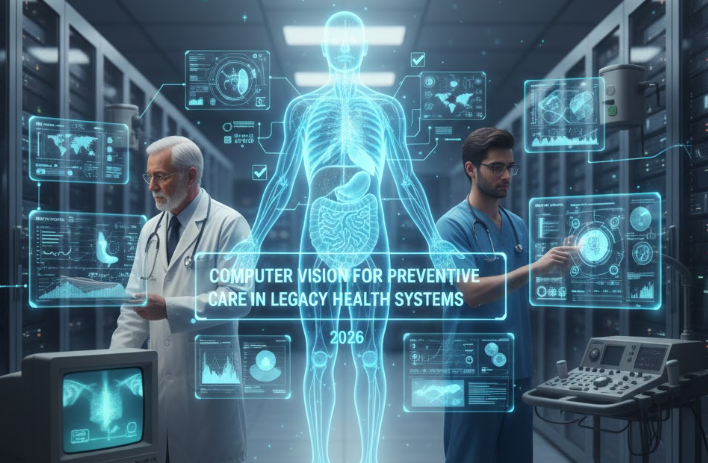
Healthcare has long followed a familiar rhythm. A patient feels unwell. A visit happens. Tests are ordered. Treatment begins. That approach saved countless lives. Still, it struggles under modern pressure. Aging populations, staff shortages, and rising costs stretch legacy health systems thin.
Visual artificial intelligence offers a new layer of awareness. Instead of waiting for problems to surface, health systems can now observe subtle signals earlier. Cameras, imaging tools, and intelligent models work together to identify risk before harm occurs.
This shift does not replace existing infrastructure. Instead, it enhances what already exists. Like giving seasoned clinicians a second set of eyes, visual AI strengthens preventive care quietly and continuously.
Why Preventive Care Is Hard in Legacy Health Systems
Most legacy health systems were built to respond, not predict. Workflows revolve around appointments, diagnostics, and interventions after symptoms appear.
Preventive programs exist, yet they rely heavily on time, staffing, and patient participation. As a result, early warning signs often go unnoticed. Subtle movement changes, posture decline, or environmental hazards escape brief clinical encounters.
Manual review adds another challenge. Clinicians analyze charts and images under intense pressure. Fatigue increases risk. Small visual cues slip through cracks.
AI-powered visual analysis helps close those gaps by monitoring consistently without exhaustion.
How Visual AI Supports Preventive Healthcare
Visual AI systems analyze images and video to identify health-related patterns. These tools review medical scans, patient movement, facial expressions, and environmental conditions.
Instead of replacing clinicians, they assist them. Alerts highlight anomalies. Trends surface early. Decisions remain human.
This approach shifts preventive care forward on the timeline. Earlier insight leads to earlier action.
Why Visual AI Works Well in Legacy Environments
Healthcare rarely starts fresh. Hospitals depend on aging infrastructure, familiar workflows, and established systems.
Visual AI integrates without forcing full replacement. Existing cameras, imaging devices, and monitoring systems remain in place. Intelligence layers on top.
Insights feed into dashboards clinicians already use. Adoption feels evolutionary rather than disruptive.
This compatibility makes modernization achievable for legacy systems.
Early Risk Detection Through Visual Intelligence
Early detection changes outcomes.
Visual systems identify gradual changes that humans may miss. A slight shuffle in gait may signal fall risk. Changes in skin tone may reflect circulation issues. Facial asymmetry can indicate neurological concern.
Because these systems observe continuously, trends emerge clearly. Clinicians intervene sooner. Care becomes gentler. Recovery improves.
Reducing Fall Risk in Clinical Settings
Falls represent a major safety concern, especially in hospitals and elder care facilities.
Visual monitoring tracks posture, balance, and movement patterns. When instability increases, alerts notify staff.
Preventive steps follow. Adjustments happen before accidents occur.
This proactive approach reduces injuries, length of stay, and associated costs.
Supporting Chronic Condition Management
Chronic conditions demand consistent observation.
Visual analysis helps track movement speed, tremors, breathing patterns, and fatigue indicators. Subtle decline appears earlier than patient reports.
Instead of relying solely on self-reporting, clinicians gain objective insight.
Care becomes proactive rather than reactive.
Enhancing Medical Imaging Interpretation
Radiology already depends on visual data. AI strengthens interpretation.
Models analyze X-rays, MRIs, and CT scans to flag anomalies. Radiologists review highlighted areas rather than scanning everything manually.
This reduces oversight risk and accelerates diagnosis.
Legacy imaging workflows benefit without disruption.
Shortening Diagnostic Delays
Delays cost lives.
Visual triage tools prioritize cases based on risk indicators. Emergency departments benefit greatly.
Critical cases surface faster. Clinicians respond sooner.
Efficiency improves without increasing staff burden.
Environmental Safety and Visual Monitoring
Patient outcomes depend on surroundings.
Visual monitoring identifies spills, obstructions, overcrowding, and unsafe conditions. Alerts prompt timely response.
Older facilities gain smarter oversight without renovation.
Safety improves quietly in the background.
Protecting Patient Dignity and Privacy
Ethical design matters.
Many systems analyze silhouettes or abstracted movement rather than identifiable imagery. Data anonymization reduces exposure.
Preventive insight does not require intrusive surveillance.
When designed responsibly, visual AI respects dignity.
Reducing Staff Burnout Through Supportive Technology
Healthcare workers face constant pressure.
Visual monitoring reduces cognitive load. AI watches continuously so humans do not have to.
Alerts replace constant vigilance. Patterns replace guesswork.
Staff feel supported, not replaced.
Morale improves.
Integration With Electronic Health Records
Legacy health systems rely on EHR platforms.
Visual insights integrate directly into existing records. Alerts appear alongside vitals and lab results.
Clinicians see a unified picture instead of fragmented data.
Integration drives trust and adoption.
Overcoming Adoption Resistance
Change invites skepticism.
Clear communication matters. Demonstrating small wins builds confidence.
When teams see fewer incidents and smoother workflows, resistance fades.
Results speak louder than promises.
Data Quality Improvements Over Time
AI depends on data.
Legacy records vary in quality. Visual data captures real-world behavior directly.
As systems learn, accuracy improves. Better insight produces better care.
A positive cycle forms.
Ethical Oversight and Governance
Responsible deployment requires oversight.
Transparency builds trust. Patients deserve clarity.
Bias mitigation remains essential. Diverse data improves fairness.
Governance ensures accountability.
Ethics anchor innovation.
Financial Impact of Preventive Visual AI
Budgets matter.
Preventing incidents costs less than treating them. Reduced falls, fewer readmissions, and shorter stays add up.
Investment pays off gradually but reliably.
Legacy systems benefit without massive overhaul.
Scaling Across Health Networks
Large networks struggle with consistency.
Visual systems scale across locations easily. Standardized monitoring improves equity.
Patients receive similar preventive attention regardless of facility age.
Impact multiplies.
Training Models for Real-World Settings
Legacy environments vary widely.
Models train on diverse lighting, layouts, and equipment. Continuous learning refines accuracy.
Adaptability defines success.
Real-Time Alerts Enable Fast Action
Timing saves lives.
Instant alerts trigger immediate response. Small actions prevent large events.
Prevention becomes active.
Remote Monitoring and Patient Engagement
Between visits, patients often disengage.
Home-based visual monitoring supports early detection safely.
Patients feel supported without constant appointments.
Engagement improves outcomes.
Regulatory Alignment and Compliance
Healthcare regulation evolves constantly.
Secure design, audit trails, and transparency support compliance.
Modern standards become achievable for older systems.
Looking Ahead
Visual AI will grow more perceptive.
Detection will move earlier. Integration will deepen.
Legacy systems will feel modern without losing experience.
Conclusion
Visual intelligence transforms legacy health systems from reactive responders into proactive protectors. By adding continuous observation to existing infrastructure, healthcare organizations detect risk earlier, act faster, and care better.
The future of healthcare does not discard the past. It strengthens it. Visual AI ensures experience meets foresight, creating safer environments for patients and providers alike.
FAQ
1. What role does visual AI play in preventive healthcare?
It identifies early risk signals through continuous observation before symptoms escalate.
2. Can older hospitals adopt this technology easily?
Yes. Most solutions integrate with existing cameras, imaging tools, and EHR systems.
3. Does visual AI replace clinical judgment?
No. It supports clinicians by highlighting patterns and risks.
4. How is patient privacy protected?
Through anonymization, secure processing, and ethical system design.
5. What outcomes improve most?
Fall prevention, earlier diagnosis, reduced costs, and improved patient safety.