
Healthcare workflows are under constant pressure. Patient volumes rise. Administrative demands grow. Clinicians juggle documentation, diagnostics, and decision-making in fast-moving environments. Every inefficiency compounds. Every delay matters. This is where computer vision medical workflow integration begins to make a meaningful difference.
Computer vision medical workflow solutions bring intelligence to visual data that already exists in hospitals. Cameras, imaging systems, and video feeds are everywhere. Yet most of that visual information remains underused. Computer vision changes that by turning images and motion into actionable insight.
Think of it as giving healthcare systems a second set of eyes that never blink. These systems observe quietly, interpret consistently, and support staff without adding cognitive load. As a result, workflows become smoother, safer, and more efficient.
Why workflow efficiency is critical in healthcare
Healthcare efficiency is not about rushing care. It is about removing unnecessary friction. When workflows stall, patients wait longer, staff experience burnout, and errors increase.
Manual steps still dominate many clinical processes. Forms are filled repeatedly. Equipment is searched for. Rooms wait to be turned over. These delays accumulate.
Computer vision medical workflow integration targets these pain points. By automating observation and interpretation, it reduces wasted motion and idle time. Clinicians spend less time chasing processes and more time delivering care.
Efficiency improves without sacrificing compassion.
Understanding computer vision in medical settings
Computer vision allows machines to interpret visual information such as images, video, and movement. In healthcare, that means understanding what is happening in real time across clinical spaces.
Systems detect presence, posture, motion, and object placement. They recognize workflows rather than individuals. Importantly, most implementations focus on patterns, not identity.
Computer vision medical workflow tools operate in the background. They do not interrupt clinicians. Instead, they provide insight when needed.
This subtlety is what makes integration successful.
Reducing administrative burden through visual automation
Administrative tasks consume significant clinician time. Documentation, tracking, and compliance checks add pressure.
Computer vision automates parts of this burden. For example, it records when procedures begin and end. It tracks equipment usage automatically. It verifies room occupancy without manual input.
As a result, documentation becomes more accurate and less intrusive. Staff spend fewer hours on screens.
Computer vision medical workflow efficiency grows by reclaiming time.
Optimizing patient flow with computer vision
Patient flow determines hospital performance. Bottlenecks increase wait times and reduce satisfaction.
Computer vision medical workflow systems monitor movement through departments. They detect delays in triage, imaging, and discharge.
Dashboards reveal congestion patterns. Staff intervene proactively.
Flow improves because problems are visible before they escalate.
Enhancing operating room efficiency
Operating rooms are among the most valuable hospital assets. Delays here are costly.
Computer vision tracks surgical phases automatically. It identifies idle time between cases. It monitors equipment readiness.
Turnover becomes faster. Scheduling becomes more accurate.
Operating room efficiency improves without adding pressure to surgical teams.
Improving imaging workflow efficiency
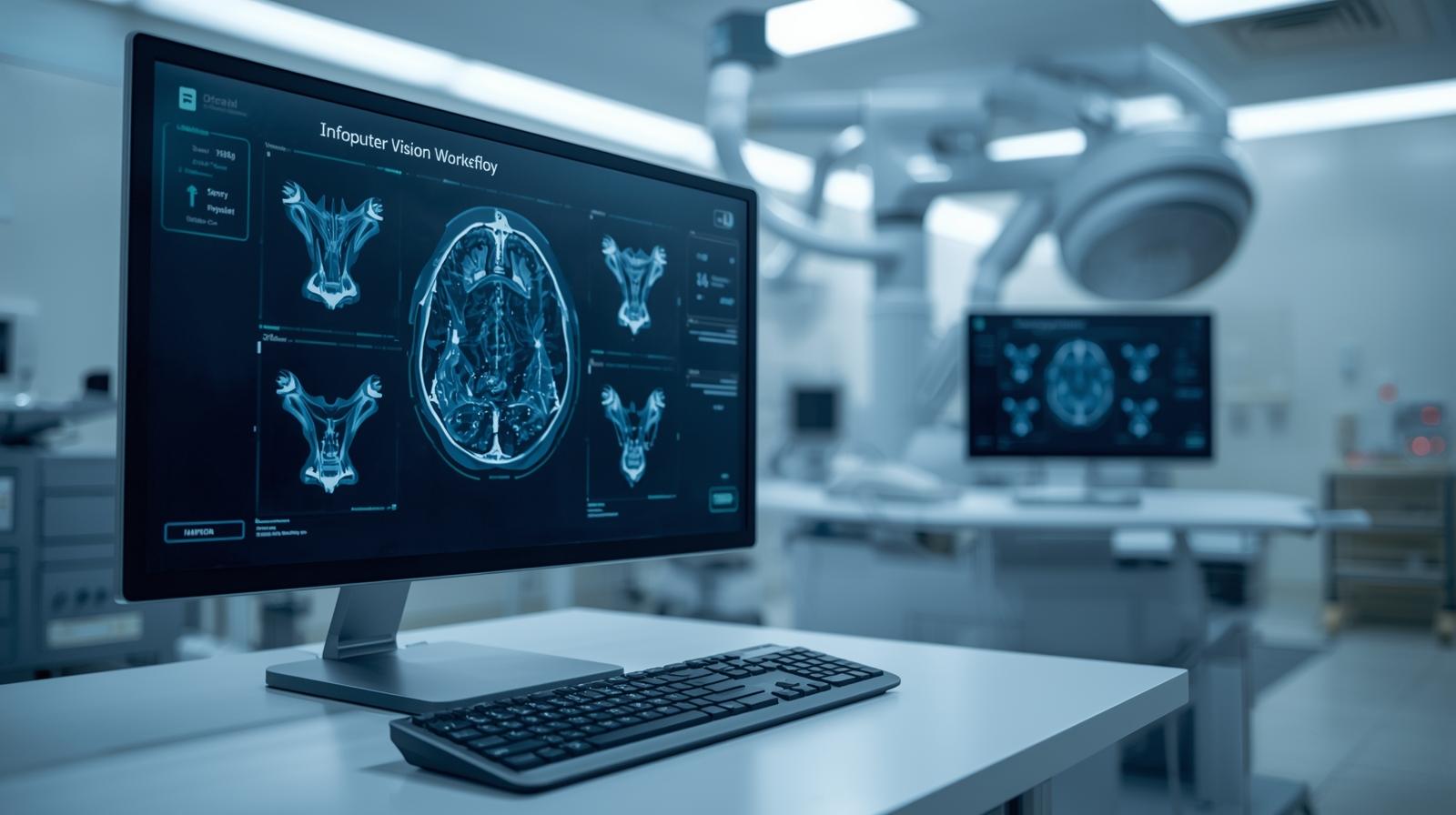
Medical imaging produces vast visual data. Radiology workflows often struggle with prioritization.
Computer vision flags urgent findings early. It detects anomalies that require immediate attention.
Worklists reorder dynamically. Critical cases move first.
Computer vision medical workflow integration ensures imaging resources are used effectively.
Streamlining emergency department operations
Emergency departments operate under constant uncertainty. Patient acuity varies rapidly.
Computer vision monitors waiting areas and treatment rooms. It detects overcrowding and prolonged waits.
Alerts prompt staffing adjustments. Resources shift dynamically.
Emergency care becomes responsive rather than reactive.
Supporting nursing workflows
Nurses coordinate care across patients and tasks. Interruptions are frequent.
Computer vision reduces unnecessary checks. It confirms patient presence. It detects bed exits and unusual inactivity.
Nurses respond based on priority rather than routine rounds.
Computer vision medical workflow efficiency supports both safety and workload balance.
Automating equipment tracking
Lost or misplaced equipment wastes time. Searching delays care.
Computer vision identifies equipment location visually. It tracks usage patterns.
Staff locate devices quickly. Inventory management improves.
Efficiency increases because tools are available when needed.
Reducing errors through visual confirmation
Errors often occur during transitions. Handovers, room changes, and equipment setup introduce risk.
Computer vision confirms correct setup visually. It verifies procedure readiness.
Mistakes are caught early. Confidence increases.
Computer vision medical workflow systems act as silent safety checks.
Enhancing infection control workflows
Infection control relies on consistent behavior. Monitoring compliance manually is difficult.
Computer vision detects hand hygiene events and room cleaning activity. It tracks compliance trends.
Feedback improves adherence. Outbreak risk decreases.
Efficiency aligns with safety.
Improving documentation accuracy
Documentation errors create downstream issues. Manual timestamps are often inaccurate.
Computer vision captures events automatically. Start and end times are precise.
Billing accuracy improves. Compliance strengthens.
Computer vision medical workflow integration reduces administrative rework.
Integrating computer vision with existing systems
Successful integration avoids disruption. New tools must fit existing workflows.
Computer vision platforms integrate with electronic health records and dashboards. Insights appear where clinicians already look.
Training remains minimal. Adoption accelerates.
Efficiency gains arrive quickly.
Balancing privacy and efficiency
Privacy concerns matter deeply in healthcare. Visual monitoring must be respectful.
Modern computer vision medical workflow systems avoid facial recognition. They analyze motion and context instead.
Data is anonymized. Access is controlled.
Efficiency improves without compromising dignity.
Reducing clinician burnout
Burnout threatens healthcare sustainability. Excess workload drains energy.
Computer vision removes small burdens that accumulate. Fewer interruptions. Less manual tracking.
Clinicians regain focus. Morale improves.
Efficiency supports wellbeing, not just output.
Data-driven workflow optimization
Computer vision generates workflow data continuously. Patterns emerge.
Hospitals identify inefficiencies objectively. Improvements are measured.
Decisions shift from anecdotal to evidence-based.
Computer vision medical workflow insights guide continuous improvement.
Improving training and skill development
Visual data supports learning. Trainees review workflows objectively.
Best practices are reinforced. Variability decreases.
Training becomes consistent and efficient.
Knowledge transfer strengthens across teams.
Supporting multidisciplinary coordination
Healthcare workflows span departments. Coordination challenges persist.
Computer vision provides shared visibility. Everyone sees the same flow.
Communication improves. Silos weaken.
Efficiency grows through alignment.
Adapting workflows in real time
Healthcare conditions change rapidly. Static plans fail.
Computer vision enables dynamic adjustment. Staffing adapts. Resources shift.
Real-time awareness supports resilience.
Computer vision medical workflow systems keep pace with reality.
Measuring efficiency without disruption
Traditional measurement requires audits and observations. These disrupt care.
Computer vision measures passively. Data collection is continuous.
Metrics improve without added workload.
Efficiency measurement becomes effortless.
Challenges in computer vision integration
Integration requires planning. Infrastructure must support video data. Change management matters.
However, phased deployment reduces risk. Pilots demonstrate value.
Most challenges are organizational, not technical.
Benefits outweigh initial effort.
Regulatory and compliance considerations
Healthcare regulation demands transparency. Automation must align with standards.
Computer vision systems provide audit trails. Events are documented automatically.
Compliance improves through consistency.
Regulatory confidence strengthens.
Economic impact of workflow efficiency
Efficiency reduces costs. Shorter stays. Better asset utilization.
Revenue improves through accurate documentation.
Computer vision medical workflow integration delivers measurable financial value.
Sustainability improves.
Global adoption and scalability
Healthcare systems vary globally. Workflow challenges remain universal.
Computer vision adapts across contexts. Software scales easily.
Efficiency improvements reach diverse settings.
Global care quality benefits.
Future of computer vision in healthcare workflows
Computer vision capabilities will expand. Predictive workflows will emerge.
Systems will anticipate needs before delays occur.
Healthcare will become more proactive.
Computer vision medical workflow efficiency will continue evolving.
Conclusion
Computer vision medical workflow integration transforms healthcare efficiency by turning visual data into meaningful insight. It removes friction quietly, supports clinicians thoughtfully, and improves patient experience without disruption.
By enhancing workflows rather than replacing people, computer vision becomes a trusted ally. Efficiency grows through awareness, not pressure.
In a healthcare system stretched thin, smarter workflows are not a luxury. They are essential. Computer vision offers a clear path forward.
FAQ
1. What is computer vision medical workflow integration?
It is the use of computer vision to observe and optimize clinical workflows using visual data.
2. How does computer vision improve healthcare efficiency?
It reduces manual tasks, identifies bottlenecks, and supports real-time decision-making.
3. Does computer vision replace clinicians?
No, it supports clinicians by removing inefficiencies and providing insight.
4. Is patient privacy protected with computer vision systems?
Yes, responsible systems focus on patterns, not identity, and use anonymized data.
5. Where is computer vision most effective in healthcare workflows?
It is highly effective in operating rooms, emergency departments, imaging, and patient flow management.