

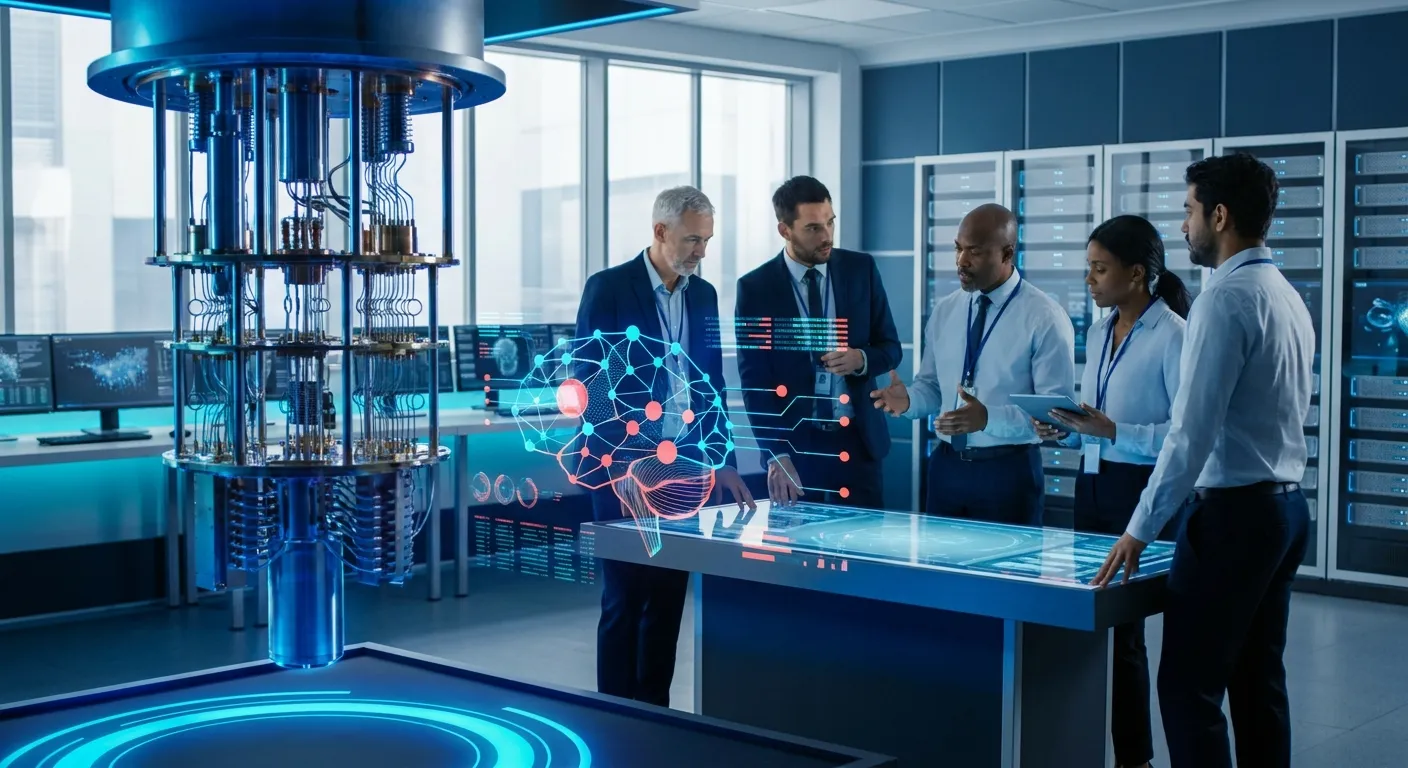
Quantum AI Computing represents a fascinating convergence of two of the most transformative technologies of our era: quantum computing and artificial intelligence. This field explores how quantum principles, such as superposition and entanglement, can enhance AI algorithms, potentially solving complex problems far beyond the capabilities of classical computers. As AI models grow in complexity and data demands skyrocket, moreover, quantum computing offers a glimpse into a future where processing power is no longer a bottleneck.
The Convergence of Quantum Mechanics and Artificial Intelligence
The integration of quantum mechanics with artificial intelligence marks a significant advancement in computational science. Traditionally, AI systems rely on classical bits, representing information as either 0 or 1. Quantum computing, conversely, uses quantum bits, or qubits, which can exist in multiple states simultaneously due to superposition. Consequently, this fundamental difference allows quantum systems to process information in fundamentally new ways. Entanglement, another quantum phenomenon, links qubits together, meaning the state of one instantly affects the others, regardless of distance. This interconnectedness provides an exponential increase in computational power, which is invaluable for complex AI tasks.
Consider the potential impact on machine learning. Many machine learning algorithms involve optimizing complex functions over vast datasets. Quantum machine learning algorithms, or QML, could accelerate these optimization processes significantly. For example, in pattern recognition, quantum algorithms might identify subtle correlations in data that classical methods would miss. Therefore, the ability to explore a much larger solution space simultaneously could lead to more robust and accurate AI models. Researchers are actively developing quantum algorithms tailored for various AI applications, including classification, regression, and clustering. This ongoing research demonstrates the profound implications for future AI development.
Unlocking New Computational Paradigms with Quantum AI Computing
Traditional AI, particularly deep learning, relies heavily on classical hardware. However, this hardware faces inherent physical limitations. Quantum AI Computing promises to overcome these by leveraging quantum phenomena. Imagine algorithms that can process vast datasets exponentially faster. Alternatively, consider optimizing solutions to intractable problems in areas like drug discovery, material science, and financial modeling. Early research already demonstrates the potential for quantum algorithms to accelerate machine learning tasks like pattern recognition and optimization. This paves the way for more sophisticated and efficient AI systems.
Furthermore, the ability of quantum systems to handle high-dimensional spaces naturally aligns with the demands of modern AI. Many AI problems involve analyzing data with numerous features. Classical computers struggle with the exponential growth in complexity as the number of features increases. Quantum computers, by contrast, can represent and manipulate these high-dimensional spaces more efficiently. This capability is particularly relevant for tasks such as natural language processing and computer vision, where understanding complex relationships within data is paramount. As a result, new breakthroughs in these fields could emerge.
Applications Across Industries: A Transformative Outlook
The impact of quantum machine intelligence extends far beyond theoretical computer science. Diverse industries stand to benefit immensely. In pharmaceuticals, for instance, drug discovery could be revolutionized. Quantum simulations might accurately model molecular interactions, speeding up the identification of new drug candidates. This would drastically reduce the time and cost associated with bringing new medicines to market. Consequently, patients could gain access to life-saving treatments much faster.
Financial services also represent a key area for innovation. Complex financial models, risk assessment, and fraud detection could see dramatic improvements. Quantum algorithms might optimize investment portfolios more effectively. They could also detect anomalies in transactions with greater precision. This would lead to more secure and profitable financial systems. Furthermore, in logistics and supply chain management, optimizing routes and resource allocation is a constant challenge. Quantum optimization algorithms could find the most efficient solutions, leading to significant cost savings and improved operational efficiency. The potential for disruption across these sectors is immense.
The Role of Quantum Neural Networks in Advanced AI
A particularly exciting area within quantum-enhanced AI is the development of quantum neural networks (QNNs). These networks aim to harness quantum principles to build more powerful and efficient artificial neural networks. Unlike classical neural networks that use classical neurons, QNNs utilize qubits and quantum gates to perform computations. This allows them to explore complex relationships in data that are inaccessible to classical counterparts. For example, QNNs might be particularly adept at learning from quantum data, which is becoming increasingly relevant in fields like quantum chemistry and materials science.
Researchers are exploring various architectures for QNNs, some inspired by classical deep learning models, others entirely new. The goal is to develop networks that can perform tasks like pattern recognition, classification, and generation with unprecedented speed and accuracy. While still in early development, the promise of QNNs suggests a future where AI systems possess enhanced learning capabilities and can tackle problems currently considered intractable. This could lead to a new generation of intelligent systems.
Challenges and the Road Ahead for Quantum AI Computing
Despite its immense promise, Quantum AI Computing is still in its nascent stages. Significant challenges remain in building stable, scalable quantum hardware. Developing robust quantum algorithms that can effectively run on these machines is also crucial. The current ‘noisy intermediate-scale quantum’ (NISQ) devices offer a testing ground, but practical, fault-tolerant quantum computers are still years away. Furthermore, educating a workforce skilled in both quantum mechanics and AI will be crucial for accelerating progress. However, the potential rewards—revolutionary breakthroughs in science, technology, and industry—make this a frontier well worth exploring.
One major hurdle involves error correction. Qubits are inherently fragile and susceptible to environmental noise, leading to errors in computation. Developing effective quantum error correction codes is essential for building reliable quantum computers. This research is highly complex and requires significant scientific and engineering effort. Moreover, the interfaces between classical and quantum computing systems need to be refined. Hybrid quantum-classical algorithms, which offload computationally intensive parts to quantum processors while keeping other parts on classical machines, are a promising interim solution. This approach helps to maximize the utility of current quantum hardware.
The Future Landscape of Quantum and AI Synergy
The integration of quantum computing with AI is not merely an incremental step; it’s a leap towards a new computational paradigm. While the journey is long, the vision of what Quantum AI Computing can achieve fuels intense research and investment. This promises a future where today’s impossibilities become tomorrow’s standard. We are on the cusp of a technological revolution. This synergy will redefine what is possible in scientific discovery and technological innovation. Organizations like Quantum Journal provide valuable insights into ongoing research in this rapidly evolving field.
As quantum hardware matures and algorithms become more sophisticated, the distinction between classical and quantum AI might blur. Future AI systems could seamlessly integrate both paradigms, leveraging the strengths of each for specific tasks. This hybrid approach could unlock unprecedented levels of intelligence and problem-solving capabilities. Therefore, continuous investment in research and development, alongside fostering a skilled workforce, will be paramount. The global scientific community is working collaboratively to push these boundaries. For further reading on the broader implications of AI, resources like IBM Research AI offer compelling perspectives.
Ultimately, the long-term goal is to build universal fault-tolerant quantum computers capable of running any quantum algorithm. This will enable the full realization of the potential of Quantum AI Computing. The journey requires sustained effort, but the transformative power it holds for humanity makes it an endeavor of immense importance. The next few decades will undoubtedly be a period of profound discovery and innovation in this exciting domain. Consequently, the world watches with anticipation.
Conclusion
Quantum AI Computing stands as a testament to human ingenuity, pushing the boundaries of what computers can achieve. This fascinating field promises to redefine problem-solving across numerous sectors, from medicine to finance. While significant challenges remain, the steady progress in quantum hardware and algorithm development paints a hopeful picture. The synergy between quantum mechanics and artificial intelligence will undoubtedly shape the future of technology, creating a new era of computational power and intelligent systems. Therefore, staying informed about these developments is crucial for anyone interested in the forefront of innovation.
FAQ
What is the core concept behind quantum-enhanced AI?
The core concept involves utilizing quantum mechanical principles, such as superposition and entanglement, to enhance artificial intelligence algorithms. This approach aims to create more powerful and efficient AI systems capable of solving problems beyond classical computing limits.
How will quantum machine learning impact industries?
Quantum machine learning is expected to transform industries by accelerating complex tasks. This includes drug discovery, financial modeling, and logistics optimization. It could lead to faster innovation, more accurate predictions, and improved efficiency across various sectors.
What are the primary challenges in developing quantum-powered AI?
Key challenges include building stable and scalable quantum hardware, developing robust quantum algorithms, and overcoming qubit fragility and error correction issues. Additionally, fostering a workforce skilled in both quantum mechanics and AI is essential.
Is this technology available for widespread use now?
No, quantum-powered AI is currently in its early research and development stages. While ‘noisy intermediate-scale quantum’ devices exist for testing, practical, fault-tolerant quantum computers and widespread applications are still years away.
What is a quantum neural network?
A quantum neural network (QNN) is an artificial neural network that uses qubits and quantum gates for computations. It aims to leverage quantum principles to build more powerful and efficient learning models, potentially excelling at tasks involving complex data relationships.
Explore more: More from TechZone AI
Leave feedback about this