

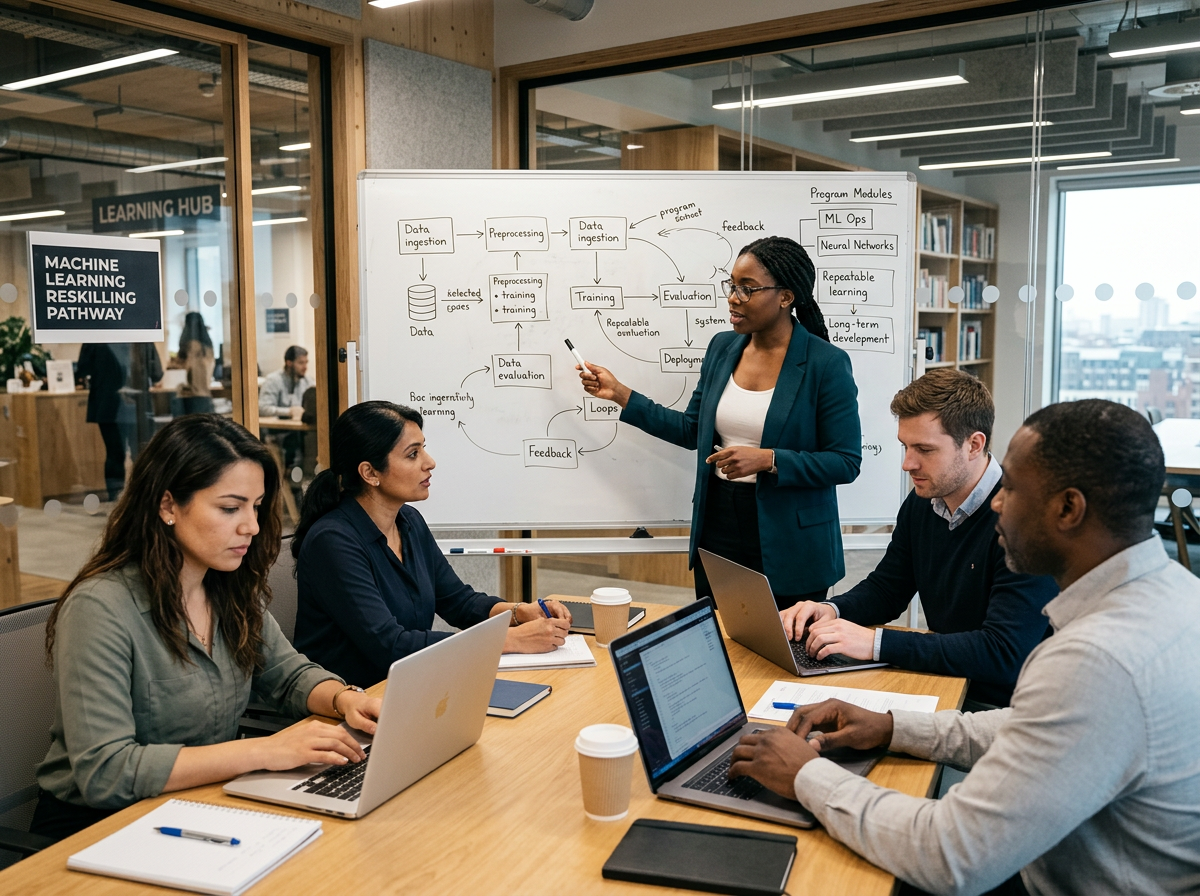
Artificial intelligence and machine learning continue transforming how businesses operate across nearly every industry. Organizations now rely on automation, predictive analytics, intelligent software, and data-driven systems to improve efficiency and remain competitive. Because of these rapid changes, workforce development has become one of the most important priorities for modern businesses. As a result, sustainable ML reskilling strategies are now essential for preparing employees for long-term success in AI-driven workplaces.
Many organizations initially focused only on adopting new technologies. However, businesses soon realized that technology alone could not guarantee operational success. Employees also need the skills required to manage, monitor, and improve intelligent systems effectively. Consequently, workforce reskilling has evolved from a temporary training initiative into a long-term business strategy.
Sustainable ML reskilling helps employees adapt to changing job requirements while supporting organizational growth and innovation. These training models focus on continuous learning instead of one-time technical instruction. Businesses that invest in long-term workforce development often improve productivity, employee retention, and operational flexibility.
Rapid technological advancement also creates ongoing challenges for employers and workers alike. Machine learning tools, automation systems, and AI platforms evolve constantly. Therefore, organizations need training frameworks that can adapt continuously to emerging technologies and workforce demands.
Companies that prioritize workforce development usually respond more effectively to industry changes. Skilled employees can manage new technologies with greater confidence while contributing more actively to digital transformation efforts. This adaptability strengthens long-term competitiveness and operational resilience across industries.
Why Long-Term Reskilling Matters
Technology continues changing faster than traditional workforce development models can often support. Many businesses still rely on outdated training strategies that focus only on immediate operational needs. Unfortunately, these short-term approaches rarely prepare employees for continuous technological evolution.
Sustainable ML reskilling addresses this problem by emphasizing adaptability and lifelong learning. Employees develop foundational technical knowledge that helps them transition more easily between evolving tools, workflows, and operational systems. Consequently, organizations reduce skill gaps while improving workforce flexibility.
Labor market demands also continue shifting rapidly. Jobs that once required only manual or administrative skills now involve data analysis, automation oversight, and digital collaboration. Workers who lack modern technical capabilities may struggle to remain competitive in changing employment environments.
Organizations benefit significantly from continuous learning cultures as well. Employees who regularly update their skills often become more innovative, adaptable, and confident during operational changes. These qualities improve collaboration and support stronger long-term business performance.
Employee retention additionally improves through workforce development initiatives. Many professionals prefer working for organizations that invest in career growth and future-ready skills. Businesses that prioritize training therefore often reduce turnover while strengthening internal expertise.
Long-term reskilling also supports economic resilience. Companies with adaptable workforces can respond more effectively to technological disruption, industry shifts, and operational challenges without depending entirely on external hiring.
The Connection Between AI Growth and Workforce Change
Artificial intelligence now influences industries ranging from healthcare and manufacturing to finance, logistics, education, and retail. Machine learning systems help businesses automate repetitive tasks, analyze operational data, improve forecasting, and optimize workflows. Consequently, workforce responsibilities continue evolving alongside these technologies.
Sustainable ML reskilling helps employees understand how automation changes operational environments. Workers no longer simply complete isolated tasks. Instead, many employees now interact directly with intelligent systems that support decision-making and workflow management.
Machine learning technologies often eliminate repetitive manual processes while increasing demand for analytical thinking, digital literacy, and operational oversight. Therefore, businesses must help employees transition toward higher-value responsibilities that require human judgment and adaptability.
Cross-functional collaboration has also become more important in AI-supported workplaces. Technical teams, operations managers, data analysts, and business leaders increasingly work together within integrated digital environments. Workforce development programs should therefore encourage both technical and communication skills.
Emerging technologies continue creating entirely new career paths as well. AI ethics specialists, machine learning operations managers, automation analysts, and intelligent systems coordinators now play important roles across industries. Employees need access to continuous education opportunities that support these evolving career possibilities.
Businesses that ignore workforce development may struggle with adoption challenges, productivity declines, and talent shortages. In contrast, organizations that invest in long-term learning models often achieve smoother digital transformation outcomes.
Building Effective Reskilling Frameworks
Successful workforce development requires more than occasional workshops or isolated training sessions. Sustainable ML reskilling depends on structured learning frameworks that support continuous improvement and long-term adaptability.
Organizations should begin by evaluating current workforce capabilities carefully. Skill assessments help businesses identify technical gaps, operational challenges, and future workforce requirements. This analysis allows companies to design more targeted and effective learning programs.
Flexible learning pathways also improve participation and long-term success. Employees often balance training alongside daily responsibilities, so organizations should provide accessible options such as online courses, workshops, mentoring programs, and self-paced learning platforms.
Hands-on learning experiences remain especially valuable. Workers retain information more effectively when they interact directly with machine learning tools, datasets, and operational simulations. Practical projects help employees build confidence while improving real-world problem-solving abilities.
Businesses should additionally align training with operational goals. Employees become more engaged when they understand how learning supports daily responsibilities and long-term career development. Clear relevance strengthens motivation and participation throughout workforce development initiatives.
Leadership support further improves reskilling outcomes. Executives who actively promote learning cultures encourage stronger workforce engagement while reinforcing organizational commitment to employee growth.
Continuous evaluation also remains essential. Organizations should regularly review learning outcomes, workforce performance, and technological changes to ensure training programs remain effective and relevant.
The Importance of Continuous Learning Cultures
Technology evolves continuously, which means workforce education cannot remain static. Businesses that treat training as a one-time requirement often struggle to maintain operational competitiveness over time. Therefore, organizations increasingly focus on creating cultures centered around continuous learning.
Sustainable ML reskilling becomes more effective when employees view education as an ongoing part of professional development rather than a temporary obligation. Continuous learning cultures encourage adaptability while reducing fear surrounding technological change.
Organizations should normalize skill development throughout daily operations. Learning opportunities can include collaborative problem-solving sessions, internal workshops, mentorship programs, and knowledge-sharing initiatives across departments.
Recognition programs also strengthen engagement. Employees often feel more motivated when organizations acknowledge learning achievements and career development progress. Positive reinforcement encourages continued participation and skill improvement.
Managers play an important role in fostering learning cultures as well. Supervisors who support training initiatives and encourage experimentation often create more adaptable and innovative teams. Employees become more comfortable exploring new technologies when leadership values curiosity and growth.
Cross-department collaboration further improves workforce learning. Employees gain broader operational understanding when they interact with technical teams, analytics specialists, and automation experts. This collaboration strengthens organizational flexibility and problem-solving capabilities.
Learning cultures additionally support long-term business resilience. Organizations with adaptable employees often recover more effectively from operational disruptions and technological shifts.
Challenges Facing Workforce Reskilling Programs
Despite growing investment in employee development, many organizations still face significant challenges during implementation. Sustainable ML reskilling requires long-term commitment, operational flexibility, and strategic planning to succeed effectively.
Time limitations remain one of the most common obstacles. Employees already manage demanding workloads, making it difficult to balance operational responsibilities with continuous education. Businesses must therefore create flexible learning schedules that support participation without overwhelming workers.
Skill diversity within organizations also complicates training efforts. Some employees may already possess technical experience, while others need foundational digital literacy education. Companies should therefore offer personalized learning pathways that address different skill levels and career goals.
Rapid technological change creates additional complexity. Machine learning frameworks, automation tools, and operational platforms evolve constantly. Consequently, organizations must update training materials regularly to maintain relevance.
Budget concerns may further limit workforce development efforts. Comprehensive training programs require investment in instructors, platforms, certifications, and operational support. However, businesses that ignore workforce development often face larger long-term costs related to turnover and skill shortages.
Employee resistance sometimes emerges during digital transformation initiatives as well. Workers may fear automation-related job changes or struggle with unfamiliar technologies. Transparent communication and supportive learning environments help reduce these concerns significantly.
Measuring success can also prove difficult. Organizations need clear performance metrics that evaluate learning outcomes, operational improvements, and workforce adaptability effectively.
How Businesses Benefit From Workforce Reskilling
Organizations gain several important advantages when they invest in long-term workforce development. Sustainable ML reskilling supports not only employee growth but also operational efficiency, innovation, and competitive performance.
Productivity often improves significantly after employees develop stronger technical capabilities. Workers who understand machine learning systems can manage workflows more efficiently while reducing operational errors and delays.
Innovation also increases within learning-focused organizations. Employees with updated skills often identify new opportunities for automation, process optimization, and data-driven decision-making. This creativity supports stronger business growth and adaptability.
Recruitment advantages additionally emerge through workforce development investments. Skilled professionals increasingly seek employers that prioritize continuous learning and career advancement opportunities. Companies with strong learning cultures therefore often attract higher-quality talent.
Operational flexibility improves as well. Businesses with adaptable employees can integrate new technologies more effectively while responding faster to industry changes and customer demands.
Customer experiences may strengthen through improved workforce capabilities too. Skilled employees can manage AI-powered systems more effectively, leading to better service quality, faster response times, and more accurate operational outcomes.
Long-term cost savings also support reskilling initiatives. Developing internal talent often proves more sustainable than relying entirely on external hiring for specialized technical roles.
Preparing Workforces for the Future
Artificial intelligence and machine learning technologies will continue expanding across industries during the coming years. Businesses must therefore prepare employees for evolving operational environments and future technological demands.
Sustainable ML reskilling helps organizations build adaptable workforces capable of managing continuous change. Employees who understand foundational AI concepts often transition more easily into emerging roles and operational systems.
Future-focused learning models should emphasize both technical and human-centered skills. Critical thinking, collaboration, communication, and ethical decision-making will remain valuable alongside automation and data analysis capabilities.
Ethics and responsible AI education will likely become increasingly important as well. Employees should understand fairness, privacy, cybersecurity, and accountability considerations related to machine learning technologies.
Partnerships between businesses, educational institutions, and governments may further strengthen workforce readiness. Collaborative initiatives often provide broader access to learning resources, certifications, and industry expertise.
Organizations that prioritize adaptability today will remain better positioned for future growth and technological evolution. Workforce development should therefore remain a continuous strategic priority rather than a temporary operational response.
Conclusion
Machine learning and artificial intelligence continue reshaping industries, operational workflows, and workforce expectations worldwide. Businesses that rely only on technology adoption without investing in employee development often struggle with long-term transformation success.
Sustainable ML reskilling helps organizations create adaptable, innovative, and future-ready workforces capable of managing evolving technologies confidently. Continuous learning models improve operational efficiency, employee engagement, and organizational resilience across industries.
Successful workforce development requires flexible learning frameworks, practical training opportunities, leadership support, and ongoing adaptation to technological change. Businesses that prioritize long-term education often achieve stronger operational outcomes and greater competitiveness.
As AI technologies continue advancing, workforce adaptability will remain one of the most valuable assets organizations can develop. Companies that invest in sustainable learning cultures today will remain better prepared for future opportunities, industry changes, and digital transformation challenges.
FAQ
1. Why Is Continuous Workforce Training Important for AI Industries?
Continuous learning helps employees adapt to rapidly changing technologies and evolving operational requirements.
2. What Skills Should Machine Learning Reskilling Programs Include?
Programs should include automation tools, data analysis, digital literacy, collaboration, and AI workflow management skills.
3. How Does Workforce Development Benefit Businesses Long Term?
Workforce development improves productivity, innovation, employee retention, and operational flexibility over time.
4. What Challenges Affect Employee Reskilling Initiatives?
Time constraints, funding limitations, skill diversity, and rapid technological change commonly affect training programs.
5. How Can Organizations Build Strong Learning Cultures?
Businesses can support learning through leadership involvement, flexible education programs, mentorship, and continuous skill development opportunities.





Leave feedback about this