

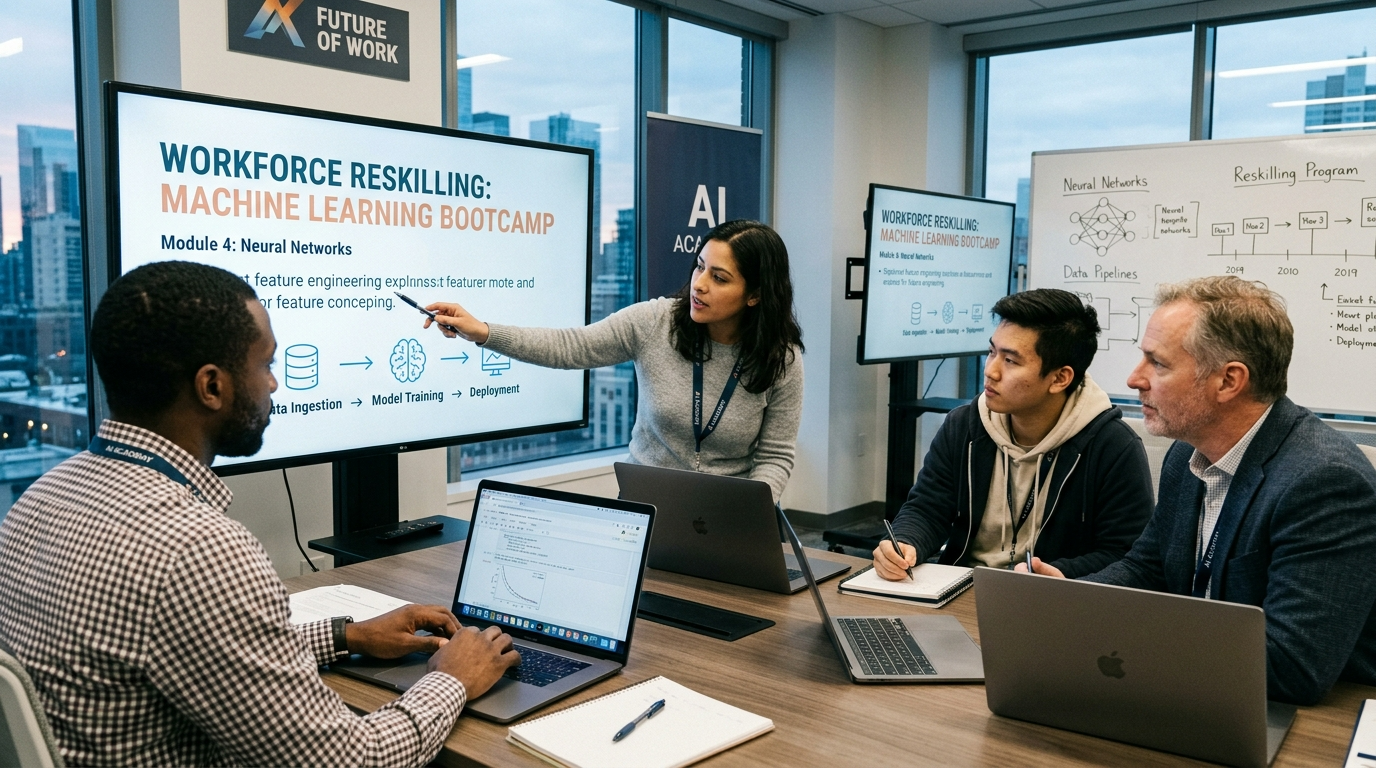
Artificial intelligence continues transforming modern organizations. Machine learning systems now influence decision-making, automation, analytics, and customer experiences across industries. However, adopting AI technologies requires more than infrastructure upgrades. Organizations must also develop skilled teams capable of designing, deploying, and maintaining machine learning systems. For this reason, workforce reskilling for ML has become a major priority for human resources leaders.
Companies that invest in employee development gain a significant advantage during digital transformation. Rather than hiring entirely new teams, many organizations choose to retrain existing employees. This approach preserves institutional knowledge while building modern technical capabilities.
Moreover, machine learning operations (MLOps) require collaboration between data scientists, engineers, and business teams.
As a result, effective workforce reskilling for ML programs prepare employees for new responsibilities across the entire AI lifecycle.
Through strategic learning initiatives, HR departments can help organizations build sustainable machine learning capabilities.
Why Organizations Need Workforce Reskilling for AI
Artificial intelligence adoption is accelerating rapidly. However, many organizations struggle to find professionals with machine learning expertise.
Talent shortages make it difficult to build fully new AI teams.
Therefore, workforce reskilling for ML offers a practical solution for bridging skill gaps.
Existing employees already understand company operations and business goals. With proper training, they can transition into technical roles that support machine learning initiatives.
Furthermore, machine learning systems require interdisciplinary collaboration.
Data scientists, engineers, analysts, and operations teams must work together to deploy AI models effectively.
Reskilling programs prepare employees to participate in these collaborative environments.
Additionally, organizations that invest in employee development improve workforce engagement.
Workers who receive new learning opportunities often feel more motivated and loyal.
Consequently, workforce reskilling for ML strengthens both innovation and employee retention.
Key Skills Required for ML and MLOps Roles
Human resources teams must identify the technical and operational skills needed to support workforce reskilling for ML programs.
Machine learning and MLOps require a diverse combination of capabilities.
Machine Learning Fundamentals
Employees must understand the basic concepts behind machine learning models.
Training programs often introduce topics such as supervised learning, model evaluation, and feature engineering.
These foundational concepts help employees understand how AI systems generate predictions.
A strong knowledge base supports successful workforce reskilling for ML initiatives.
Data Engineering and Data Management
Machine learning systems rely heavily on large datasets.
Employees must learn how to collect, clean, and organize data effectively.
Data management skills ensure that machine learning models receive accurate training inputs.
Model Deployment and MLOps Practices
Machine learning operations focus on deploying models into production environments.
Employees need skills related to monitoring, updating, and scaling AI models.
MLOps knowledge allows organizations to maintain reliable machine learning systems.
Collaboration and Communication
AI initiatives involve multiple departments working together.
Employees must learn how to communicate technical insights clearly.
Effective collaboration strengthens the success of workforce reskilling for ML programs.
The Role of HR in Machine Learning Transformation
Human resources departments play a central role in implementing workforce reskilling for ML strategies.
HR leaders coordinate training programs, evaluate skill gaps, and design career development pathways.
First, HR teams must assess existing workforce capabilities.
Skill assessments help identify employees who may benefit from machine learning training.
Next, HR departments collaborate with technical leaders to design learning programs.
These programs may include workshops, online courses, mentorship opportunities, and practical projects.
Additionally, HR leaders should align training initiatives with business goals.
Reskilling programs must support the organization’s broader AI strategy.
When HR teams actively support workforce reskilling for ML, companies accelerate their digital transformation efforts.
Designing Effective Reskilling Programs
Organizations must carefully design training initiatives to support workforce reskilling for ML successfully.
Effective programs combine structured learning with practical experience.
Develop Clear Learning Pathways
Employees should follow structured learning journeys that build technical knowledge gradually.
Learning pathways often begin with introductory courses and progress toward advanced topics.
Clear pathways help participants understand how their skills evolve over time.
Incorporate Hands-On Training
Practical experience helps employees apply theoretical knowledge.
Training programs should include real-world projects that simulate machine learning workflows.
Hands-on experience improves the effectiveness of workforce reskilling for ML initiatives.
Encourage Mentorship and Peer Learning
Mentorship programs allow experienced professionals to guide learners through technical challenges.
Peer collaboration also helps employees share knowledge and solve problems together.
Measure Training Outcomes
Organizations should evaluate the success of training programs through measurable outcomes.
Metrics such as skill assessments, project completion, and model deployment performance provide valuable insights.
Continuous evaluation ensures that reskilling programs remain effective.
Challenges in Workforce Reskilling Initiatives
Although workforce reskilling for ML provides significant benefits, organizations may face challenges during implementation.
One challenge involves time constraints.
Employees often balance training with existing responsibilities.
Organizations must provide flexible learning schedules to support skill development.
Another challenge involves technical complexity.
Machine learning concepts can be difficult for beginners to understand.
Training programs must break down complex topics into manageable lessons.
Additionally, leadership support remains essential.
Without strong executive backing, reskilling initiatives may struggle to receive adequate resources.
Despite these challenges, organizations that prioritize workforce reskilling for ML often achieve stronger long-term AI capabilities.
Benefits of Reskilling Employees for ML and MLOps
Organizations investing in workforce reskilling for ML gain several strategic advantages.
First, internal talent development reduces recruitment costs.
Hiring specialized AI professionals can be expensive.
Reskilling programs allow companies to build technical capabilities using existing employees.
Second, reskilling strengthens organizational agility.
Companies with trained teams can adopt new AI technologies more quickly.
Third, workforce development improves employee engagement.
Workers appreciate opportunities to learn valuable technical skills.
Finally, reskilling supports innovation.
Employees trained in machine learning contribute new ideas and insights.
These benefits demonstrate why workforce reskilling for ML plays an essential role in modern business strategies.
Future Trends in Workforce Reskilling
As artificial intelligence continues evolving, workforce reskilling for ML will remain a central priority for organizations.
Several emerging trends will shape future workforce development strategies.
One trend involves personalized learning platforms.
AI-driven training systems adapt course content to individual skill levels.
Another trend includes industry partnerships with universities and technical institutions.
These collaborations help organizations provide advanced training opportunities.
Additionally, companies increasingly use simulation-based learning environments.
Employees can practice deploying machine learning models in controlled environments.
These innovations strengthen the impact of workforce reskilling for ML programs.
Organizations that embrace modern training strategies will remain competitive in the AI-driven economy.
Conclusion
Artificial intelligence continues reshaping how organizations operate and compete. However, technology alone cannot drive successful transformation. Skilled employees remain essential for building, deploying, and maintaining machine learning systems.
Through effective workforce reskilling for ML, organizations empower employees to adapt to evolving technological demands.
Reskilling initiatives help companies close talent gaps while preserving valuable institutional knowledge.
Moreover, HR leaders play a critical role in designing learning pathways, coordinating training programs, and supporting career development.
Organizations that invest in employee education strengthen their innovation capabilities.
As AI adoption continues accelerating, companies must prioritize workforce development strategies that prepare employees for future roles.
Ultimately, successful reskilling programs enable organizations to unlock the full potential of machine learning and MLOps technologies.
FAQ
1. Why should companies invest in employee reskilling for machine learning?
Reskilling helps organizations develop internal talent capable of supporting AI initiatives without relying entirely on external hiring.
2. What skills are needed for MLOps roles?
Employees often need knowledge of machine learning concepts, data management, model deployment, and system monitoring.
3. How long does machine learning reskilling usually take?
Training programs vary widely, but many structured programs run for several months with hands-on projects.
4. Can non-technical employees learn machine learning skills?
Yes. With structured learning programs and mentorship, many employees successfully transition into AI-related roles.
5. What role does HR play in AI workforce development?
HR teams coordinate training programs, evaluate skill gaps, and design learning pathways that support organizational AI strategies.
Leave feedback about this