

Organizations across many industries rely on visual data to improve operations, automate inspections, and enhance decision-making. Cameras now monitor production lines, warehouses, transportation hubs, and retail environments. However, many companies still operate older IT infrastructures that struggle to support advanced artificial intelligence workloads. In response, hybrid cloud computer vision has emerged as a practical solution for integrating AI with legacy systems.
Hybrid cloud architectures combine local infrastructure with cloud-based computing resources. This design allows organizations to process visual data efficiently without replacing existing systems.
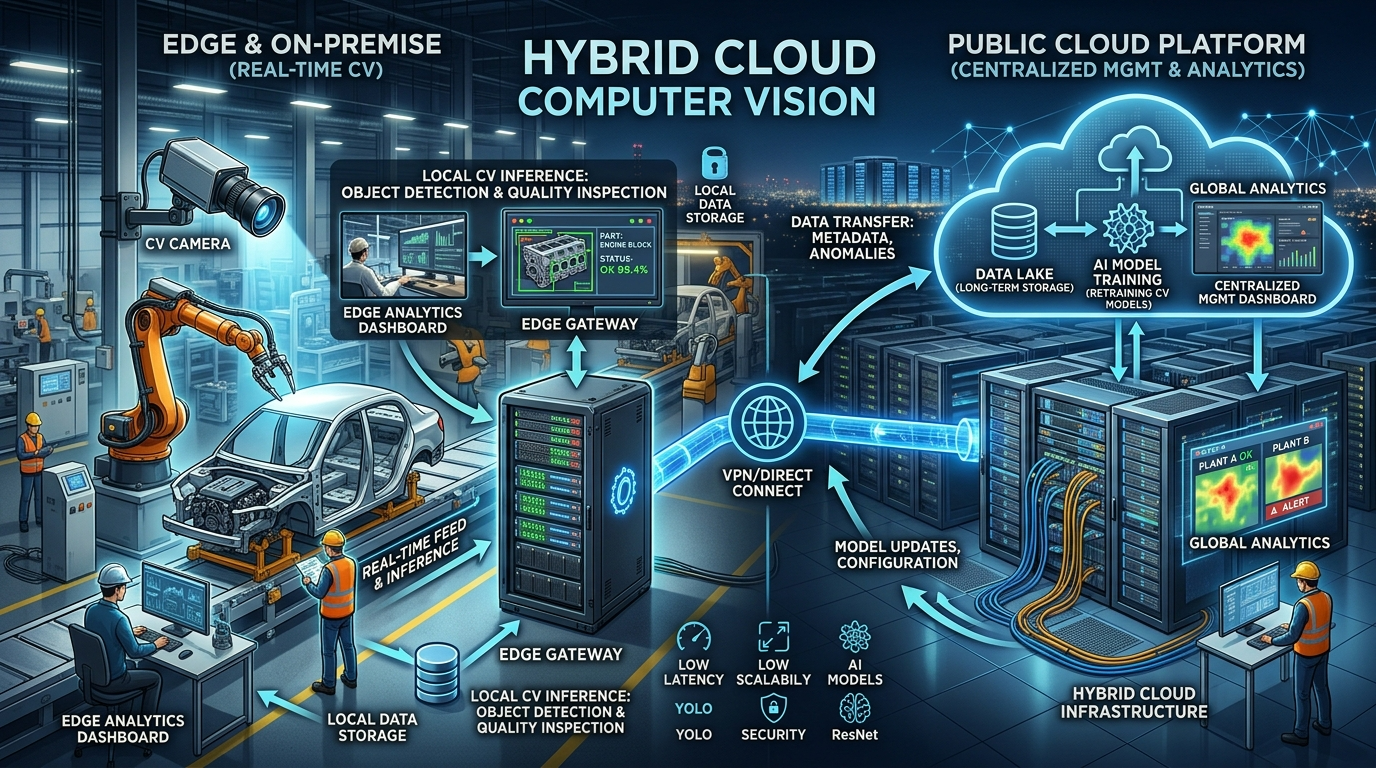
Instead of sending all image data to the cloud, hybrid environments distribute workloads across edge devices, on-premise servers, and remote platforms.
As a result, companies gain flexibility, scalability, and improved performance.
Through hybrid cloud computer vision, businesses modernize operations while protecting investments in legacy technology.
This balanced approach enables AI-driven innovation without disruptive infrastructure changes.
Understanding Hybrid Cloud Architectures
Hybrid computing environments combine multiple infrastructure layers into a unified system.
These environments include on-premise servers, private cloud resources, public cloud services, and edge computing devices.
When applied to visual AI, hybrid cloud computer vision distributes image processing tasks across these layers.
For instance, cameras may capture visual data at the edge.
Local processors analyze images in real time.
Meanwhile, cloud platforms handle large-scale data storage, advanced analytics, and model training.
This architecture provides both speed and scalability.
Local processing reduces latency, while cloud resources provide powerful computing capabilities.
Organizations using legacy infrastructure benefit from this flexibility.
They can maintain existing systems while gradually introducing AI capabilities.
Consequently, hybrid cloud computer vision offers a realistic pathway toward digital transformation.
Why Legacy Systems Require Hybrid Cloud Approaches
Many companies rely on legacy infrastructure that was never designed to support modern artificial intelligence workloads.
Traditional systems often struggle with large datasets and real-time processing demands.
Therefore, hybrid cloud computer vision becomes a practical solution for modernization.
Instead of replacing entire infrastructure stacks, organizations extend existing systems with cloud resources.
This method preserves valuable hardware investments while enabling advanced AI capabilities.
Moreover, hybrid architectures improve operational resilience.
If network connectivity fails, local systems continue processing visual data.
Cloud services then support long-term storage and deeper analysis once connections are restored.
Legacy environments also benefit from gradual migration strategies.
Companies can implement hybrid cloud computer vision in stages rather than performing disruptive system replacements.
This phased approach reduces risk and improves technology adoption.
Core Components of Hybrid Vision Architectures
Several key components work together to enable hybrid cloud computer vision environments.
These elements form the foundation for scalable and flexible AI systems.
Edge Computing Devices
Edge devices process images close to where data originates.
Cameras and embedded processors analyze visual information immediately after capture.
This local processing reduces latency and improves system responsiveness.
Edge technology strengthens the effectiveness of hybrid cloud computer vision solutions.
On-Premise Infrastructure
Existing servers and storage systems continue playing an important role in hybrid architectures.
These resources manage internal workloads and maintain compatibility with legacy applications.
On-premise systems also support local security policies and compliance requirements.
Cloud Computing Platforms
Cloud platforms provide scalable computing power for large workloads.
Organizations use these services to train machine learning models, analyze historical datasets, and store visual data.
Cloud integration expands the capabilities of hybrid cloud computer vision deployments.
AI and Machine Learning Models
Machine learning models perform tasks such as object detection, image classification, and anomaly detection.
These algorithms analyze visual data across edge devices and cloud systems.
Optimized models allow hybrid infrastructures to process images efficiently.
Advantages of Hybrid Cloud Vision Solutions
Organizations adopting hybrid cloud computer vision gain numerous operational advantages.
These benefits help companies improve performance while controlling infrastructure costs.
Scalability
Cloud platforms provide nearly unlimited computing capacity.
Organizations scale workloads quickly when demand increases.
Hybrid architectures allow visual AI systems to expand without replacing local infrastructure.
Reduced Latency
Edge devices process visual data immediately.
This capability enables faster decision-making.
Manufacturing inspections and safety monitoring systems benefit from real-time responses.
Latency reduction strengthens hybrid cloud computer vision performance.
Cost Efficiency
Hybrid environments allow companies to balance computing workloads.
Local infrastructure handles routine tasks.
Cloud platforms support heavy processing workloads when necessary.
This balanced approach reduces unnecessary infrastructure spending.
Improved Data Management
Visual data often requires large storage capacity.
Hybrid architectures store frequently accessed data locally while archiving historical datasets in the cloud.
Effective data management supports reliable hybrid cloud computer vision deployments.
Implementing Hybrid Vision Systems in Legacy Environments
Organizations must carefully plan integration strategies when deploying hybrid cloud computer vision solutions.
Proper planning ensures compatibility with existing infrastructure.
Evaluating Current Infrastructure
Engineers first assess network capabilities, storage capacity, and computing resources.
This evaluation identifies where hybrid technologies can provide the most value.
Selecting the Right Hybrid Architecture
Different environments require different architectures.
Manufacturing facilities may prioritize edge processing.
Retail environments may rely more heavily on cloud analytics.
Choosing the correct configuration ensures effective hybrid cloud computer vision implementation.
Deploying Optimized AI Models
Machine learning models must be optimized for hybrid environments.
Lightweight models run on edge devices.
More complex algorithms operate in the cloud.
This distributed approach improves performance across the entire system.
Establishing Monitoring and Maintenance Processes
System monitoring ensures that hybrid infrastructures operate efficiently.
Organizations track processing performance, system uptime, and AI accuracy.
Continuous monitoring strengthens the reliability of hybrid cloud computer vision systems.
Challenges of Hybrid Vision Architectures
Despite its advantages, implementing hybrid cloud computer vision can introduce several challenges.
Organizations must address these issues to ensure successful deployment.
One common challenge involves system complexity.
Hybrid architectures combine multiple computing environments.
Managing these systems requires specialized expertise.
Another challenge involves data synchronization.
Edge devices and cloud systems must exchange information efficiently.
Engineers must design architectures that maintain consistent datasets across platforms.
Security also becomes an important consideration.
Organizations must protect visual data across local networks and cloud environments.
Strong security policies help safeguard sensitive information.
Although challenges exist, careful planning allows companies to overcome these obstacles.
With the right strategy, hybrid cloud computer vision systems deliver significant operational value.
Future Trends in Hybrid Computer Vision
Technological innovation continues advancing hybrid cloud computer vision capabilities.
Several emerging trends will shape the future of hybrid AI infrastructures.
One trend involves more powerful edge processors.
Advanced chips allow complex machine learning models to run locally.
Another development includes improved orchestration platforms.
These platforms automatically distribute workloads between edge devices and cloud resources.
Additionally, artificial intelligence platforms increasingly support hybrid deployment models.
Developers can train models in the cloud and deploy them across distributed environments.
Furthermore, improvements in networking technologies will strengthen hybrid systems.
High-speed connectivity will enable smoother communication between infrastructure layers.
As these technologies mature, hybrid cloud computer vision will become even more accessible for organizations operating legacy systems.
Conclusion
Visual data plays an increasingly important role in modern business operations. However, many organizations still rely on legacy infrastructure that cannot easily support advanced artificial intelligence workloads.
Through hybrid cloud computer vision, companies combine local processing, edge computing, and cloud resources into a unified architecture.
This approach enables scalable AI capabilities while preserving existing infrastructure investments.
Hybrid environments deliver faster processing, improved reliability, and efficient data management.
Organizations benefit from real-time visual insights without performing costly system replacements.
As industries continue adopting artificial intelligence technologies, hybrid architectures will play a vital role in bridging the gap between legacy systems and modern AI capabilities.
Companies that embrace this strategy will gain the flexibility required to innovate and compete in increasingly data-driven environments.
FAQ
1. What is a hybrid cloud architecture for computer vision?
It combines edge devices, local infrastructure, and cloud platforms to process visual data efficiently.
2. Why are hybrid systems useful for legacy environments?
They allow organizations to add AI capabilities without replacing existing infrastructure.
3. How does hybrid computing improve computer vision performance?
Edge devices process images quickly, while cloud systems handle complex analytics and storage.
4. What industries benefit from hybrid visual AI systems?
Manufacturing, transportation, retail, healthcare, and logistics frequently use hybrid vision technologies.
5. Is hybrid cloud computing secure for visual data processing?
Yes. With proper security policies and encryption, organizations can protect data across both local and cloud environments.



Leave feedback about this