

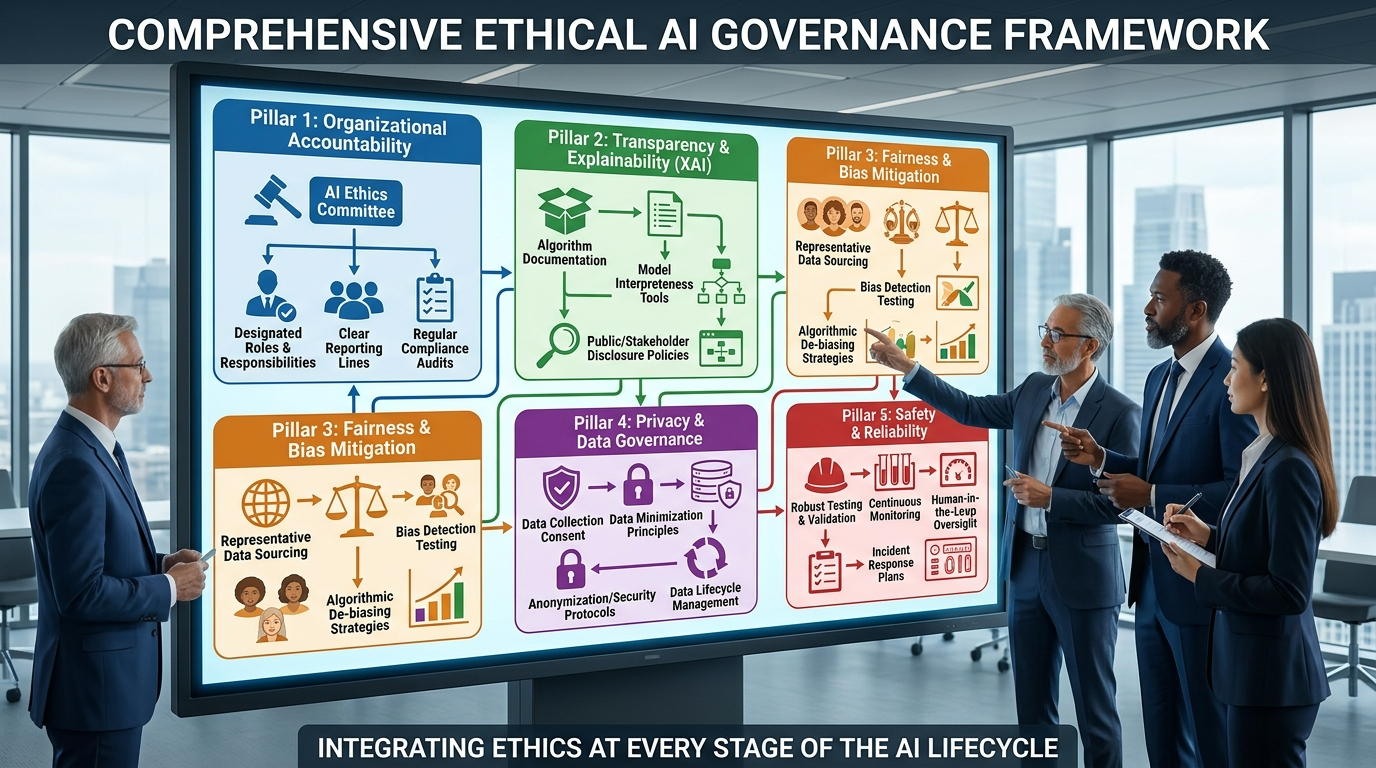
Artificial intelligence now influences many aspects of modern society. Businesses rely on AI systems for decision-making, automation, and data analysis. While these technologies offer powerful capabilities, they also introduce ethical concerns. Consequently, organizations must adopt ethical AI governance models to ensure responsible development and deployment.
Governance frameworks guide how companies design, monitor, and manage artificial intelligence systems. These models help organizations maintain transparency, accountability, and fairness in automated processes.
Moreover, governance strategies ensure that AI systems operate within legal and ethical boundaries.
Without clear governance structures, organizations risk deploying technologies that produce biased outcomes or violate privacy standards.
Therefore, implementing ethical AI governance models has become essential for businesses that want to use artificial intelligence responsibly while maintaining public trust.
As AI adoption continues expanding, governance frameworks will play an increasingly important role in shaping ethical technology ecosystems.
Understanding AI Governance in Modern Organizations
AI governance refers to the policies, procedures, and oversight mechanisms used to manage artificial intelligence systems. These structures guide how organizations design, deploy, and monitor automated technologies.
In practice, ethical AI governance models ensure that organizations follow responsible principles throughout the AI lifecycle.
For example, governance policies define how developers collect and use data for training machine learning models.
These frameworks also specify how organizations monitor model behavior once systems are deployed.
Additionally, governance processes establish accountability structures that identify who is responsible for AI decisions.
Because artificial intelligence systems often influence critical outcomes, organizations must maintain strong oversight.
Governance structures therefore provide a structured approach to managing risks associated with automated technologies.
By implementing effective governance models, companies align AI innovation with ethical standards and regulatory requirements.
Why Ethical Governance Is Essential for AI
Artificial intelligence systems operate using complex algorithms that analyze vast amounts of data. While these systems deliver valuable insights, they can also introduce risks.
Consequently, ethical AI governance models help organizations manage potential ethical and operational challenges.
One major concern involves algorithmic bias. If training data reflects social inequalities, AI models may produce unfair outcomes.
Governance frameworks ensure that organizations monitor data sources and model behavior carefully.
Another concern involves transparency. Stakeholders often need explanations for automated decisions.
Governance policies require organizations to document AI processes and provide clear explanations when needed.
Furthermore, ethical governance strengthens regulatory compliance.
Governments worldwide are developing rules that require responsible AI deployment.
Organizations that adopt governance frameworks early can adapt more easily to evolving regulations.
Ultimately, ethical oversight ensures that AI systems deliver value while minimizing risks.
Core Principles of Ethical AI Governance
Effective ethical AI governance models rely on several guiding principles that shape responsible technology management.
These principles help organizations align innovation with ethical standards.
Transparency
Transparency ensures that AI systems remain understandable to stakeholders.
Organizations should document model development processes, data sources, and decision logic.
Clear documentation allows regulators and internal teams to review AI behavior.
Transparency also strengthens trust between organizations and the communities they serve.
Fairness
Fairness ensures that AI systems treat individuals and groups equitably.
Organizations must evaluate models to detect potential biases in data or algorithms.
When biases appear, engineers should adjust training datasets or model design.
Fairness is a central objective within ethical AI governance models.
Accountability
Accountability clarifies responsibility for AI-driven decisions.
Organizations must identify individuals or teams responsible for overseeing automated systems.
This approach ensures that human oversight remains central to AI governance.
Privacy Protection
Artificial intelligence often relies on large datasets that may include personal information.
Governance frameworks establish guidelines for data protection and responsible data usage.
Privacy protections ensure compliance with legal requirements and ethical standards.
Governance Structures for AI Systems
Organizations implementing ethical AI governance models typically establish structured oversight frameworks.
These frameworks involve multiple roles and processes that support responsible AI management.
AI Ethics Committees
Many organizations create ethics committees to review AI projects.
These committees evaluate potential risks associated with new technologies.
They also ensure that AI initiatives align with company values and ethical principles.
Ethics committees often include experts from technology, legal, and business teams.
AI Governance Boards
Governance boards oversee large-scale AI deployments across organizations.
These boards establish policies and review compliance with governance frameworks.
Through structured oversight, governance boards strengthen ethical AI governance models across departments.
Risk Management Teams
Risk management teams monitor operational risks related to AI technologies.
They analyze potential impacts on security, privacy, and regulatory compliance.
These teams work closely with developers and engineers during system deployment.
Compliance and Legal Teams
Legal professionals ensure that AI systems meet regulatory requirements.
They interpret laws related to data protection, discrimination, and algorithmic transparency.
Their expertise helps organizations avoid legal complications.
Implementing Governance Throughout the AI Lifecycle
Successful ethical AI governance models operate across the entire lifecycle of artificial intelligence systems.
Governance begins during early stages of AI development.
Design Phase
During the design phase, developers evaluate ethical risks associated with AI applications.
Teams assess data quality, fairness considerations, and privacy concerns.
Early governance ensures that responsible practices guide system architecture.
Development Phase
During development, engineers build machine learning models using approved datasets.
Governance frameworks require documentation of model design and training methods.
These records support transparency and accountability.
Deployment Phase
When organizations deploy AI systems, monitoring tools track performance and detect anomalies.
Governance processes ensure that systems operate within ethical guidelines.
Continuous oversight helps maintain reliable system behavior.
Maintenance Phase
AI models require ongoing monitoring after deployment.
Data distributions may change over time, affecting model performance.
Maintenance teams review model outcomes and update systems as needed.
This continuous oversight strengthens ethical AI governance models.
Technologies Supporting Responsible AI Governance
Modern technologies help organizations implement ethical AI governance models effectively.
These tools support transparency, monitoring, and auditing of AI systems.
Explainable AI Platforms
Explainable AI tools analyze model predictions and identify key decision factors.
Visualization tools help engineers interpret complex machine learning algorithms.
These insights improve transparency in automated decision processes.
Model Monitoring Systems
Monitoring platforms track system performance in real-time.
These tools detect anomalies, bias patterns, or data drift.
Continuous monitoring ensures that AI systems operate reliably.
Data Governance Platforms
Data governance systems manage the lifecycle of datasets used in AI development.
These platforms track data sources, quality metrics, and usage policies.
Reliable data management strengthens ethical governance practices.
Audit and Compliance Tools
Audit platforms maintain records of AI activities.
Organizations use these records to demonstrate regulatory compliance.
These tools play an important role in maintaining accountability within ethical AI governance models.
Challenges in Establishing Ethical AI Governance
Although governance frameworks provide significant benefits, organizations often encounter challenges.
Implementing ethical AI governance models requires coordination across multiple teams.
One challenge involves technical complexity.
Modern AI systems use sophisticated algorithms that are difficult to interpret.
Organizations must invest in tools that improve explainability.
Another challenge involves organizational culture.
Employees must understand why ethical oversight is necessary.
Training programs help teams adopt responsible AI practices.
Additionally, global regulations continue evolving.
Organizations must adapt governance strategies as new policies emerge.
Despite these challenges, governance remains essential for responsible AI development.
Future Directions for AI Governance
The field of AI governance continues evolving as technology advances.
Several trends will shape the future of ethical AI governance models.
One major trend involves international collaboration on AI regulation.
Governments and organizations are developing global standards for responsible AI.
Another trend involves automated governance tools.
These systems analyze AI behavior and detect risks automatically.
Additionally, organizations increasingly adopt “ethics by design” approaches.
In this approach, developers integrate ethical considerations during early system design.
Finally, cross-disciplinary collaboration is expanding.
Experts from ethics, law, and technology work together to develop comprehensive governance strategies.
These developments will strengthen responsible AI management worldwide.
Conclusion
Artificial intelligence offers remarkable opportunities to improve productivity, efficiency, and innovation. However, these technologies also introduce ethical challenges that organizations must address.
Through strong ethical AI governance models, companies can ensure responsible development and deployment of AI systems.
Governance frameworks promote transparency, fairness, and accountability in automated decision-making.
They also help organizations comply with evolving regulatory requirements.
Although implementing governance structures requires effort and coordination, the benefits are significant.
Organizations that prioritize ethical oversight build stronger trust with customers, regulators, and employees.
As artificial intelligence continues transforming industries, governance will remain essential for ensuring that technology benefits society responsibly.
FAQ
1. What is AI governance in simple terms?
AI governance refers to policies and oversight structures that ensure artificial intelligence systems operate responsibly.
2. Why do organizations need ethical oversight for AI systems?
Ethical oversight helps prevent bias, protect privacy, and ensure automated decisions remain transparent.
3. Who is responsible for monitoring AI systems in organizations?
Responsibility often falls to governance boards, ethics committees, and risk management teams.
4. How can companies reduce bias in machine learning models?
Organizations analyze training datasets, evaluate model outputs, and adjust algorithms to reduce unfair outcomes.
5. Are governments regulating artificial intelligence technologies?
Yes. Many countries are developing regulations that require responsible AI deployment and transparency.


Leave feedback about this