

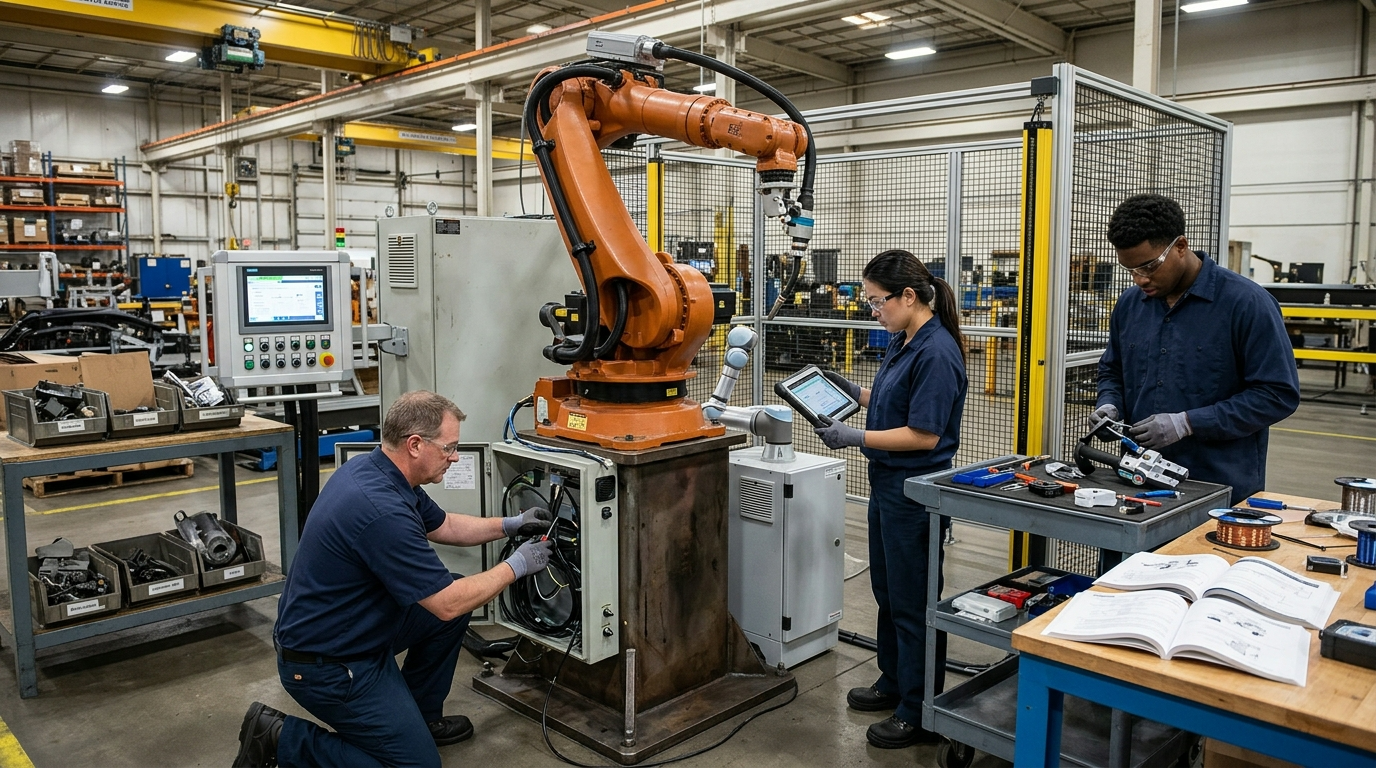
Manufacturing companies often rely on equipment that has been in operation for decades. These legacy systems continue to support production, yet they may lack the automation required for modern efficiency. Consequently, retrofitting robotics manufacturing systems has become a practical strategy for companies seeking modernization without replacing entire production lines.
Rather than discarding existing infrastructure, manufacturers integrate robotic technologies into their current processes. This approach reduces costs while improving productivity and accuracy.
Moreover, retrofitting enables factories to adopt automation gradually. Companies can introduce robotics where it delivers the most value while maintaining operational continuity.
Because many businesses cannot afford full factory reconstruction, retrofitting provides a realistic path toward digital transformation.
In this guide, you will learn how retrofitting robotics manufacturing systems helps organizations upgrade legacy equipment, improve operational efficiency, and prepare factories for the future of automated manufacturing.
Why Legacy Manufacturing Systems Still Exist
Many manufacturing facilities continue operating equipment installed years ago. These machines remain reliable and often represent significant capital investments.
Because replacing them entirely would be costly, companies prefer modernization strategies instead. Therefore, retrofitting robotics manufacturing systems allows businesses to extend the life of existing infrastructure.
Legacy systems frequently handle core processes such as assembly, machining, or material handling. While these systems perform well mechanically, they may lack advanced automation capabilities.
By adding robotics to these environments, manufacturers improve production efficiency without abandoning functional machinery.
Additionally, older equipment often integrates with established workflows and employee expertise.
Retrofitting enables organizations to preserve these advantages while adopting modern automation technologies.
As a result, companies can evolve their operations without disrupting production.
Understanding the Concept of Robotics Retrofitting
Robotics retrofitting involves integrating robotic technologies into existing manufacturing environments. Instead of building new automated factories, companies upgrade their current facilities.
Through retrofitting robotics manufacturing systems, organizations install robotic arms, sensors, and control systems alongside traditional machines.
These upgrades enable automation of tasks previously performed manually.
For example, robots can assist with material loading, part positioning, or product inspection.
Because many modern robots are flexible and compact, they can operate within existing workstations.
Furthermore, retrofitting projects typically require fewer infrastructure changes than full automation initiatives.
Companies often integrate robotics gradually across production lines.
This step-by-step approach allows engineers to evaluate system performance and refine automation strategies over time.
Ultimately, retrofitting creates a bridge between traditional manufacturing and modern automated production.
Key Benefits of Retrofitting Robotics in Manufacturing
Manufacturers implementing retrofitting robotics manufacturing systems experience several operational advantages.
These benefits make robotics retrofitting an attractive strategy for industrial modernization.
Improved Production Efficiency
Robots perform repetitive tasks with consistent speed and accuracy.
By automating these activities, factories increase output while maintaining quality standards.
Additionally, robots operate continuously without fatigue.
Consequently, production cycles become more efficient.
Reduced Operational Costs
Although retrofitting requires initial investment, it often reduces long-term operating expenses.
Automation minimizes manual labor for repetitive tasks and reduces errors that cause costly defects.
Therefore, companies implementing retrofitting robotics manufacturing systems often achieve significant financial savings over time.
Enhanced Product Quality
Robotic systems execute tasks with high precision.
This consistency improves product quality and reduces variability in production.
Automated inspection systems also identify defects earlier in the manufacturing process.
Extended Equipment Lifespan
Legacy machines often remain mechanically sound.
By integrating robotics, companies improve system capabilities without replacing reliable equipment.
This approach allows manufacturers to maximize the value of existing assets.
Key Technologies Used in Robotics Retrofitting
Several technologies enable successful retrofitting robotics manufacturing systems across different industries.
These tools enhance the capabilities of legacy equipment while maintaining production continuity.
Industrial Robotic Arms
Robotic arms are among the most common retrofitting components.
They assist with tasks such as welding, assembly, packaging, and machine tending.
Because robotic arms are highly programmable, engineers can adapt them to many production processes.
Sensors and Machine Vision
Sensors allow robots to detect objects, movement, and environmental conditions.
Machine vision systems enable robots to analyze images and guide operations.
These technologies enhance the accuracy of automated systems.
Additionally, sensors improve safety within collaborative manufacturing environments.
Programmable Logic Controllers
Programmable logic controllers coordinate communication between robots and existing machinery.
These systems manage signals, monitor performance, and control automated processes.
Through effective integration, PLCs support reliable retrofitting robotics manufacturing systems.
Cloud Monitoring Platforms
Modern robotics systems often connect to cloud-based monitoring tools.
Engineers can track system performance and detect maintenance issues remotely.
Cloud platforms also support data analysis and continuous improvement in manufacturing operations.
Steps to Successfully Retrofit Robotics into Legacy Systems
Implementing robotics in existing factories requires careful planning. Organizations must follow structured processes to ensure success.
These steps help companies manage retrofitting robotics manufacturing systems effectively.
Evaluate Existing Production Workflows
Engineers must analyze current workflows before introducing robotics.
This evaluation identifies tasks that benefit most from automation.
For example, repetitive or physically demanding operations often represent ideal candidates for robotic assistance.
Select Appropriate Robotic Solutions
Different manufacturing tasks require different robotic technologies.
Manufacturers should select robots that align with production requirements and available workspace.
Flexible cobots often work well in retrofit environments because they require minimal infrastructure changes.
Integrate Robotics with Legacy Equipment
Successful retrofitting requires compatibility between new robotics and existing machinery.
Engineers may develop custom interfaces or control systems to connect technologies.
Through proper integration, retrofitting robotics manufacturing systems operate seamlessly with older equipment.
Train Employees and Operators
Employees must learn how to operate and maintain robotic systems.
Training programs help workers understand automation workflows and safety procedures.
This education ensures smooth collaboration between human workers and robotic technologies.
Challenges of Retrofitting Robotics in Manufacturing
Although retrofitting offers many benefits, companies may encounter challenges during implementation.
Understanding these issues helps organizations plan effective retrofitting robotics manufacturing systems.
Technical Integration Complexity
Older machines may use outdated communication protocols.
Integrating robotics with legacy systems sometimes requires custom engineering solutions.
However, experienced integration teams can overcome these obstacles.
Initial Investment Costs
Robotic technologies require upfront financial investment.
Nevertheless, many companies recover these costs through improved productivity and reduced operational expenses.
Workforce Adjustment
Employees may initially feel uncertain about automation technologies.
Clear communication and training programs help workers adapt to new roles within automated environments.
System Compatibility Issues
Legacy equipment varies widely across manufacturing environments.
Therefore, integration strategies must be tailored to each facility.
Careful planning ensures compatibility and long-term system reliability.
Future Trends in Retrofitting Manufacturing Systems
Manufacturing automation continues evolving rapidly. As technologies advance, retrofitting robotics manufacturing systems will become even more effective.
One emerging trend involves collaborative robots designed specifically for retrofit environments.
These cobots operate safely alongside human workers and require minimal installation time.
Another development includes artificial intelligence integration.
AI-powered robots analyze production data and optimize operations automatically.
Additionally, digital twin technology allows engineers to simulate manufacturing environments before implementing robotics.
These simulations help organizations plan retrofitting projects more efficiently.
Finally, industrial IoT networks are transforming manufacturing connectivity.
Smart sensors collect real-time production data that supports predictive maintenance and process optimization.
Together, these innovations will make robotics retrofitting even more accessible for manufacturers.
Conclusion
Manufacturers face increasing pressure to improve productivity while managing operational costs. Full factory replacement is rarely practical for organizations relying on legacy equipment.
However, retrofitting robotics manufacturing systems provides an effective path toward modernization.
By integrating robotic technologies into existing production environments, companies improve efficiency, enhance product quality, and extend the life of valuable equipment.
Although retrofitting requires planning and investment, the long-term benefits are significant.
Manufacturers that adopt robotics gradually can modernize operations while maintaining stability.
As automation technologies continue to evolve, retrofitting strategies will play an essential role in transforming traditional factories into smart manufacturing environments.
Organizations that embrace this approach will remain competitive in the rapidly changing industrial landscape.
FAQ
1. What does retrofitting robotics mean in manufacturing?
It refers to integrating robotic technologies into existing production equipment instead of replacing entire manufacturing systems.
2. Can older factories adopt robotic automation successfully?
Yes. Many legacy factories improve efficiency by adding robots to specific processes without rebuilding production lines.
3. What types of robots are commonly used in retrofit projects?
Robotic arms, collaborative robots, and automated material handling systems are frequently used.
4. How long does a robotics retrofit project typically take?
Implementation timelines vary depending on system complexity, but many projects can be completed within several months.
5. Do employees need training when robots are introduced?
Yes. Workers usually receive training on robotic operation, safety procedures, and maintenance requirements.


Leave feedback about this