

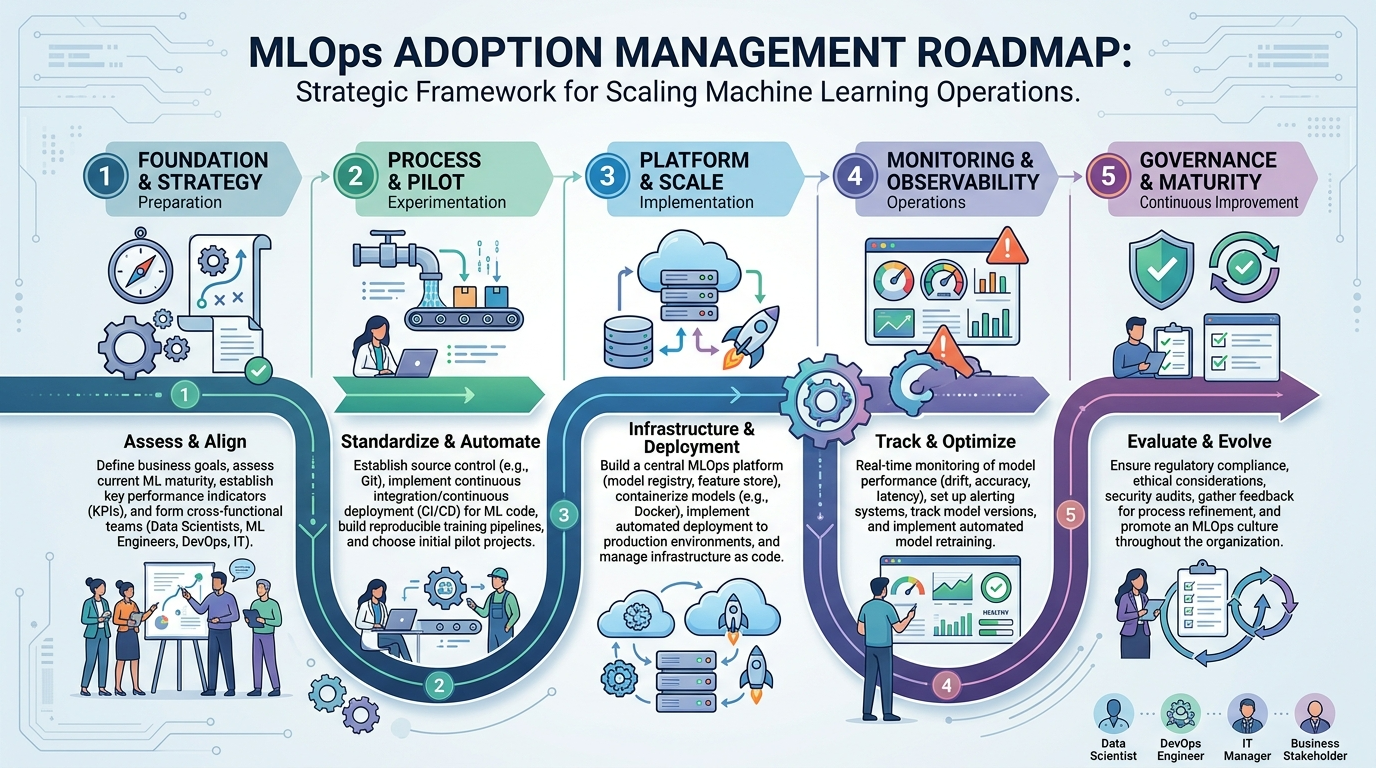
Artificial intelligence is transforming how organizations operate. Businesses now rely on machine learning to improve predictions, automate tasks, and support better decision-making. However, adopting these technologies requires more than technical expertise. Companies must also guide employees through new processes and workflows. For this reason, MLOps adoption management has become essential for successful AI transformation.
MLOps combines machine learning with operational practices that ensure models remain reliable in production. While the technology offers many advantages, implementing it can disrupt traditional workflows.
Therefore, organizations must carefully manage the transition to prevent confusion or resistance among employees.
Effective change management ensures teams understand new tools, collaborate effectively, and adapt to evolving processes.
In this guide, you will learn how MLOps adoption management supports organizational change, improves collaboration, and enables sustainable machine learning operations.
Why Organizational Change Matters in MLOps
Adopting machine learning operations affects multiple departments within a company. Data scientists, engineers, product managers, and business leaders must work together more closely.
Because these teams often operate independently, change management becomes necessary.
Through effective MLOps adoption management, organizations create structured processes that guide teams through the transition.
First, new workflows require employees to learn additional tools and practices.
Second, collaboration between technical and business teams becomes more important.
Third, leadership must align strategic goals with machine learning initiatives.
Without a clear strategy, AI projects may struggle to deliver value.
However, when organizations manage change effectively, machine learning initiatives can scale successfully.
Consequently, companies can integrate AI into everyday operations.
Understanding the Role of MLOps in AI Deployment
MLOps focuses on managing machine learning models after development. It ensures models remain reliable, scalable, and easy to maintain.
Organizations implementing MLOps adoption management focus on improving collaboration between development and operations teams.
Machine learning models require continuous monitoring because real-world data changes over time.
If models degrade, predictions may become inaccurate.
Therefore, teams must monitor model performance and update systems regularly.
MLOps frameworks provide tools for automating these tasks.
Additionally, automated pipelines allow organizations to deploy models faster and more reliably.
By combining automation with collaboration, companies create stable machine learning infrastructures.
This approach helps organizations maintain consistent performance across AI-driven systems.
Challenges Organizations Face When Adopting MLOps
Although machine learning operations offer many benefits, organizations may encounter challenges during implementation.
Understanding these obstacles helps companies design stronger MLOps adoption management strategies.
Cultural Resistance
Employees often feel uncertain about new technologies.
Some team members may worry that automation will change their roles.
Therefore, leaders must communicate clearly about the purpose and benefits of machine learning operations.
Transparency helps employees understand how new systems support their work.
Skill Gaps
Many organizations lack professionals trained in machine learning operations.
Employees may need training in data pipelines, cloud infrastructure, or model monitoring.
Companies implementing MLOps adoption management must invest in technical education programs.
Reskilling initiatives help employees gain the skills needed for new responsibilities.
Process Complexity
Machine learning workflows often involve multiple stages, including data preparation, model training, and deployment.
Coordinating these activities across teams can become complex.
Clear documentation and workflow automation help simplify operations.
Technology Integration Issues
Organizations often rely on existing IT infrastructure.
Integrating new machine learning tools with legacy systems can present technical challenges.
Therefore, careful planning is necessary to ensure compatibility and reliability.
Strategies for Successful MLOps Adoption
Organizations that implement thoughtful strategies can manage change more effectively.
Several best practices strengthen MLOps adoption management across teams.
Develop a Clear Transformation Roadmap
Leadership should define clear goals for machine learning adoption.
This roadmap outlines project priorities, expected outcomes, and timelines.
Employees benefit from understanding how machine learning initiatives align with company objectives.
A clear strategy reduces uncertainty and supports coordinated progress.
Build Cross-Functional Teams
Machine learning operations require collaboration across departments.
Data scientists design models, engineers deploy systems, and analysts evaluate results.
Through effective MLOps adoption management, organizations encourage communication between these teams.
Cross-functional collaboration improves project success rates.
Invest in Training and Education
Reskilling employees helps organizations build internal expertise.
Training programs may include courses in machine learning engineering, data pipelines, and cloud technologies.
Learning opportunities empower employees to contribute to AI initiatives.
As a result, companies develop stronger technical capabilities.
Implement Incremental Change
Large transformations can overwhelm teams.
Instead, organizations should introduce machine learning operations gradually.
Pilot projects allow teams to experiment with new workflows before scaling systems across the company.
Incremental progress supports sustainable MLOps adoption management.
Technology Tools Supporting MLOps Transformation
Several technology platforms support organizations adopting machine learning operations.
These tools help automate workflows and improve MLOps adoption management across teams.
Model Deployment Platforms
Deployment platforms simplify the process of moving machine learning models into production environments.
These systems automate tasks such as version control and infrastructure configuration.
As a result, teams can deploy models more efficiently.
Monitoring and Observability Tools
Monitoring systems track model performance in real time.
These tools detect issues such as prediction errors or data drift.
Organizations using strong monitoring platforms improve MLOps adoption management by maintaining reliable AI systems.
Data Pipeline Automation
Automated data pipelines manage the flow of information from raw datasets to machine learning models.
These pipelines ensure data remains consistent and accessible.
Reliable data infrastructure supports scalable machine learning operations.
Collaboration Platforms
Collaboration tools help teams share code, documentation, and experiment results.
Version control systems also track changes across machine learning projects.
These platforms strengthen communication between development and operations teams.
Leadership’s Role in AI Change Management
Leadership plays a critical role in guiding organizations through AI transformation.
Executives must support MLOps adoption management initiatives with clear communication and strategic planning.
First, leaders should communicate the purpose of machine learning initiatives.
Employees need to understand how AI supports business goals.
Second, executives must allocate resources for training, infrastructure, and experimentation.
Investment in innovation demonstrates long-term commitment to technology transformation.
Third, leadership should encourage collaboration across departments.
Organizations benefit when data scientists, engineers, and business teams work together.
Finally, leaders must promote a culture of continuous learning.
Technology evolves rapidly, and employees must adapt accordingly.
Strong leadership ensures organizations remain resilient during technological change.
Future Trends in Organizational AI Transformation
As artificial intelligence adoption increases, organizations will refine their approaches to managing change.
Future MLOps adoption management practices will likely incorporate new technologies and frameworks.
One emerging trend involves automated machine learning platforms.
These systems simplify model development and deployment, making AI accessible to more teams.
Another development includes AI governance frameworks.
Companies increasingly implement policies to ensure responsible and ethical AI use.
Additionally, cloud computing platforms continue to improve machine learning infrastructure.
Scalable environments allow organizations to manage complex data pipelines and model deployments.
Collaboration tools will also become more advanced.
Integrated platforms will connect development, operations, and analytics teams more effectively.
These innovations will make machine learning adoption smoother and more efficient for organizations.
Conclusion
Artificial intelligence is reshaping how organizations operate and compete. However, implementing machine learning technologies requires careful coordination across teams and processes.
Through effective MLOps adoption management, companies can guide employees through technological change while building reliable AI systems.
Successful transformation involves clear strategies, employee training, and strong leadership support.
Organizations must also invest in collaborative tools and scalable infrastructure.
Although change may seem challenging, structured management practices make AI adoption more manageable.
Businesses that develop strong machine learning operations will gain a significant competitive advantage in the evolving digital economy.
By embracing thoughtful change management, organizations can unlock the full potential of artificial intelligence while supporting their workforce through the transition.
FAQ
1. Why do organizations struggle when adopting machine learning operations?
Many organizations face challenges due to skill gaps, complex workflows, and resistance to new technologies.
2. What skills are important for teams working with machine learning systems?
Teams often need knowledge in data engineering, machine learning modeling, cloud infrastructure, and monitoring systems.
3. How can companies train employees for AI-driven workflows?
Organizations can offer training programs, online courses, mentorship opportunities, and hands-on project experience.
4. What role does leadership play in AI transformation?
Leadership sets strategic goals, provides resources, and encourages collaboration across departments during technology adoption.
5. Can small organizations adopt machine learning operations successfully?
Yes. Many smaller organizations begin with pilot projects and gradually expand their machine learning infrastructure.


Leave feedback about this