

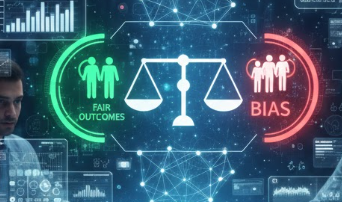
Algorithmic bias rarely announces itself. It slips quietly into datasets, models, and decisions, often hidden behind impressive accuracy metrics. One model looks fair on paper, yet its outcomes tell a different story. Another system performs well overall but consistently fails certain groups. That is the reality many organizations face today.
Algorithmic bias detection tools exist to surface those blind spots. They shine light into places where intuition alone falls short. More importantly, they help teams move from awareness to action. Fairness becomes measurable. Improvement becomes possible.
In this guide, we explore the best tools to detect and reduce algorithmic bias. We also explain how they fit into real-world workflows, why no single tool is enough, and how organizations can combine technology with process to build more responsible AI.
Why Algorithmic Bias Detection Tools Matter
Bias in AI is not just a technical issue. It is a social, legal, and reputational risk.
When biased systems affect hiring, lending, healthcare, or public services, consequences escalate quickly. Trust erodes. Compliance issues arise. Harm becomes visible.
Algorithmic bias detection tools matter because they make fairness observable. Without tools, teams rely on assumptions. With tools, they rely on evidence.
These tools do not guarantee fairness. However, they create the conditions for accountability and improvement.
Understanding Algorithmic Bias in AI Systems
Before exploring tools, it helps to clarify what bias looks like.
Bias can appear in data, models, or outcomes. It may stem from historical inequality, sampling gaps, or design choices. Sometimes it emerges through proxy variables that correlate with protected attributes.
Algorithmic bias detection tools analyze these patterns systematically. They compare performance across groups, flag disparities, and reveal where models behave unevenly.
Understanding bias is the first step toward reducing it.
Types of Bias That Detection Tools Address
Bias comes in many forms.
Representation bias occurs when datasets underrepresent certain groups. Measurement bias arises from flawed data collection. Outcome bias appears when model predictions affect groups differently.
Help identify these patterns quantitatively. They examine error rates, false positives, and false negatives across demographics.
Different tools focus on different bias types. Knowing which bias matters most guides tool selection.
Why Manual Bias Review Is Not Enough
Human review plays a role, yet it has limits.
Teams cannot manually inspect millions of predictions. Subtle disparities remain invisible without statistical analysis.
Algorithmic bias detection tools scale fairness evaluation. They analyze patterns humans cannot see.
Automation supports, rather than replaces, ethical judgment.
Tools amplify human awareness.
Key Features of Effective Bias Detection Tools
Not all tools offer equal value.
Effective algorithmic bias detection tools provide clear metrics, visual insights, and actionable recommendations. They integrate with existing ML pipelines. They support iteration.
Transparency matters. Tools should explain why a disparity exists, not just that it exists.
Usability matters too. If teams cannot understand outputs, improvement stalls.
Open-Source Algorithmic Bias Detection Tools
Open-source tools lead much of the innovation in bias detection.
They allow transparency, flexibility, and community validation. Many organizations start here.
These tools often integrate well with popular ML frameworks. They also encourage experimentation.
However, open-source solutions require expertise to deploy and maintain.
IBM AI Fairness 360
IBM AI Fairness 360 is one of the most widely used algorithmic bias detection tools.
It offers a comprehensive set of fairness metrics and mitigation algorithms. Users can analyze datasets and model outputs across multiple definitions of fairness.
The toolkit supports comparison before and after mitigation. This helps teams measure progress.
Its flexibility makes it suitable for research and production, although it requires technical proficiency.
Google’s What-If Tool
The What-If Tool focuses on model interpretability and fairness exploration.
Users interactively test model behavior by changing input features. This reveals how predictions shift across groups.
As an algorithmic bias detection tool, it emphasizes intuition and exploration. It works well alongside TensorFlow models.
The visual interface helps non-experts engage with fairness questions.
Microsoft Fairlearn
Fairlearn provides tools to assess and improve fairness in machine learning models.
It integrates directly with Python workflows and popular libraries. Fairlearn focuses on disparity metrics and constraint-based mitigation.
Fairlearn balances rigor with usability.
Its tight integration with development pipelines supports continuous evaluation.
Aequitas Bias Audit Toolkit
Aequitas specializes in bias audits.
It focuses on evaluating outcomes rather than model internals. This makes it useful when models are opaque.
Aequitas produces clear reports highlighting disparities across groups.
Organizations use it as part of compliance and accountability efforts.
Outcome-focused tools complement model-centric ones.
Commercial Algorithmic Bias Detection Platforms
Beyond open-source, commercial platforms offer end-to-end solutions.
These platforms integrate bias detection, monitoring, and governance. They reduce deployment friction.
Commercial algorithmic bias detection tools appeal to enterprises seeking scalability and support.
They trade flexibility for convenience.
Fiddler AI
Fiddler AI combines explainability, monitoring, and fairness analysis.
It tracks model performance across groups in production environments. Alerts surface emerging bias issues.
As algorithmic bias detection tools mature, production monitoring becomes essential.
Fiddler emphasizes operational fairness, not just development-time checks.
Arize AI
Arize AI focuses on ML observability.
Its bias detection features monitor data drift and performance disparities. Teams see how models behave across populations over time.
This longitudinal view supports proactive mitigation.
Bias evolves. Monitoring catches it early.
DataRobot MLOps
DataRobot integrates fairness assessment into its MLOps platform.
Users evaluate models against fairness constraints before deployment. Ongoing monitoring tracks compliance.
As algorithmic bias detection tools integrate with MLOps, fairness becomes continuous.
Governance becomes operational.
Bias Detection During Data Preparation
Bias enters early.
Many support dataset analysis before training. They highlight representation gaps and skewed distributions.
Early detection prevents downstream harm.
Cleaning data costs less than fixing deployed systems.
Prevention beats correction.
Bias Detection During Model Training
Training-time evaluation reveals model behavior.
Tools compute fairness metrics alongside accuracy metrics. Teams see trade-offs clearly.
Algorithmic bias detection tools support iterative improvement. Models adjust based on feedback.
Fairness becomes a tuning parameter.
Bias Detection in Production Systems
Bias does not stop evolving after deployment.
Data distributions change. User behavior shifts. Context evolves.
Production monitoring tools track disparities continuously. Alerts trigger investigation.
In production protect long-term trust.
Static checks are not enough.
Reducing Bias With Mitigation Algorithms
Detection alone does not solve bias.
Many tools include mitigation strategies. These adjust data, training processes, or outputs.
Pre-processing methods rebalance datasets. In-processing methods modify learning objectives. Post-processing methods adjust predictions.
Algorithmic bias detection tools guide selection based on context.
Mitigation requires care.
Trade-Offs Between Fairness and Accuracy
Fairness introduces complexity.
Reducing bias may affect accuracy. Trade-offs must be evaluated transparently.
Help quantify these trade-offs. Teams make informed decisions rather than guesses.
Transparency builds confidence.
No metric exists in isolation.
Choosing the Right Tool for Your Organization
Tool choice depends on context.
Research teams may prefer open-source flexibility. Enterprises may need integrated platforms.
Algorithmic bias detection tools should align with skills, scale, and risk tolerance.
One size rarely fits all.
Combination approaches work best.
Integrating Bias Detection Into ML Workflows
Fairness checks should not be ad hoc.
Algorithmic bias detection tools integrate best when embedded into pipelines. Automated checks run alongside tests.
This makes fairness routine.
Consistency beats sporadic review.
Governance and Documentation Support
Bias detection tools support governance.
Reports document decisions. Audits demonstrate diligence. Transparency improves accountability.
Regulators increasingly expect evidence of fairness efforts.
Algorithmic bias detection tools provide that evidence.
Documentation protects organizations.
Human Oversight and Ethical Judgment
Tools do not replace judgment.
Algorithmic bias detection tools surface patterns. Humans interpret them.
Context matters. Social impact matters.
Ethical review complements technical analysis.
Humans remain responsible.
Limitations of Algorithmic Bias Detection Tools
No tool is perfect.
Metrics depend on definitions. Protected attributes may be unavailable. Some bias remains hidden.
Reduce risk, not eliminate it.
Awareness of limitations prevents false confidence.
Humility improves outcomes.
Emerging Trends in Bias Detection
Bias detection continues to evolve.
New metrics address intersectionality. Tools incorporate causal analysis. Automation improves scalability.
Future algorithmic bias detection tools will integrate deeper into development environments.
Fairness becomes infrastructure.
Building a Bias-Aware AI Culture
Tools succeed when culture supports them.
Teams must value fairness. Leadership must endorse accountability.
Empower action, but culture sustains it.
Commitment turns insight into change.
Conclusion
Algorithmic bias detection tools play a crucial role in building fairer, more trustworthy AI systems. They reveal hidden disparities, support informed decisions, and enable continuous improvement. Yet tools alone are not enough.
Real progress happens when organizations combine detection technology with thoughtful governance, ethical judgment, and cultural commitment. Bias becomes visible. Responsibility becomes shared.
In the end, fairness is not a destination. It is a practice. With the right tools and mindset, that practice becomes achievable at scale.
FAQ
1. What are algorithmic bias detection tools?
They are tools that analyze datasets and models to identify unfair disparities across groups.
2. Can bias detection tools eliminate bias completely?
No. They help reduce and manage bias, but human oversight remains essential.
3. Are open-source bias detection tools reliable?
Yes. Many are widely validated and used in production with proper expertise.
4. Should bias detection happen before or after deployment?
Both. Bias should be evaluated throughout the model lifecycle.
5. Do bias detection tools slow down ML development?
When integrated well, they improve quality without significantly slowing progress.






Leave feedback about this