
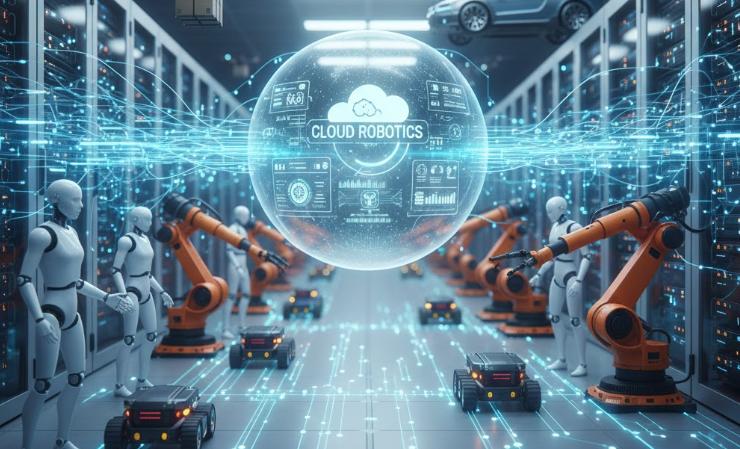
Automation used to feel heavy. Big machines. Fixed programs. Long setup times. Cloud robotics automation flips that story completely. Instead of isolated robots working alone, we now see connected systems learning, sharing, and improving together.
Think of it like this. Traditional robots were calculators. Cloud robotics turns them into smartphones. Suddenly, they update, collaborate, and adapt in real time.
As businesses chase speed, flexibility, and intelligence, cloud robotics automation emerges as a defining force. It blends robotics with cloud computing, artificial intelligence, and data-driven orchestration. The result feels less mechanical and more alive.
So why does this matter now? Because productivity no longer comes from doing more work. It comes from doing smarter work.
What Cloud Robotics Automation Really Means
Cloud robotics automation refers to robotic systems that rely on cloud infrastructure for processing, learning, storage, and coordination.
Instead of placing all intelligence on the robot itself, developers offload heavy computation to the cloud. Robots become lighter, cheaper, and more flexible.
This shift changes everything. Robots can access shared knowledge. They can receive updates instantly. They can learn from the experience of other robots across the world.
In short, cloud robotics automation turns individual machines into connected teammates.
Why Cloud Robotics Automation Is Gaining Momentum
Several forces push cloud robotics forward at once.
First, cloud computing matured. Scalable infrastructure became affordable and reliable. Latency dropped. Security improved.
Second, artificial intelligence advanced rapidly. Machine learning models grew more powerful but also more demanding. The cloud handles those demands efficiently.
Third, industries demanded flexibility. Fixed automation struggles in fast-changing environments. Cloud robotics adapts instead.
Because of these trends, cloud robotics automation moved from theory into practice.
Cloud Robotics Automation vs Traditional Robotics
Traditional robotics relies on local processing. Every robot carries its own brain. Updates require downtime. Learning stays isolated.
Cloud robotics automation works differently. Intelligence lives centrally. Robots connect, sync, and evolve continuously.
As a result, deployment speeds increase. Maintenance becomes simpler. Capabilities expand faster.
That does not mean traditional robotics disappears. Instead, cloud robotics enhances it.
Think of traditional robots as solo musicians. Cloud robotics turns them into an orchestra.
The Role of the Cloud in Robotics Automation
The cloud acts as the nervous system.
It stores massive datasets, runs complex AI models and coordinates fleets of robots.
When a robot encounters a new scenario, the cloud helps interpret it. When one robot learns something useful, others benefit.
This shared intelligence drives continuous improvement.
Cloud robotics automation also enables remote monitoring. Teams can manage robots from anywhere. Updates happen over the air.
Productivity increases because friction decreases.
Artificial Intelligence Inside Cloud Robotics Automation
AI fuels the intelligence layer.
Computer vision helps robots see. Natural language processing helps them understand instructions. Reinforcement learning helps them improve through experience.
These AI models often require more compute than local hardware allows. Cloud environments solve that problem.
Moreover, cloud-based AI models update frequently. Robots stay current without physical intervention.
Because of AI, cloud robotics automation feels less scripted and more responsive.
Scalability Through Cloud Robotics Automation
Scaling traditional automation costs time and money. Each robot requires configuration. Each update multiplies effort.
Cloud robotics automation scales differently.
Add a robot. Connect it. Sync it. Done.
Because intelligence centralizes, new robots inherit existing capabilities instantly.
This scalability suits modern business needs. Seasonal demand spikes. New locations open. Automation keeps pace.
As businesses grow, cloud robotics grows with them.
Cloud Robotics Automation in Manufacturing
Manufacturing leads adoption.
Factories use cloud robotics automation for assembly, inspection, and material handling.
Robots adjust workflows based on real-time data. Production lines become flexible rather than rigid.
When demand changes, software updates replace physical retooling.
Additionally, predictive maintenance improves uptime. Sensors feed data to the cloud. AI spots issues early.
Manufacturers gain speed without sacrificing quality.
Warehouse and Logistics Transformation
Warehouses thrive on efficiency. Cloud robotics automation delivers it.
Autonomous mobile robots navigate dynamically. They share maps and traffic data through the cloud.
When layouts change, robots adapt quickly. When volumes spike, fleets scale smoothly.
Cloud coordination prevents collisions. It optimizes routes. It balances workloads.
Logistics becomes faster, safer, and more predictable.
Healthcare and Cloud Robotics Automation
Healthcare values precision and adaptability.
Cloud robotics automation supports surgery, diagnostics, and hospital logistics.
Robots access medical databases securely. They learn from aggregated outcomes. They assist clinicians rather than replace them.
For example, surgical robots receive software enhancements remotely. Imaging robots improve accuracy through shared learning.
Patient care benefits from both consistency and innovation.
Service Industries and Cloud Robotics Automation
Robots increasingly serve customers.
Hotels deploy robots for delivery. Retailers use them for inventory. Offices automate cleaning and security.
Cloud robotics automation enables these robots to understand environments and interact naturally.
Updates improve behavior continuously. Feedback loops refine performance.
Service robots feel less robotic and more helpful.
Cost Efficiency of Cloud Robotics Automation
Cost matters.
Cloud robotics automation reduces hardware requirements. Robots need less onboard computing power.
Maintenance costs drop. Updates happen remotely. Diagnostics improve.
Furthermore, shared intelligence reduces duplication. Organizations pay once and benefit many times.
While cloud infrastructure carries ongoing costs, efficiency gains often outweigh expenses.
Over time, automation becomes more affordable.
Cybersecurity in Cloud Robotics Automation
Connectivity introduces risk. Security becomes critical.
Leading cloud robotics automation platforms embed encryption, authentication, and access control.
Robots communicate securely. Cloud environments isolate workloads.
Regular updates patch vulnerabilities quickly.
Security requires vigilance. However, centralized control simplifies response.
When designed properly, cloud robotics automation strengthens resilience.
Data and Privacy Considerations
Robots collect data. Cloud systems store it.
Responsible cloud robotics automation respects privacy and governance.
Sensitive data requires protection. Access must be controlled. Usage must remain transparent.
Regulations influence design choices. Ethical considerations guide implementation.
Trust depends on responsible data handling.
Latency and Reliability Challenges
Cloud dependence raises concerns.
Latency matters for real-time control. Connectivity failures disrupt operations.
Hybrid approaches address this. Critical functions remain local. Non-critical tasks move to the cloud.
Edge computing bridges gaps.
With proper architecture, cloud robotics automation balances speed and reliability.
Human-Robot Collaboration in the Cloud Era
Cloud robotics automation changes how humans work with robots.
Shared interfaces improve coordination. AI assists decision-making.
Robots handle repetitive tasks. Humans focus on creativity and oversight.
Training becomes easier. Cloud platforms simulate scenarios. Workers learn faster.
Collaboration feels natural rather than forced.
Cloud Robotics Automation and Digital Twins
Digital twins enhance planning.
Virtual replicas of robots and environments live in the cloud.
Teams test changes safely. Scenarios play out virtually.
Cloud robotics automation leverages these twins to reduce risk and cost.
Before deploying updates, teams validate outcomes digitally.
Reality improves because simulation leads.
Software Platforms Driving Cloud Robotics Automation
Several platforms lead development.
Robot Operating System (ROS) integrates with cloud services. Cloud providers offer robotics toolkits.
These platforms accelerate innovation. Developers focus on functionality rather than infrastructure.
Ecosystems grow. Communities share solutions.
Standardization pushes adoption forward.
Cloud Robotics Automation for Small Businesses
Cloud robotics is not just for giants.
Subscription models lower entry barriers. Modular robots simplify deployment.
Small businesses automate incrementally. They scale as confidence grows.
Cloud robotics automation democratizes access.
Innovation spreads beyond large enterprises.
The Environmental Impact of Cloud Robotics Automation
Sustainability matters.
Efficient robots reduce waste. Optimized processes save energy.
Cloud data centers increasingly use renewable energy.
Automation supports circular economy models.
Cloud robotics automation aligns productivity with responsibility.
Future Trends in Cloud Robotics Automation
The future looks connected.
Robots will collaborate across organizations. Learning will globalize.
AI models will personalize behavior. Autonomy will increase.
Cloud-native robotics startups will flourish.
Cloud robotics automation will define next-generation productivity.
Challenges Ahead for Cloud Robotics Automation
Challenges remain.
Interoperability issues persist. Standards evolve slowly.
Skills gaps limit adoption. Training must catch up.
Ethical questions demand attention.
Yet progress continues.
Challenges shape better solutions.
Why Cloud Robotics Automation Is a Strategic Advantage
Automation strategies shape competitiveness.
Cloud robotics automation offers flexibility, intelligence, and scalability.
Organizations that adopt early gain experience. They adapt faster.
Late adopters face steeper curves.
Strategy matters as much as technology.
Conclusion
Cloud robotics automation represents a fundamental shift in how work gets done. By combining robotics, cloud computing, and artificial intelligence, it creates systems that learn, adapt, and scale.
Productivity no longer depends on rigid machines. It flows from connected intelligence.
As industries evolve, cloud robotics automation will move from advantage to necessity. Organizations that embrace it thoughtfully will lead. Those that hesitate will follow.
The future of automation-driven productivity lives in the cloud.
FAQ
1. What is cloud robotics automation?
Cloud robotics automation uses cloud computing to provide intelligence, coordination, and scalability for robotic systems.
2. How does cloud robotics improve productivity?
It enables shared learning, rapid updates, flexible scaling, and smarter decision-making.
3. Is cloud robotics automation secure?
Yes, when designed properly with encryption, access control, and continuous updates.
4. Can small businesses use cloud robotics automation?
Absolutely. Subscription models and modular systems make adoption accessible.
5. Will cloud robotics replace human workers?
No. It supports humans by handling repetitive tasks and enhancing collaboration.



Leave feedback about this